
10.6 Introduction to Factoring Polynomials
Find the Greatest Common Factor of Two or More Expressions
Earlier we multiplied factors together to get a product. Now, we will be reversing this process; we will start with a product and then break it down into its factors. Splitting a product into factors is called factoring.
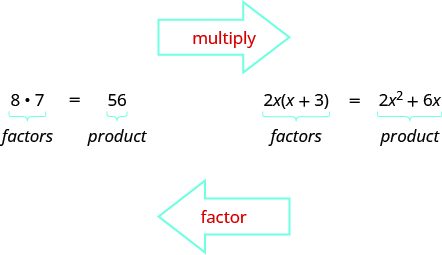
In The Language of Algebra we factored numbers to find the least common multiple (LCM) of two or more numbers. Now we will factor expressions and find the greatest common factor of two or more expressions. The method we use is similar to what we used to find the LCM.
First we will find the greatest common factor of two numbers.
In the previous example, we found the greatest common factor of constants. The greatest common factor of an algebraic expression can contain variables raised to powers along with coefficients. We summarize the steps we use to find the greatest common factor.
In the examples so far, the greatest common factor was a constant. In the next two examples we will get variables in the greatest common factor.
Factor the Greatest Common Factor from a Polynomial
Just like in arithmetic, where it is sometimes useful to represent a number in factored form (for example, as in algebra it can be useful to represent a polynomial in factored form. One way to do this is by finding the greatest common factor of all the terms. Remember that you can multiply a polynomial by a monomial as follows:
Here, we will start with a product, like and end with its factors, To do this we apply the Distributive Property “in reverse”.
The form on the left is used to multiply. The form on the right is used to factor.
So how do we use the Distributive Property to factor a polynomial? We find the GCF of all the terms and write the polynomial as a product!
Notice that in Example 5, we used the word factor as both a noun and a verb:
The expressions in the next example have several factors in common. Remember to write the GCF as the product of all the common factors.
Now we’ll factor the greatest common factor from a trinomial. We start by finding the GCF of all three terms.
In the next example, we factor a variable from a binomial.
When there are several common factors, as we’ll see in the next two examples, good organization and neat work helps!
When the leading coefficient, the coefficient of the first term, is negative, we factor the negative out as part of the GCF.
Pay close attention to the signs of the terms in the next example.
Key Concepts
- Find the greatest common factor.
- Factor each coefficient into primes. Write all variables with exponents in expanded form.
- List all factors—matching common factors in a column. In each column, circle the common factors.
- Bring down the common factors that all expressions share.
- Multiply the factors.
- Distributive Property
- If , , are real numbers, then
and
- If , , are real numbers, then
- Factor the greatest common factor from a polynomial.
- Find the GCF of all the terms of the polynomial.
- Rewrite each term as a product using the GCF.
- Use the Distributive Property ‘in reverse’ to factor the expression.
- Check by multiplying the factors.
Section Exercises
Practice Makes Perfect
Find the Greatest Common Factor of Two or More Expressions
In the following exercises, find the greatest common factor.
15
25
4
5
3x
12p3
2a
10y
5x3
7b2
Factor the Greatest Common Factor from a Polynomial
In the following exercises, factor the greatest common factor from each polynomial.
5(y + 3)
4(b − 5)
7(x − 1)
3(n2 + 7n + 4)
6(q2 + 5q + 7)
c(9c + 22)
x(17x + 7)
q(4q + 7)
3r(r + 9)
10u(3u − 1)
b(a + 8)
11y(5 − y3)
15c2(3c − 1)
6c(c2 − d2)
24x2(2x + 3)
18a3(8a3 + 5)
10(y2 + 5y + 4)
12(u2 − 3u − 9)
5p2(p2 − 4p − 3)
8c3(c2 + 5c − 7)
−7(p + 12)
−6b(3b + 11)
−8a2(a − 4)
−9b3(b2 − 7)
Everyday Math
Revenue A manufacturer of microwave ovens has found that the revenue received from selling microwaves a cost of dollars each is given by the polynomial Factor the greatest common factor from this polynomial.
Height of a baseball The height of a baseball hit with velocity feet/second at feet above ground level is with the number of seconds since it was hit. Factor the greatest common factor from this polynomial.
−4(4t2 − 20t − 1)
Writing Exercises
The greatest common factor of and is Explain what this means.
What is the GCF of , , and ? Write a general rule that tells how to find the GCF of , , and .
Answers will vary.
Self Check
ⓐ After completing the exercises, use this checklist to evaluate your mastery of the objectives of this section.
ⓑ Overall, after looking at the checklist, do you think you are well-prepared for the next Chapter? Why or why not?
Chapter Review Exercises
Add and Subtract Polynomials
Identify Polynomials, Monomials, Binomials and Trinomials
In the following exercises, determine if each of the following polynomials is a monomial, binomial, trinomial, or other polynomial.
trinomial
binomial
Determine the Degree of Polynomials
In the following exercises, determine the degree of each polynomial.
2
0
Add and Subtract Monomials
In the following exercises, add or subtract the monomials.
15p
Add
−3n5
Subtract from
Add and Subtract Polynomials
In the following exercises, add or subtract the polynomials.
10a2 + 4a − 1
6y2 − 3y + 3
Find the sum of and
8q3 + q2 + 6q − 29
Find the difference of and
Evaluate a Polynomial for a Given Value of the Variable
In the following exercises, evaluate each polynomial for the given value.
when
995
when
when
2,955
when
when
−163
when
A pair of glasses is dropped off a bridge feet above a river. The polynomial gives the height of the glasses seconds after they were dropped. Find the height of the glasses when
64 feet
The fuel efficiency (in miles per gallon) of a bus going at a speed of miles per hour is given by the polynomial Find the fuel efficiency when mph.
Use Multiplication Properties of Exponents
Simplify Expressions with Exponents
In the following exercises, simplify.
216
0.25
Simplify Expressions Using the Product Property of Exponents
In the following exercises, simplify each expression.
p13
a6
Simplify Expressions Using the Power Property of Exponents
In the following exercises, simplify each expression.
y12
310
Simplify Expressions Using the Product to a Power Property
In the following exercises, simplify each expression.
64n2
256a8b8
Simplify Expressions by Applying Several Properties
In the following exercises, simplify each expression.
27a15
x21
Multiply Monomials
In the following exercises, multiply the monomials.
−54p5
56x3y11
Multiply Polynomials
Multiply a Polynomial by a Monomial
In the following exercises, multiply.
70 − 7x
−625y4 + 5y
Multiply a Binomial by a Binomial
In the following exercises, multiply the binomials using various methods.
a2 + 7a + 10
6x2 − 19x − 7
n2 + 9n + 8
5u2 + 37u − 24
p2 + 11p + 28
27c2 − 3c − 4
Multiply a Trinomial by a Binomial
In the following exercises, multiply using any method.
x3 − 2x2 − 24x − 21
m3 − m2 − 72m − 180
Divide Monomials
Simplify Expressions Using the Quotient Property of Exponents
In the following exercises, simplify.
26 or 64
Simplify Expressions with Zero Exponents
In the following exercises, simplify.
1
1
Simplify Expressions Using the Quotient to a Power Property
In the following exercises, simplify.
Simplify Expressions by Applying Several Properties
In the following exercises, simplify.
a2
Divide Monomials
In the following exercises, divide the monomials.
9p9
Integer Exponents and Scientific Notation
Use the Definition of a Negative Exponent
In the following exercises, simplify.
Simplify Expressions with Integer Exponents
In the following exercises, simplify.
x6
k6
b10
Convert from Decimal Notation to Scientific Notation
In the following exercises, write each number in scientific notation.
5.3 × 10⁶
The thickness of a piece of paper is about millimeter.
9.7 × 10⁻² millimeter
According to www.cleanair.com, U.S. businesses use about tons of paper per year.
Convert Scientific Notation to Decimal Form
In the following exercises, convert each number to decimal form.
29,000
0.375
Multiply and Divide Using Scientific Notation
In the following exercises, multiply and write your answer in decimal form.
6,000
30,000,000,000
Introduction to Factoring Polynomials
Find the Greatest Common Factor of Two or More Expressions
In the following exercises, find the greatest common factor.
5
4x2
Factor the Greatest Common Factor from a Polynomial
In the following exercises, factor the greatest common factor from each polynomial.
8(2u − 3)
6p(p + 1)
−9a3(a2 + 1)
5(y2 − 11y + 9)
Chapter Practice Test
For the polynomial
- ⓐ Is it a monomial, binomial, or trinomial?
- ⓑ What is its degree?
- ⓐ trinomial
- ⓑ 4
In the following exercises, simplify each expression.
6x2 − 3x + 11
n5
−48x5y9
s2 + 17s + 72
55a2 − 41a + 6
24a2 + 34ab − 45b2
x14
3y2 − 7x
x9
In the following exercises, factor the greatest common factor from each polynomial.
−6x(x + 5)
According to www.cleanair.org, the amount of trash generated in the US in one year averages out to pounds of trash per person. Write this number in scientific notation.
Convert to decimal form.
0.000525
In the following exercises, simplify, and write your answer in decimal form.
A hiker drops a pebble from a bridge feet above a canyon. The polynomial gives the height of the pebble seconds a after it was dropped. Find the height when
Adapted from Prealgebra 2e by OpenStax (openstax.org), licensed under CC BY-NC-SA 4.0. Changes were made. License: CC-BY-NC-SA-4.0.