
10.2 Use Multiplication Properties of Exponents
Simplify Expressions with Exponents
Remember that an exponent indicates repeated multiplication of the same quantity. For example, means to multiply four factors of so means This format is known as exponential notation.
In the expression the exponent tells us how many times we use the base as a factor.
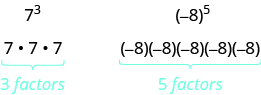
Before we begin working with variable expressions containing exponents, let’s simplify a few expressions involving only numbers.
Simplify Expressions Using the Product Property of Exponents
You have seen that when you combine like terms by adding and subtracting, you need to have the same base with the same exponent. But when you multiply and divide, the exponents may be different, and sometimes the bases may be different, too. We’ll derive the properties of exponents by looking for patterns in several examples. All the exponent properties hold true for any real numbers, but right now we will only use whole number exponents.
First, we will look at an example that leads to the Product Property.
 | |
|---|---|
| What does this mean?
How many factors altogether? | 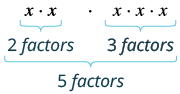 |
| So, we have |  |
| Notice that 5 is the sum of the exponents, 2 and 3. |  |
| We write: |
The base stayed the same and we added the exponents. This leads to the Product Property for Exponents.
An example with numbers helps to verify this property.
We can extend the Product Property of Exponents to more than two factors.
Simplify Expressions Using the Power Property of Exponents
Now let’s look at an exponential expression that contains a power raised to a power. See if you can discover a general property.
 | |
|---|---|
 | |
| What does this mean?
How many factors altogether? | 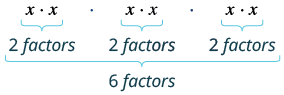 |
| So, we have |  |
| Notice that 6 is the product of the exponents, 2 and 3. |  |
| We write: |
We multiplied the exponents. This leads to the Power Property for Exponents.
An example with numbers helps to verify this property.
Simplify Expressions Using the Product to a Power Property
We will now look at an expression containing a product that is raised to a power. Look for a pattern.
| What does this mean? | |
| We group the like factors together. | |
| How many factors of 2 and of | |
| Notice that each factor was raised to the power. | |
| We write: |
|
The exponent applies to each of the factors. This leads to the Product to a Power Property for Exponents.
An example with numbers helps to verify this property:
Simplify Expressions by Applying Several Properties
We now have three properties for multiplying expressions with exponents. Let’s summarize them and then we’ll do some examples that use more than one of the properties.
Multiply Monomials
Since a monomial is an algebraic expression, we can use the properties for simplifying expressions with exponents to multiply the monomials.
Key Concepts
- Exponential Notation
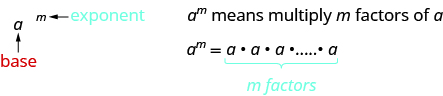
This is read to the power.
- Product Property of Exponents
- If is a real number and are counting numbers, then
- To multiply with like bases, add the exponents.
- Power Property for Exponents
- If is a real number and are counting numbers, then
- Product to a Power Property for Exponents
- If and are real numbers and is a whole number, then
Practice Makes Perfect
Simplify Expressions with Exponents
In the following exercises, simplify each expression with exponents.
1,024
0.008
625
−625
−10,000
−0.25
Simplify Expressions Using the Product Property of Exponents
In the following exercises, simplify each expression using the Product Property of Exponents.
x9
a5
314
z6
xa+2
ya+b
Simplify Expressions Using the Power Property of Exponents
In the following exercises, simplify each expression using the Power Property of Exponents.
u8
y20
1012
x90
x2y
5xy
Simplify Expressions Using the Product to a Power Property
In the following exercises, simplify each expression using the Product to a Power Property.
25a2
−216m3
16r2s2
256x4y4z4
Simplify Expressions by Applying Several Properties
In the following exercises, simplify each expression.
x14
a36
45x3
200a5
8m18
1,000x6y3
16a12b8
1,024a10
25,000p24
x18y18
144m8n22
Multiply Monomials
In the following exercises, multiply the following monomials.
−60x6
72u7
4r11
36a5b7
8x2y5
Everyday Math
Email Janet emails a joke to six of her friends and tells them to forward it to six of their friends, who forward it to six of their friends, and so on. The number of people who receive the email on the second round is on the third round is as shown in the table. How many people will receive the email on the eighth round? Simplify the expression to show the number of people who receive the email.
| Round | Number of people |
|---|---|
1,679,616
Salary Raul’s boss gives him a raise every year on his birthday. This means that each year, Raul’s salary is times his last year’s salary. If his original salary was , his salary after year was after years was after years was as shown in the table below. What will Raul’s salary be after years? Simplify the expression, to show Raul’s salary in dollars.
| Year | Salary |
|---|---|
Writing Exercises
Use the Product Property for Exponents to explain why
Answers will vary.
Explain why but
Jorge thinks is What is wrong with his reasoning?
Answers will vary.
Explain why is and not
Self Check
ⓐ After completing the exercises, use this checklist to evaluate your mastery of the objectives of this section.
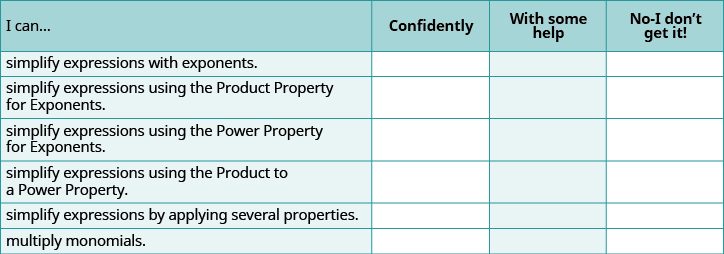
ⓑ After reviewing this checklist, what will you do to become confident for all objectives?
Adapted from Prealgebra 2e by OpenStax (openstax.org), licensed under CC BY-NC-SA 4.0. Changes were made. License: CC-BY-NC-SA-4.0.