
10.1 Add and Subtract Polynomials
Identify Polynomials, Monomials, Binomials, and Trinomials
In Evaluate, Simplify, and Translate Expressions, you learned that a term is a constant or the product of a constant and one or more variables. The constant is called a coefficient. When it is of the form where is a constant and is a whole number, it is called a monomial. A monomial, or a sum and/or difference of monomials, is called a polynomial.
Notice the roots:
- poly- means many
- mono- means one
- bi- means two
- tri- means three
Here are some examples of polynomials:
| Polynomial | |||
|---|---|---|---|
| Monomial | |||
| Binomial | |||
| Trinomial |
Notice that every monomial, binomial, and trinomial is also a polynomial. They are special members of the family of polynomials and so they have special names. We use the words ‘monomial’, ‘binomial’, and ‘trinomial’ when referring to these special polynomials and just call all the rest ‘polynomials’.
Determine the Degree of Polynomials
In this section, we will work with polynomials that have only one variable in each term. The degree of a polynomial and the degree of its terms are determined by the exponents of the variable.
A monomial that has no variable, just a constant, is a special case. The degree of a constant is —it has no variable.
Let's see how this works by looking at several polynomials. We'll take it step by step, starting with monomials, and then progressing to polynomials with more terms.
Remember: Any base written without an exponent has an implied exponent of
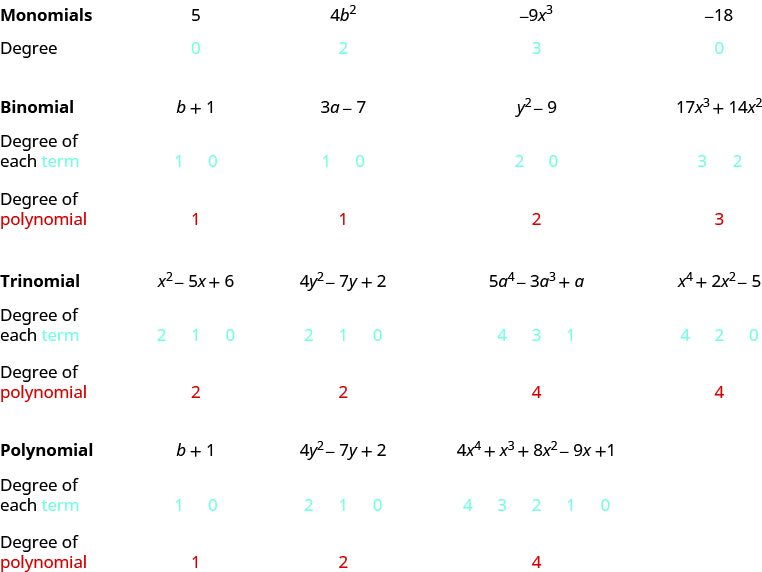
Working with polynomials is easier when you list the terms in descending order of degrees. When a polynomial is written this way, it is said to be in standard form. Look back at the polynomials in Example 2. Notice that they are all written in standard form. Get in the habit of writing the term with the highest degree first.
Add and Subtract Monomials
In The Language of Algebra, you simplified expressions by combining like terms. Adding and subtracting monomials is the same as combining like terms. Like terms must have the same variable with the same exponent. Recall that when combining like terms only the coefficients are combined, never the exponents.
Add and Subtract Polynomials
Adding and subtracting polynomials can be thought of as just adding and subtracting like terms. Look for like terms—those with the same variables with the same exponent. The Commutative Property allows us to rearrange the terms to put like terms together. It may also be helpful to underline, circle, or box like terms.
Parentheses are grouping symbols. When we add polynomials as we did in Example 6, we can rewrite the expression without parentheses and then combine like terms. But when we subtract polynomials, we must be very careful with the signs.
Evaluate a Polynomial for a Given Value
In The Language of Algebra we evaluated expressions. Since polynomials are expressions, we'll follow the same procedures to evaluate polynomials—substitute the given value for the variable into the polynomial, and then simplify.
Practice Makes Perfect
Identify Polynomials, Monomials, Binomials and Trinomials
In the following exercises, determine if each of the polynomials is a monomial, binomial, trinomial, or other polynomial.
binomial
trinomial
polynomial
monomial
Determine the Degree of Polynomials
In the following exercises, determine the degree of each polynomial.
5
1
0
Add and Subtract Monomials
In the following exercises, add or subtract the monomials.
15x2
−8u
5a + 7b
Add:
−4a −3b
Add:
16x
Subtract
−17x6
Subtract
Add and Subtract Polynomials
In the following exercises, add or subtract the polynomials.
12y2 + 4y + 8
−3x2 + 17x − 1
4a2 − 7a − 11
4m2 − 10m + 2
11z + 8
12s2 − 16s + 9
Find the sum of and
2p3 + p2 + 9p + 10
Find the sum of and
Subtract from
x2 + 3x + 4
Subtract from
Find the difference of and
11w − 66
Find the difference of and
Evaluate a Polynomial for a Given Value
In the following exercises, evaluate each polynomial for the given value.
- ⓐ
- ⓑ
- ⓒ
- ⓐ 187
- ⓑ 40
- ⓒ 2
- ⓐ
- ⓑ
- ⓒ
- ⓐ
- ⓑ
- ⓒ
- ⓐ −104
- ⓑ 4
- ⓒ 40
- ⓐ
- ⓑ
- ⓒ
A window washer drops a squeegee from a platform feet high. The polynomial gives the height of the squeegee seconds after it was dropped. Find the height after seconds.
19 feet
A manufacturer of microwave ovens has found that the revenue received from selling microwaves at a cost of p dollars each is given by the polynomial Find the revenue received when dollars.
Everyday Math
Fuel Efficiency The fuel efficiency (in miles per gallon) of a bus going at a speed of miles per hour is given by the polynomial Find the fuel efficiency when
10 mpg
Stopping Distance The number of feet it takes for a car traveling at miles per hour to stop on dry, level concrete is given by the polynomial Find the stopping distance when
Writing Exercises
Using your own words, explain the difference between a monomial, a binomial, and a trinomial.
Answers will vary.
Eloise thinks the sum is What is wrong with her reasoning?
Self Check
ⓐ After completing the exercises, use this checklist to evaluate your mastery of the objectives of this section.
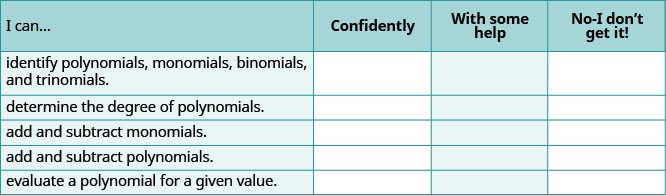
ⓑ If most of your checks were:
…confidently. Congratulations! You have achieved the objectives in this section. Reflect on the study skills you used so that you can continue to use them. What did you do to become confident of your ability to do these things? Be specific.
…with some help. This must be addressed quickly because topics you do not master become potholes in your road to success. In math, every topic builds upon previous work. It is important to make sure you have a strong foundation before you move on. Whom can you ask for help? Your fellow classmates and instructor are good resources. Is there a place on campus where math tutors are available? Can your study skills be improved?
…no—I don’t get it! This is a warning sign and you must not ignore it. You should get help right away or you will quickly be overwhelmed. See your instructor as soon as you can to discuss your situation. Together you can come up with a plan to get you the help you need.
Adapted from Prealgebra 2e by OpenStax (openstax.org), licensed under CC BY-NC-SA 4.0. Changes were made. License: CC-BY-NC-SA-4.0.