
10.3 Multiply Polynomials
Multiply a Polynomial by a Monomial
In Distributive Property you learned to use the Distributive Property to simplify expressions such as You multiplied both terms in the parentheses, by to get With this chapter's new vocabulary, you can say you were multiplying a binomial, by a monomial, Multiplying a binomial by a monomial is nothing new for you!
Multiplying a monomial by a trinomial works in much the same way.
Now we will have the monomial as the second factor.
Multiply a Binomial by a Binomial
Just like there are different ways to represent multiplication of numbers, there are several methods that can be used to multiply a binomial times a binomial.
Using the Distributive Property
We will start by using the Distributive Property. Look again at Example 6.
 | |
|---|---|
| We distributed the to get |  |
What if we have instead of ?
 | 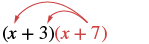 |
| Distribute . | 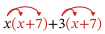 |
| Distribute again. | |
| Combine like terms. |
Notice that before combining like terms, we had four terms. We multiplied the two terms of the first binomial by the two terms of the second binomial—four multiplications.
Be careful to distinguish between a sum and a product.
Now we'll see how to multiply binomials where the variable has a coefficient.
In the previous examples, the binomials were sums. When there are differences, we pay special attention to make sure the signs of the product are correct.
Up to this point, the product of two binomials has been a trinomial. This is not always the case.
Using the FOIL Method
Remember that when you multiply a binomial by a binomial you get four terms. Sometimes you can combine like terms to get a trinomial, but sometimes there are no like terms to combine. Let's look at the last example again and pay particular attention to how we got the four terms.
Where did the first term, come from?
It is the product of the first terms in
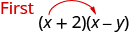
The next term, is the product of the two outer terms.

The third term, is the product of the two inner terms.

And the last term, came from multiplying the two last terms.

We abbreviate “First, Outer, Inner, Last” as FOIL. The letters stand for ‘First, Outer, Inner, Last’. The word FOIL is easy to remember and ensures we find all four products. We might say we use the FOIL method to multiply two binomials.
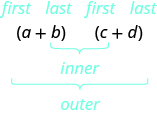
Let's look at again. Now we will work through an example where we use the FOIL pattern to multiply two binomials.
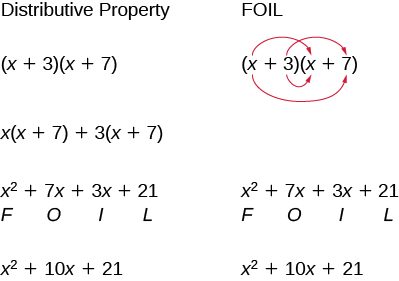
We summarize the steps of the FOIL method below. The FOIL method only applies to multiplying binomials, not other polynomials!
Using the Vertical Method
The FOIL method is usually the quickest method for multiplying two binomials, but it works only for binomials. You can use the Distributive Property to find the product of any two polynomials. Another method that works for all polynomials is the Vertical Method. It is very much like the method you use to multiply whole numbers. Look carefully at this example of multiplying two-digit numbers.
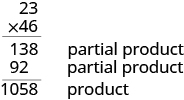
You start by multiplying by to get
Then you multiply by lining up the partial product in the correct columns.
Last, you add the partial products.
Now we'll apply this same method to multiply two binomials.
We have now used three methods for multiplying binomials. Be sure to practice each method, and try to decide which one you prefer. The three methods are listed here to help you remember them.
Multiply a Trinomial by a Binomial
We have multiplied monomials by monomials, monomials by polynomials, and binomials by binomials. Now we're ready to multiply a trinomial by a binomial. Remember, the FOIL method will not work in this case, but we can use either the Distributive Property or the Vertical Method. We first look at an example using the Distributive Property.
Now let's do this same multiplication using the Vertical Method.
Key Concepts
- Use the FOIL method for multiplying two binomials.
Step 1. Multiply the First terms. Step 2. Multiply the Outer terms. Step 3. Multiply the Inner terms. Step 4. Multiply the Last terms. Step 5. Combine like terms, when possible. - Multiplying Two Binomials: To multiply binomials, use the:
- Distributive Property
- FOIL Method
- Vertical Method
- Multiplying a Trinomial by a Binomial: To multiply a trinomial by a binomial, use the:
- Distributive Property
- Vertical Method
Practice Makes Perfect
Multiply a Polynomial by a Monomial
In the following exercises, multiply.
4x + 40
15r − 360
−3m − 33
−8z + 40
u2 + 5u
n3 − 3n2
12x2 − 120x
−27a2 − 45a
24x2 + 6xy
55p2 − 25pq
3v2 + 30v + 75
8n3 − 8n2 + 2n
−8y3 − 16y2 + 120y
5q5 − 10q4 + 30q3
−12z4 − 48z3 + 4z2
2y2 − 9y
8w − 48
Multiply a Binomial by a Binomial
In the following exercises, multiply the following binomials using: ⓐ the Distributive Property ⓑ the FOIL method ⓒ the Vertical method
x2 + 10x + 24
n2 + 9n − 36
In the following exercises, multiply the following binomials. Use any method.
y2 + 11y + 24
a2 + 22a + 96
u2 − 14u + 45
z2 − 32z + 220
x2 + 3x − 28
v2 + 7v − 60
6n2 + 11n + 5
20m2 − 88m − 9
16c2 − 1
15u2 − 82u + 112
2a2 + 5ab + 3b2
5x2 − 20x − xy + 4y
Multiply a Trinomial by a Binomial
In the following exercises, multiply using ⓐ the Distributive Property and ⓑ the Vertical Method.
u3 + 7u2 + 14u + 8
3a3 + 31a2 + 5a − 50
In the following exercises, multiply. Use either method.
y3 − 16y2 + 69y − 54
2x3 − 9x2 − 17x − 6
Everyday Math
Mental math You can use binomial multiplication to multiply numbers without a calculator. Say you need to multiply times Think of as and as
- ⓐ Multiply by the FOIL method.
- ⓑ Multiply without using a calculator.
- ⓒ Which way is easier for you? Why?
- ⓐ 195
- ⓑ 195
- ⓒ Answers will vary.
Mental math You can use binomial multiplication to multiply numbers without a calculator. Say you need to multiply times Think of as and as
- ⓐ Multiply by the FOIL method.
- ⓑ Multiply without using a calculator.
- ⓒ Which way is easier for you? Why?
Writing Exercises
Which method do you prefer to use when multiplying two binomials—the Distributive Property, the FOIL method, or the Vertical Method? Why?
Answers will vary.
Which method do you prefer to use when multiplying a trinomial by a binomial—the Distributive Property or the Vertical Method? Why?
Self Check
ⓐ After completing the exercises, use this checklist to evaluate your mastery of the objectives of this section.
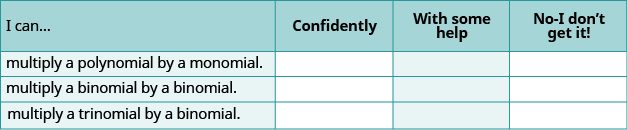
ⓑ What does this checklist tell you about your mastery of this section? What steps will you take to improve?
Adapted from Prealgebra 2e by OpenStax (openstax.org), licensed under CC BY-NC-SA 4.0. Changes were made. License: CC-BY-NC-SA-4.0.