
10.5 Integer Exponents and Scientific Notation
Use the Definition of a Negative Exponent
The Quotient Property of Exponents, introduced in Divide Monomials, had two forms depending on whether the exponent in the numerator or denominator was larger.
What if we just subtract exponents, regardless of which is larger? Let’s consider
We subtract the exponent in the denominator from the exponent in the numerator.
We can also simplify by dividing out common factors:
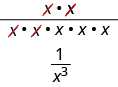
This implies that and it leads us to the definition of a negative exponent.
The negative exponent tells us to re-write the expression by taking the reciprocal of the base and then changing the sign of the exponent. Any expression that has negative exponents is not considered to be in simplest form. We will use the definition of a negative exponent and other properties of exponents to write an expression with only positive exponents.
When simplifying any expression with exponents, we must be careful to correctly identify the base that is raised to each exponent.
We must be careful to follow the order of operations. In the next example, parts ⓐ and ⓑ look similar, but we get different results.
When a variable is raised to a negative exponent, we apply the definition the same way we did with numbers.
When there is a product and an exponent we have to be careful to apply the exponent to the correct quantity. According to the order of operations, expressions in parentheses are simplified before exponents are applied. We’ll see how this works in the next example.
Now that we have defined negative exponents, the Quotient Property of Exponents needs only one form, where and m and n are integers.
When the exponent in the denominator is larger than the exponent in the numerator, the exponent of the quotient will be negative. If the result gives us a negative exponent, we will rewrite it by using the definition of negative exponents,
Simplify Expressions with Integer Exponents
All the exponent properties we developed earlier in this chapter with whole number exponents apply to integer exponents, too. We restate them here for reference.
In the next two examples, we’ll start by using the Commutative Property to group the same variables together. This makes it easier to identify the like bases before using the Product Property of Exponents.
If the monomials have numerical coefficients, we multiply the coefficients, just as we did in Use Multiplication Properties of Exponents.
In the next two examples, we’ll use the Power Property and the Product to a Power Property.
To simplify a fraction, we use the Quotient Property.
Convert from Decimal Notation to Scientific Notation
Remember working with place value for whole numbers and decimals? Our number system is based on powers of We use tens, hundreds, thousands, and so on. Our decimal numbers are also based on powers of tens—tenths, hundredths, thousandths, and so on.
Consider the numbers and We know that means and means If we write the as a power of ten in exponential form, we can rewrite these numbers in this way:
When a number is written as a product of two numbers, where the first factor is a number greater than or equal to one but less than and the second factor is a power of written in exponential form, it is said to be in scientific notation.
It is customary in scientific notation to use as the multiplication sign, even though we avoid using this sign elsewhere in algebra.
Scientific notation is a useful way of writing very large or very small numbers. It is used often in the sciences to make calculations easier.
If we look at what happened to the decimal point, we can see a method to easily convert from decimal notation to scientific notation.
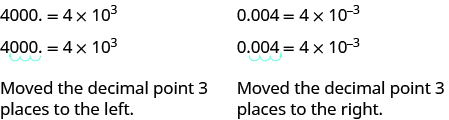
In both cases, the decimal was moved places to get the first factor, by itself.
- The power of is positive when the number is larger than
- The power of is negative when the number is between and
Convert Scientific Notation to Decimal Form
How can we convert from scientific notation to decimal form? Let’s look at two numbers written in scientific notation and see.
If we look at the location of the decimal point, we can see an easy method to convert a number from scientific notation to decimal form.

In both cases the decimal point moved 4 places. When the exponent was positive, the decimal moved to the right. When the exponent was negative, the decimal point moved to the left.
Multiply and Divide Using Scientific Notation
We use the Properties of Exponents to multiply and divide numbers in scientific notation.
Key Concepts
- Summary of Exponent Properties
- If are real numbers and are integers, then
- Convert from Decimal Notation to Scientific Notation: To convert a decimal to scientific notation:
- Move the decimal point so that the first factor is greater than or equal to 1 but less than 10.
- Count the number of decimal places, , that the decimal point was moved.
- Write the number as a product with a power of 10.
- If the original number is greater than 1, the power of 10 will be .
- If the original number is between 0 and 1, the power of 10 will be .
- Check.
- Convert Scientific Notation to Decimal Form: To convert scientific notation to decimal form:
- Determine the exponent, , on the factor 10.
- Move the decimal places, adding zeros if needed.
- If the exponent is positive, move the decimal point places to the right.
- If the exponent is negative, move the decimal point places to the left.
- Check.
Practice Makes Perfect
Use the Definition of a Negative Exponent
In the following exercises, simplify.
- ⓐ
- ⓑ
- ⓐ
- ⓑ
- ⓐ
- ⓑ
- ⓐ
- ⓑ
- ⓐ
- ⓑ
- ⓐ
- ⓑ
- ⓐ
- ⓑ
- ⓐ
- ⓑ
- ⓐ
- ⓑ
- ⓐ
- ⓑ
- ⓐ
- ⓑ
- ⓐ
- ⓑ
- ⓐ
- ⓑ
- ⓒ
- ⓐ
- ⓑ
- ⓒ
- ⓐ
- ⓑ
- ⓒ
- ⓐ
- ⓑ
- ⓒ
- ⓐ
- ⓑ
- ⓒ
- ⓐ
- ⓑ
- ⓒ
Simplify Expressions with Integer Exponents
In the following exercises, simplify.
r3
m6
b8
m7
p3
Convert from Decimal Notation to Scientific Notation
In the following exercises, write each number in scientific notation.
45,000
280,000
2.8 × 10⁵
8,750,000
1,290,000
1.29 × 10⁶
0.036
0.041
4.1 × 10⁻²
0.00000924
0.0000103
1.03 × 10⁻⁵
The population of the United States on July 4, 2010 was almost
The population of the world on July 4, 2010 was more than
6.85 × 10⁹
The average width of a human hair is centimeters.
The probability of winning the Megamillions lottery is about
5.7 × 10⁻⁹
Convert Scientific Notation to Decimal Form
In the following exercises, convert each number to decimal form.
830
16,000,000,000
0.028
0.0000000615
In 2010, the number of Facebook users each day who changed their status to ‘engaged’ was
At the start of 2012, the US federal budget had a deficit of more than
$15,000,000,000,000
The concentration of carbon dioxide in the atmosphere is
The width of a proton is of the width of an atom.
0.00001
Multiply and Divide Using Scientific Notation
In the following exercises, multiply or divide and write your answer in decimal form.
0.003
0.00000735
20,000,000
50,000,000
Everyday Math
Calories In May 2010 the Food and Beverage Manufacturers pledged to reduce their products by trillion calories by the end of 2015.
- ⓐ Write trillion in decimal notation.
- ⓑ Write trillion in scientific notation.
Length of a year The difference between the calendar year and the astronomical year is day.
- ⓐ Write this number in scientific notation.
- ⓑ How many years does it take for the difference to become 1 day?
- ⓐ 1.25 × 10⁻⁴
- ⓐ 8,000
Calculator display Many calculators automatically show answers in scientific notation if there are more digits than can fit in the calculator’s display. To find the probability of getting a particular 5-card hand from a deck of cards, Mario divided by and saw the answer Write the number in decimal notation.
Calculator display Many calculators automatically show answers in scientific notation if there are more digits than can fit in the calculator’s display. To find the number of ways Barbara could make a collage with of her favorite photographs, she multiplied Her calculator gave the answer Write the number in decimal notation.
11,441,304,000
Writing Exercises
- ⓐ Explain the meaning of the exponent in the expression
- ⓑ Explain the meaning of the exponent in the expression
When you convert a number from decimal notation to scientific notation, how do you know if the exponent will be positive or negative?
Answers will vary.
Self Check
ⓐ After completing the exercises, use this checklist to evaluate your mastery of the objectives of this section.
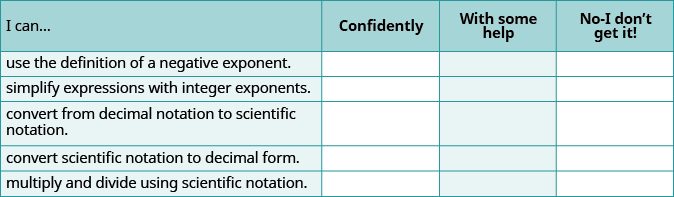
ⓑ After looking at the checklist, do you think you are well prepared for the next section? Why or why not?
Adapted from Prealgebra 2e by OpenStax (openstax.org), licensed under CC BY-NC-SA 4.0. Changes were made. License: CC-BY-NC-SA-4.0.