
3.7 Median and Mean
In the section "What is central tendency," we saw that the center of a distribution could be defined three ways: (1) the point on which a distribution would balance, (2) the value whose average absolute deviation from all the other values is minimized, and (3) the value whose average squared difference from all the other values is minimized. From the simulation in this chapter, you discovered (we hope) that the mean is the point on which a distribution would balance, the median is the value that minimizes the sum of absolute deviations, and the mean is the value that minimizes the sum of the squared deviations.
Table 1 shows the absolute and squared deviations of the numbers 2, 3, 4, 9, and 16 from their median of 4 and their mean of 6.8. You can see that the sum of absolute deviations from the median (20) is smaller than the sum of absolute deviations from the mean (22.8). On the other hand, the sum of squared deviations from the median (174) is larger than the sum of squared deviations from the mean (134.8).
Table 1. Absolute and squared deviations from the median of 4 and the mean of 6.8.
| Value | Absolute Deviation from Median | Absolute Deviation from Mean | Squared Deviation from Median | Squared Deviation from Mean |
|---|---|---|---|---|
| 2 | 2 | 4.8 | 4 | 23.04 |
| 3 | 1 | 3.8 | 1 | 14.44 |
| 4 | 0 | 2.8 | 0 | 7.84 |
| 9 | 5 | 2.2 | 25 | 4.84 |
| 16 | 12 | 9.2 | 144 | 84.64 |
| Total | 20 | 22.8 | 174 | 134.8 |
Figure 1 shows that the distribution balances at the mean of 6.8 and not at the median of 4. The relative advantages and disadvantages of the mean and median are discussed in the section "Comparing Measures" later in this chapter.
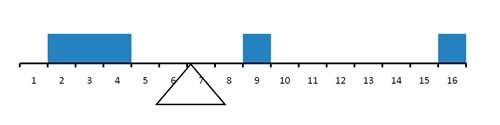
When a distribution is symmetric, then the mean and the median are the same. Consider the following distribution: 1, 3, 4, 5, 6, 7, 9. The mean and median are both 5. The mean, median, and mode are identical in the bell-shaped normal distribution.
Adapted from Online Statistics Education: A Multimedia Course of Study (onlinestatbook.com), Project Leader: David M. Lane, Rice University. Developed with NSF support. The original work is in the public domain; it is cited here at the authors' request. Changes were made: reformatted as an accessible XYZ web edition with native MathML. License: Public-Domain.