

2.2 Absolute Value and Distance on the Number Line
Narrated lesson: Absolute Value and Distance on the Number Line
Synthetic narration with English captions, a transcript, and time to think before checking the answer.
Read the transcriptDownload the videoNarration credits and licences
Find Opposites
On the number line, the negative numbers are a mirror image of the positive numbers with zero in the middle. Because the numbers and are the same distance from zero, they are called opposites. The opposite of is and the opposite of is as shown in Figure 2.3(a). Similarly, and are opposites as shown in Figure 2.3(b).
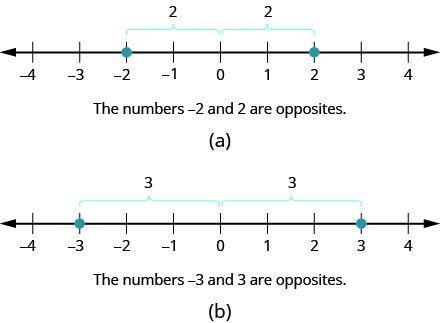
Opposite Notation
Just as the same word in English can have different meanings, the same symbol in algebra can have different meanings. The specific meaning becomes clear by looking at how it is used. You have seen the symbol in three different ways.
| Between two numbers, the symbol indicates the operation of subtraction. We read as 10 minus . | |
|---|---|
| In front of a number, the symbol indicates a negative number. We read as negative eight. | |
| In front of a variable or a number, it indicates the opposite. We read as the opposite of . | |
| Here we have two signs. The sign in the parentheses indicates that the number is negative 2. The sign outside the parentheses indicates the opposite. We read as the opposite of |
Integers
The set of counting numbers, their opposites, and is the set of integers.
We must be very careful with the signs when evaluating the opposite of a variable.
Simplify Expressions with Absolute Value
We saw that numbers such as and are opposites because they are the same distance from on the number line. They are both five units from The distance between and any number on the number line is called the absolute value of that number. Because distance is never negative, the absolute value of any number is never negative.
The symbol for absolute value is two vertical lines on either side of a number. So the absolute value of is written as and the absolute value of is written as as shown in Figure 2.6.
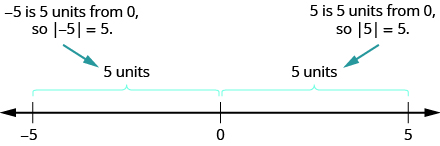
We treat absolute value bars just like we treat parentheses in the order of operations. We simplify the expression inside first.
Absolute value bars act like grouping symbols. First simplify inside the absolute value bars as much as possible. Then take the absolute value of the resulting number, and continue with any operations outside the absolute value symbols.
Practice Makes Perfect
Find Opposites
In the following exercises, find the opposite of each number.
- ⓐ
- ⓑ
Show solution
- ⓐ −2
- ⓑ 6
- ⓐ
- ⓑ
- ⓐ
- ⓑ
Show solution
- ⓐ 8
- ⓑ −1
- ⓐ
- ⓑ
In the following exercises, simplify.
Show solution
4
Show solution
15
In the following exercises, evaluate.
- ⓐ
- ⓑ
Show solution
- ⓐ −3
- ⓑ 3
- ⓐ
- ⓑ
- ⓐ
- ⓑ
Show solution
- ⓐ −12;
- ⓑ 12
- ⓐ
- ⓑ
Simplify Expressions with Absolute Value
In the following exercises, simplify each absolute value expression.
- ⓐ
- ⓑ
- ⓒ
Show solution
- ⓐ 7
- ⓑ 25
- ⓒ 0
- ⓐ
- ⓑ
- ⓒ
- ⓐ
- ⓑ
- ⓒ
Show solution
- ⓐ 32
- ⓑ 18
- ⓒ 16
- ⓐ
- ⓑ
- ⓒ
In the following exercises, evaluate each absolute value expression.
- ⓐ
- ⓑ
Show solution
- ⓐ 28
- ⓑ 15
- ⓐ
- ⓑ
- ⓐ
- ⓑ
Show solution
- ⓐ −19
- ⓑ −33
- ⓐ
- ⓑ
In the following exercises, fill in to compare each expression.
- ⓐ
- ⓑ
Show solution
- ⓐ <
- ⓑ =
- ⓐ
- ⓑ
- ⓐ
- ⓑ
Show solution
- ⓐ >
- ⓑ >
- ⓐ
- ⓑ
In the following exercises, simplify each expression.
Show solution
4
Show solution
56
Show solution
0
Show solution
8
Show solution
80
Corequisite Skills for Introductory Statistics is a custom course edition compiled for Introductory Statistics corequisite courses from OpenStax Contemporary Mathematics, Elementary Algebra 2e, Intermediate Algebra 2e, Prealgebra 2e. Content by OpenStax is reproduced as published, apart from any corrections recorded for this edition. Sections are renumbered to follow the course outline. The course outline is adapted from Larry Green's Support Course for Elementary Statistics (LibreTexts, https://stats.libretexts.org/Bookshelves/Introductory_Statistics/Support_Course_for_Elementary_Statistics), used under CC BY 4.0 (https://creativecommons.org/licenses/by/4.0/). Lessons 2.4 and 6.7 are written for this edition by XYZ Homework. Every OpenStax lesson is abridged to the subsections and practice exercises this course uses. Lessons are headed with their course titles, not the source section titles. Access the complete originals free at openstax.org. License: CC-BY-NC-SA-4.0.