
7.6 Quadratic Equations
We have already solved linear equations, equations of the form . In linear equations, the variables have no exponents. Quadratic equations are equations in which the variable is squared. Listed below are some examples of quadratic equations:
The last equation doesn’t appear to have the variable squared, but when we simplify the expression on the left we will get .
The general form of a quadratic equation is .
To solve quadratic equations we need methods different than the ones we used in solving linear equations. We will look at one method here and then several others in a later chapter.
Solve Quadratic Equations Using the Zero Product Property
We will first solve some quadratic equations by using the Zero Product Property. The Zero Product Property says that if the product of two quantities is zero, it must be that at least one of the quantities is zero. The only way to get a product equal to zero is to multiply by zero itself.
We will now use the Zero Product Property, to solve a quadratic equation.
We usually will do a little more work than we did in this last example to solve the linear equations that result from using the Zero Product Property.
Notice when we checked the solutions that each of them made just one factor equal to zero. But the product was zero for both solutions.
It may appear that there is only one factor in the next example. Remember, however, that means .
Solve Quadratic Equations by Factoring
Each of the equations we have solved in this section so far had one side in factored form. In order to use the Zero Product Property, the quadratic equation must be factored, with zero on one side. So we must be sure to start with the quadratic equation in standard form, . Then we can factor the expression on the left.
Before we factor, we must make sure the quadratic equation is in standard form.
Solving quadratic equations by factoring will make use of all the factoring techniques you have learned in this chapter! Do you recognize the special product pattern in the next example?
The left side in the next example is factored, but the right side is not zero. In order to use the Zero Product Property, one side of the equation must be zero. We’ll multiply the factors and then write the equation in standard form.
The Zero Product Property also applies to the product of three or more factors. If the product is zero, at least one of the factors must be zero. We can solve some equations of degree more than two by using the Zero Product Property, just like we solved quadratic equations.
When we factor the quadratic equation in the next example we will get three factors. However the first factor is a constant. We know that factor cannot equal 0.
Solve Applications Modeled by Quadratic Equations
The problem solving strategy we used earlier for applications that translate to linear equations will work just as well for applications that translate to quadratic equations. We will copy the problem solving strategy here so we can use it for reference.
We will start with a number problem to get practice translating words into a quadratic equation.
Were you surprised by the pair of negative integers that is one of the solutions to the previous example? The product of the two positive integers and the product of the two negative integers both give 132.
In some applications, negative solutions will result from the algebra, but will not be realistic for the situation.
In an earlier chapter, we used the Pythagorean Theorem . It gave the relation between the legs and the hypotenuse of a right triangle.
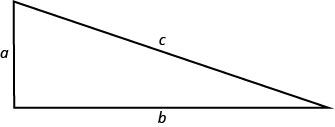
We will use this formula in the next example.
Key Concepts
- Zero Product Property If , then either or or both. See Example 1.
- Solve a quadratic equation by factoring To solve a quadratic equation by factoring: See Example 5.
- Write the quadratic equation in standard form, .
- Factor the quadratic expression.
- Use the Zero Product Property.
- Solve the linear equations.
- Check.
- Use a problem solving strategy to solve word problems See Example 12.
- Read the problem. Make sure all the words and ideas are understood.
- Identify what we are looking for.
- Name what we are looking for. Choose a variable to represent that quantity.
- Translate into an equation. It may be helpful to restate the problem in one sentence with all the important information. Then, translate the English sentence into an algebra equation.
- Solve the equation using good algebra techniques.
- Check the answer in the problem and make sure it makes sense.
- Answer the question with a complete sentence.
Section Exercises
Practice Makes Perfect
Use the Zero Product Property
In the following exercises, solve.
Solve Quadratic Equations by Factoring
In the following exercises, solve.
Solve Applications Modeled by Quadratic Equations
In the following exercises, solve.
The product of two consecutive integers is 56. Find the integers.
The product of two consecutive integers is 42. Find the integers.
The area of a rectangular carpet is 28 square feet. The length is three feet more than the width. Find the length and the width of the carpet.
A rectangular retaining wall has area 15 square feet. The height of the wall is two feet less than its length. Find the height and the length of the wall.
A pennant is shaped like a right triangle, with hypotenuse 10 feet. The length of one side of the pennant is two feet longer than the length of the other side. Find the length of the two sides of the pennant.
A reflecting pool is shaped like a right triangle, with one leg along the wall of a building. The hypotenuse is 9 feet longer than the side along the building. The third side is 7 feet longer than the side along the building. Find the lengths of all three sides of the reflecting pool.
Mixed Practice
In the following exercises, solve.
The product of two consecutive integers is 110. Find the integers.
The length of one leg of a right triangle is three feet more than the other leg. If the hypotenuse is 15 feet, find the lengths of the two legs.
Everyday Math
Area of a patio If each side of a square patio is increased by 4 feet, the area of the patio would be 196 square feet. Solve the equation for s to find the length of a side of the patio.
10 feet
Watermelon drop A watermelon is dropped from the tenth story of a building. Solve the equation for to find the number of seconds it takes the watermelon to reach the ground.
Writing Exercises
Explain how you solve a quadratic equation. How many answers do you expect to get for a quadratic equation?
Answers may vary.
Give an example of a quadratic equation that has a GCF and none of the solutions to the equation is zero.
Self Check
ⓐ After completing the exercises, use this checklist to evaluate your mastery of the objectives of this section.
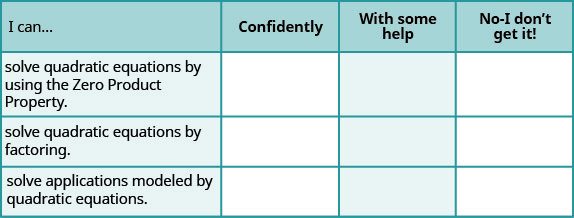
ⓑ Overall, after looking at the checklist, do you think you are well-prepared for the next section? Why or why not?
Chapter 7 Review Exercises
7.1 Greatest Common Factor and Factor by Grouping
Find the Greatest Common Factor of Two or More Expressions
In the following exercises, find the greatest common factor.
6
Factor the Greatest Common Factor from a Polynomial
In the following exercises, factor the greatest common factor from each polynomial.
Factor by Grouping
In the following exercises, factor by grouping.
7.2 Factor Trinomials of the form
Factor Trinomials of the Form
In the following exercises, factor each trinomial of the form .
Factor Trinomials of the Form
In the following exercises, factor each trinomial of the form .
7.3 Factoring Trinomials of the form
Recognize a Preliminary Strategy to Factor Polynomials Completely
In the following exercises, identify the best method to use to factor each polynomial.
Undo FOIL
Factor the GCF
Factor Trinomials of the Form with a GCF
In the following exercises, factor completely.
Factor Trinomials Using the “ac” Method
In the following exercises, factor.
Factor Trinomials with a GCF Using the “ac” Method
In the following exercises, factor.
7.4 Factoring Special Products
Factor Perfect Square Trinomials
In the following exercises, factor.
Factor Differences of Squares
In the following exercises, factor.
Factor Sums and Differences of Cubes
In the following exercises, factor.
7.5 General Strategy for Factoring Polynomials
Recognize and Use the Appropriate Method to Factor a Polynomial Completely
In the following exercises, factor completely.
7.6 Quadratic Equations
Use the Zero Product Property
In the following exercises, solve.
Solve Quadratic Equations by Factoring
In the following exercises, solve.
Solve Applications Modeled by Quadratic Equations
In the following exercises, solve.
The product of two consecutive numbers is . Find the numbers.
The area of a rectangular shaped patio is square feet. The length of the patio is feet more than its width. Find the length and width.
Practice Test
In the following exercises, find the Greatest Common Factor in each expression.
In the following exercises, factor completely.
In the following exercises, solve.
The product of two consecutive integers is 156. Find the integers.
The area of a rectangular place mat is square inches. Its length is two inches longer than the width. Find the length and width of the place mat.
Adapted from Elementary Algebra 2e by OpenStax (openstax.org), licensed under CC BY-NC-SA 4.0. Changes were made. License: CC-BY-NC-SA-4.0.