
7.5 General Strategy for Factoring Polynomials
Recognize and Use the Appropriate Method to Factor a Polynomial Completely
You have now become acquainted with all the methods of factoring that you will need in this course. (In your next algebra course, more methods will be added to your repertoire.) The figure below summarizes all the factoring methods we have covered. How To: Factor polynomials. outlines a strategy you should use when factoring polynomials.
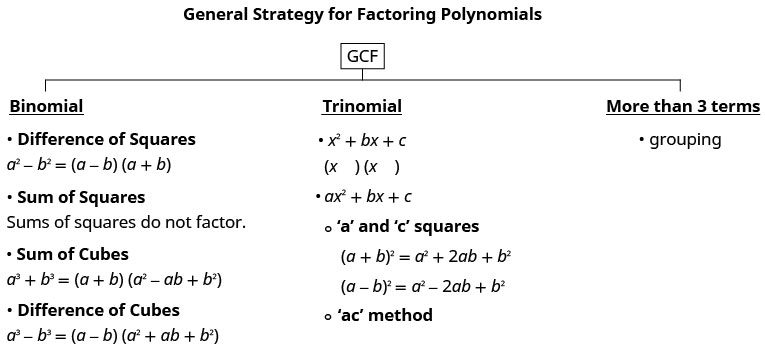
Remember, a polynomial is completely factored if, other than monomials, its factors are prime!
Key Concepts
- General Strategy for Factoring Polynomials See Figure 7.3.
- How to Factor Polynomials
- Is there a greatest common factor? Factor it out.
- Is the polynomial a binomial, trinomial, or are there more than three terms?
- If it is a binomial:
Is it a sum?- Of squares? Sums of squares do not factor.
- Of cubes? Use the sum of cubes pattern.
- Of squares? Factor as the product of conjugates.
- Of cubes? Use the difference of cubes pattern.
- If it is a trinomial:
Is it of the form ? Undo FOIL.
Is it of the form ?- If ‘a’ and ‘c’ are squares, check if it fits the trinomial square pattern.
- Use the trial and error or ‘ac’ method.
- If it has more than three terms:
Use the grouping method.
- If it is a binomial:
- Check. Is it factored completely? Do the factors multiply back to the original polynomial?
Practice Makes Perfect
Recognize and Use the Appropriate Method to Factor a Polynomial Completely
In the following exercises, factor completely.
prime
Everyday Math
Watermelon drop A springtime tradition at the University of California San Diego is the Watermelon Drop, where a watermelon is dropped from the seventh story of Urey Hall.
- ⓐ The binomial gives the height of the watermelon seconds after it is dropped. Factor the greatest common factor from this binomial.
- ⓑ If the watermelon is thrown down with initial velocity 8 feet per second, its height after seconds is given by the trinomial . Completely factor this trinomial.
ⓐ ⓑ
Pumpkin drop A fall tradition at the University of California San Diego is the Pumpkin Drop, where a pumpkin is dropped from the eleventh story of Tioga Hall.
- ⓐ The binomial gives the height of the pumpkin t seconds after it is dropped. Factor the greatest common factor from this binomial.
- ⓑ If the pumpkin is thrown down with initial velocity 32 feet per second, its height after seconds is given by the trinomial . Completely factor this trinomial.
Writing Exercises
The difference of squares can be factored as . But it is not completely factored. What more must be done to completely factor it?
Answer may vary.
Of all the factoring methods covered in this chapter (GCF, grouping, undo FOIL, ‘ac’ method, special products) which is the easiest for you? Which is the hardest? Explain your answers.
Self Check
ⓐ After completing the exercises, use this checklist to evaluate your mastery of the objectives of this section.

ⓑ Overall, after looking at the checklist, do you think you are well-prepared for the next section? Why or why not?
Adapted from Elementary Algebra 2e by OpenStax (openstax.org), licensed under CC BY-NC-SA 4.0. Changes were made. License: CC-BY-NC-SA-4.0.