
7.1 Greatest Common Factor and Factor by Grouping
Find the Greatest Common Factor of Two or More Expressions
Earlier we multiplied factors together to get a product. Now, we will be reversing this process; we will start with a product and then break it down into its factors. Splitting a product into factors is called factoring.
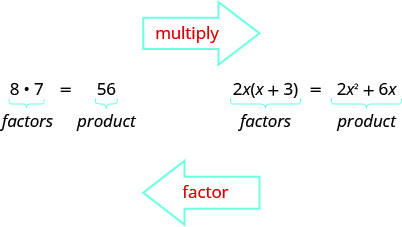
We have learned how to factor numbers to find the least common multiple (LCM) of two or more numbers. Now we will factor expressions and find the greatest common factor of two or more expressions. The method we use is similar to what we used to find the LCM.
First we’ll find the GCF of two numbers.
We summarize the steps we use to find the GCF below.
In the first example, the GCF was a constant. In the next two examples, we will get variables in the greatest common factor.
Factor the Greatest Common Factor from a Polynomial
Just like in arithmetic, where it is sometimes useful to represent a number in factored form (for example, 12 as in algebra, it can be useful to represent a polynomial in factored form. One way to do this is by finding the GCF of all the terms. Remember, we multiply a polynomial by a monomial as follows:
Now we will start with a product, like , and end with its factors, . To do this we apply the Distributive Property “in reverse.”
We state the Distributive Property here just as you saw it in earlier chapters and “in reverse.”
So how do you use the Distributive Property to factor a polynomial? You just find the GCF of all the terms and write the polynomial as a product!
The expressions in the next example have several factors in common. Remember to write the GCF as the product of all the common factors.
Now we’ll factor the greatest common factor from a trinomial. We start by finding the GCF of all three terms.
When the leading coefficient is negative, we factor the negative out as part of the GCF.
Factor by Grouping
When there is no common factor of all the terms of a polynomial, look for a common factor in just some of the terms. When there are four terms, a good way to start is by separating the polynomial into two parts with two terms in each part. Then look for the GCF in each part. If the polynomial can be factored, you will find a common factor emerges from both parts.
(Not all polynomials can be factored. Just like some numbers are prime, some polynomials are prime.)
Key Concepts
- Finding the Greatest Common Factor (GCF): To find the GCF of two expressions:
- Factor each coefficient into primes. Write all variables with exponents in expanded form.
- List all factors—matching common factors in a column. In each column, circle the common factors.
- Bring down the common factors that all expressions share.
- Multiply the factors as in Example 2.
- Factor the Greatest Common Factor from a Polynomial: To factor a greatest common factor from a polynomial:
- Find the GCF of all the terms of the polynomial.
- Rewrite each term as a product using the GCF.
- Use the ‘reverse’ Distributive Property to factor the expression.
- Check by multiplying the factors as in Example 5.
- Factor by Grouping: To factor a polynomial with four or more terms
- Group terms with common factors.
- Factor out the common factor in each group.
- Factor the common factor from the expression.
- Check by multiplying the factors as in Example 15.
Practice Makes Perfect
Find the Greatest Common Factor of Two or More Expressions
In the following exercises, find the greatest common factor.
8, 18
2
24, 40
72, 162
18
150, 275
10a, 50
10
5b, 30
Factor the Greatest Common Factor from a Polynomial
In the following exercises, factor the greatest common factor from each polynomial.
Factor by Grouping
In the following exercises, factor by grouping.
Mixed Practice
In the following exercises, factor.
Everyday Math
Area of a rectangle The area of a rectangle with length 6 less than the width is given by the expression , where width. Factor the greatest common factor from the polynomial.
Height of a baseball The height of a baseball t seconds after it is hit is given by the expression . Factor the greatest common factor from the polynomial.
Writing Exercises
The greatest common factor of 36 and 60 is 12. Explain what this means.
Answers will vary.
What is the GCF of ? Write a general rule that tells you how to find the GCF of .
Self Check
ⓐ After completing the exercises, use this checklist to evaluate your mastery of the objectives of this section.
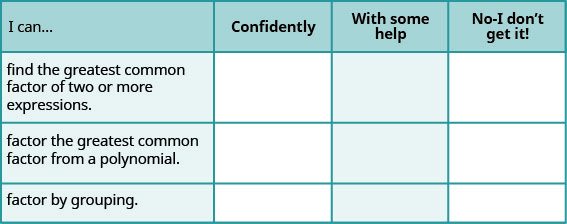
ⓑ If most of your checks were:
…confidently. Congratulations! You have achieved your goals in this section! Reflect on the study skills you used so that you can continue to use them. What did you do to become confident of your ability to do these things? Be specific!
…with some help. This must be addressed quickly as topics you do not master become potholes in your road to success. Math is sequential—every topic builds upon previous work. It is important to make sure you have a strong foundation before you move on. Whom can you ask for help? Your fellow classmates and instructor are good resources. Is there a place on campus where math tutors are available? Can your study skills be improved?
…no - I don’t get it! This is critical and you must not ignore it. You need to get help immediately or you will quickly be overwhelmed. See your instructor as soon as possible to discuss your situation. Together you can come up with a plan to get you the help you need.
Adapted from Elementary Algebra 2e by OpenStax (openstax.org), licensed under CC BY-NC-SA 4.0. Changes were made. License: CC-BY-NC-SA-4.0.