
7.2 Factor Trinomials of the Form x2+bx+c
Factor Trinomials of the Form x2 + bx + c
You have already learned how to multiply binomials using FOIL. Now you’ll need to “undo” this multiplication—to start with the product and end up with the factors. Let’s look at an example of multiplying binomials to refresh your memory.
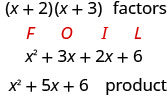
To factor the trinomial means to start with the product, , and end with the factors, . You need to think about where each of the terms in the trinomial came from.
The first term came from multiplying the first term in each binomial. So to get in the product, each binomial must start with an x.
The last term in the trinomial came from multiplying the last term in each binomial. So the last terms must multiply to 6.
What two numbers multiply to 6?
The factors of 6 could be 1 and 6, or 2 and 3. How do you know which pair to use?
Consider the middle term. It came from adding the outer and inner terms.
So the numbers that must have a product of 6 will need a sum of 5. We’ll test both possibilities and summarize the results in Table 7.1—the table will be very helpful when you work with numbers that can be factored in many different ways.
| Factors of | Sum of factors |
|---|---|
We see that 2 and 3 are the numbers that multiply to 6 and add to 5. So we have the factors of . They are .
You should check this by multiplying.
Looking back, we started with , which is of the form , where and . We factored it into two binomials of the form .
To get the correct factors, we found two numbers m and n whose product is c and sum is b.
Let’s summarize the steps we used to find the factors.
Factor Trinomials of the Form x2 + bx + c with b Negative, c Positive
In the examples so far, all terms in the trinomial were positive. What happens when there are negative terms? Well, it depends which term is negative. Let’s look first at trinomials with only the middle term negative.
Remember: To get a negative sum and a positive product, the numbers must both be negative.
Again, think about FOIL and where each term in the trinomial came from. Just as before,
- the first term, , comes from the product of the two first terms in each binomial factor, x and x;
- the positive last term is the product of the two last terms
- the negative middle term is the sum of the outer and inner terms.
How do you get a positive product and a negative sum? With two negative numbers.
Factor Trinomials of the Form with c Negative
Now, what if the last term in the trinomial is negative? Think about FOIL. The last term is the product of the last terms in the two binomials. A negative product results from multiplying two numbers with opposite signs. You have to be very careful to choose factors to make sure you get the correct sign for the middle term, too.
Remember: To get a negative product, the numbers must have different signs.
Let’s make a minor change to the last trinomial and see what effect it has on the factors.
Some trinomials are prime. The only way to be certain a trinomial is prime is to list all the possibilities and show that none of them work.
Let’s summarize the method we just developed to factor trinomials of the form .
Factor Trinomials of the Form x2 + bxy + cy2
Sometimes you’ll need to factor trinomials of the form with two variables, such as The first term, , is the product of the first terms of the binomial factors, . The in the last term means that the second terms of the binomial factors must each contain y. To get the coefficients b and c, you use the same process summarized in the previous objective.
Key Concepts
- Factor trinomials of the form
- Write the factors as two binomials with first terms x: .
- Find two numbers m and n that
Multiply to c,
Add to b, - Use m and n as the last terms of the factors: .
- Check by multiplying the factors.
Practice Makes Perfect
Factor Trinomials of the Form
In the following exercises, factor each trinomial of the form .
prime
Factor Trinomials of the Form
In the following exercises, factor each trinomial of the form . If the trinomial cannot be factored, answer “Prime.”
prime
prime
Mixed Practice
In the following exercises, factor each expression.
prime
prime
Everyday Math
Consecutive integers Deirdre is thinking of two consecutive integers whose product is 56. The trinomial describes how these numbers are related. Factor the trinomial.
Consecutive integers Deshawn is thinking of two consecutive integers whose product is 182. The trinomial describes how these numbers are related. Factor the trinomial.
Writing Exercises
Many trinomials of the form factor into the product of two binomials . Explain how you find the values of m and n.
Answers may vary
How do you determine whether to use plus or minus signs in the binomial factors of a trinomial of the form where and may be positive or negative numbers?
Will factored as . Bill factored it as . Phil factored it as . Who is correct? Explain why the other two are wrong.
Answers may vary
Look at Example 3, where we factored . We made a table listing all pairs of factors of 60 and their sums. Do you find this kind of table helpful? Why or why not?
Self Check
ⓐ After completing the exercises, use this checklist to evaluate your mastery of the objectives of this section.
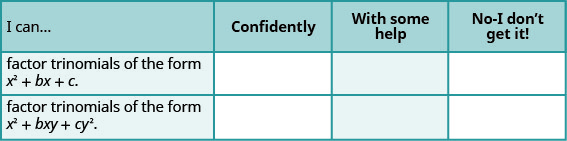
ⓑ After reviewing this checklist, what will you do to become confident for all goals?
Adapted from Elementary Algebra 2e by OpenStax (openstax.org), licensed under CC BY-NC-SA 4.0. Changes were made. License: CC-BY-NC-SA-4.0.