
7.4 Factor Special Products
The strategy for factoring we developed in the last section will guide you as you factor most binomials, trinomials, and polynomials with more than three terms. We have seen that some binomials and trinomials result from special products—squaring binomials and multiplying conjugates. If you learn to recognize these kinds of polynomials, you can use the special products patterns to factor them much more quickly.
Factor Perfect Square Trinomials
Some trinomials are perfect squares. They result from multiplying a binomial times itself. You can square a binomial by using FOIL, but using the Binomial Squares pattern you saw in a previous chapter saves you a step. Let’s review the Binomial Squares pattern by squaring a binomial using FOIL.
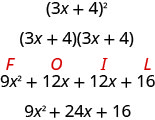
The first term is the square of the first term of the binomial and the last term is the square of the last. The middle term is twice the product of the two terms of the binomial.
The trinomial 9x2 + 24x +16 is called a perfect square trinomial. It is the square of the binomial 3x+4.
We’ll repeat the Binomial Squares Pattern here to use as a reference in factoring.
When you square a binomial, the product is a perfect square trinomial. In this chapter, you are learning to factor—now, you will start with a perfect square trinomial and factor it into its prime factors.
You could factor this trinomial using the methods described in the last section, since it is of the form ax2 + bx + c. But if you recognize that the first and last terms are squares and the trinomial fits the perfect square trinomials pattern, you will save yourself a lot of work.
Here is the pattern—the reverse of the binomial squares pattern.
To make use of this pattern, you have to recognize that a given trinomial fits it. Check first to see if the leading coefficient is a perfect square, . Next check that the last term is a perfect square, . Then check the middle term—is it twice the product, 2ab? If everything checks, you can easily write the factors.
The sign of the middle term determines which pattern we will use. When the middle term is negative, we use the pattern , which factors to .
The steps are summarized here.
We’ll work one now where the middle term is negative.
The next example will be a perfect square trinomial with two variables.
Remember the very first step in our Strategy for Factoring Polynomials? It was to ask “is there a greatest common factor?” and, if there was, you factor the GCF before going any further. Perfect square trinomials may have a GCF in all three terms and it should be factored out first. And, sometimes, once the GCF has been factored, you will recognize a perfect square trinomial.
Factor Differences of Squares
The other special product you saw in the previous chapter was the Product of Conjugates pattern. You used this to multiply two binomials that were conjugates. Here’s an example:
Remember, when you multiply conjugate binomials, the middle terms of the product add to 0. All you have left is a binomial, the difference of squares.
Multiplying conjugates is the only way to get a binomial from the product of two binomials.
To factor, we will use the product pattern “in reverse” to factor the difference of squares. A difference of squares factors to a product of conjugates.
Remember, “difference” refers to subtraction. So, to use this pattern you must make sure you have a binomial in which two squares are being subtracted.
It is important to remember that sums of squares do not factor into a product of binomials. There are no binomial factors that multiply together to get a sum of squares. After removing any GCF, the expression is prime!
Don’t forget that 1 is a perfect square. We’ll need to use that fact in the next example.
The binomial in the next example may look “backwards,” but it’s still the difference of squares.
To completely factor the binomial in the next example, we’ll factor a difference of squares twice!
As always, you should look for a common factor first whenever you have an expression to factor. Sometimes a common factor may “disguise” the difference of squares and you won’t recognize the perfect squares until you factor the GCF.
Factor Sums and Differences of Cubes
There is another special pattern for factoring, one that we did not use when we multiplied polynomials. This is the pattern for the sum and difference of cubes. We will write these formulas first and then check them by multiplication.
We’ll check the first pattern and leave the second to you.
 | |
|---|---|
| Distribute. |  |
| Multiply. | |
| Combine like terms. |
The two patterns look very similar, don’t they? But notice the signs in the factors. The sign of the binomial factor matches the sign in the original binomial. And the sign of the middle term of the trinomial factor is the opposite of the sign in the original binomial. If you recognize the pattern of the signs, it may help you memorize the patterns.
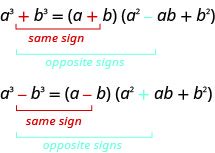
The trinomial factor in the sum and difference of cubes pattern cannot be factored.
It can be very helpful if you learn to recognize the cubes of the integers from 1 to 10, just like you have learned to recognize squares. We have listed the cubes of the integers from 1 to 10 in Table 7.2.
| n | 1 | 2 | 3 | 4 | 5 | 6 | 7 | 8 | 9 | 10 |
|---|---|---|---|---|---|---|---|---|---|---|
| 1 | 8 | 27 | 64 | 125 | 216 | 343 | 512 | 729 | 1000 |
Be careful to use the correct signs in the factors of the sum and difference of cubes.
In the next example, we first factor out the GCF. Then we can recognize the sum of cubes.
Key Concepts
- Factor perfect square trinomials See Example 1.
- Factor differences of squares See Example 6.
- Factor sum and difference of cubes To factor the sum or difference of cubes: See Example 13.
- Does the binomial fit the sum or difference of cubes pattern? Is it a sum or difference? Are the first and last terms perfect cubes?
- Write them as cubes.
- Use either the sum or difference of cubes pattern.
- Simplify inside the parentheses
- Check by multiplying the factors.
Practice Makes Perfect
Factor Perfect Square Trinomials
In the following exercises, factor.
Factor Differences of Squares
In the following exercises, factor.
Factor Sums and Differences of Cubes
In the following exercises, factor.
Mixed Practice
In the following exercises, factor.
Everyday Math
Landscaping Sue and Alan are planning to put a 15 foot square swimming pool in their backyard. They will surround the pool with a tiled deck, the same width on all sides. If the width of the deck is w, the total area of the pool and deck is given by the trinomial . Factor the trinomial.
Home repair The height a twelve foot ladder can reach up the side of a building if the ladder’s base is b feet from the building is the square root of the binomial . Factor the binomial.
Writing Exercises
Why was it important to practice using the binomial squares pattern in the chapter on multiplying polynomials?
Answers may vary.
How do you recognize the binomial squares pattern?
Explain why . Use algebra, words, or pictures.
Answers may vary.
Maribel factored as . Was she right or wrong? How do you know?
Self Check
ⓐ After completing the exercises, use this checklist to evaluate your mastery of the objectives of this section.
ⓑ On a scale of 1–10, how would you rate your mastery of this section in light of your responses on the checklist? How can you improve this?
Adapted from Elementary Algebra 2e by OpenStax (openstax.org), licensed under CC BY-NC-SA 4.0. Changes were made. License: CC-BY-NC-SA-4.0.