Recall that an equation may be true or false, depending on the values of any variables involved. For example, the equation
is true only if or . An equation that is true only for certain values of the variable, and false for others, is called a conditional equation. When you solve a conditional equation, you are finding the values of the variable that make the equation true.
Some equations are true for all legitimate values of the variables. Such equations are called identities. Here are some examples of identities.
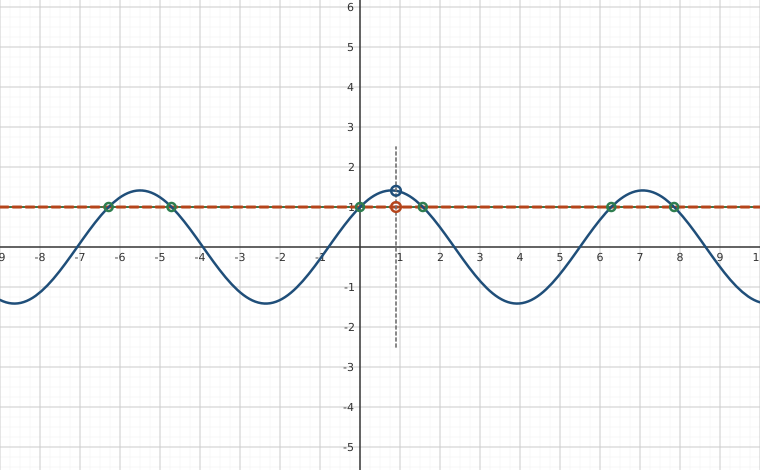
Interactive figureIdentity or conditional equation? Graph both sides and see where they agreeDrag the Input a slider from -7 to 8.
XYZ Graph · viewer build 5edf91b
Two equations tested the same way, by graphing each side. The rust curve is the left side of sin²x + cos²x = 1: it lies flat along the green line y = 1 for every x, so that equation is an identity. The navy curve is the left side of sin x + cos x = 1, which meets the line only at the marked points, so that equation is conditional and those crossings are its solutions. Slide a: the rust marker never leaves the line, while the navy marker is on it only at a solution.
In an identity, the expressions on either side of the equal sign are equivalent expressions, because they have the same value for all values of the variable. When we simplify an algebraic expression, we are in fact creating an identity.
Which of the following equations are identities?
(a) and (c) are identities.
Of course, you wouldn't be asked to solve an identity, because all values of the variable are solutions. Instead, we use identities to replace one form of an expression by a more useful form. You do this when you solve a quadratic equation by factoring. For example,
Because is equivalent to , we have not changed the equation or its solutions. But now we can apply the Zero Factor principle and solve the equation.
Using identities is especially useful when we are working with trigonometric ratios.
Using Trigonometric Ratios in Identities
Because the identity
is true for any value of , it is true when is replaced, for instance, by . This gives us a new identity
Expressions involving can be manipulated by the same rules (such as the distributive law or the laws of exponents) that we use with simple variables.
Which of the following equations are identities?
(a) and (c) are identities.
Checking Identities Graphically
Is the equation an identity? The answer is no! Even though the equation is true for all positive values of , it is false for negative values of . For example, if , then
so . Because the radical symbol stands for the nonnegative square root, the left side of the equation, , is never negative. Therefore, cannot equal when is a negative number. The equation is false for .
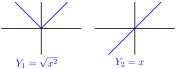
One way to see that and are not equivalent is to compare the graphs of and , shown below. You can see that and do not have the same value for .
Thus, to check to whether an equation is an identity, we can compare graphs of (left side of the equation) and (right side of the equation). If the two graphs are identical, the equation is an identity. If the two graphs are not the same, the equation is not an identity.
Use graphs to decide which of the following equations are identities.
(b) is an identity; (a) and (c) are not identities.
Pythagorean Identity
All of the trigonometric functions are related. This is plausible when you think about it, because the three trig ratios all involve the three sides of a right triangle. Taking advantage of these relationships will simplify many calculations involving the trig functions.
We'll begin by considering the relationship between and . Complete the following table with exact values.
You should find that all the entries in the last column are 1.
For all of the angles in the table,
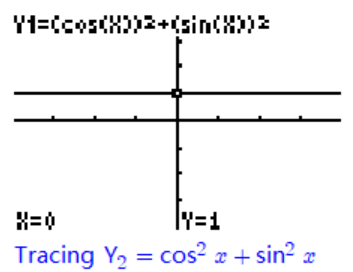
We can verify that this equation holds for all angles by graphing the expressions on either side of the equal sign. The graphs of these two functions in the ZTrig window are shown at right.
We see that the graph of appears identical to the horizontal line . In fact, the graphs are identical, and the equation is an identity. It is important enough to earn a special name.
As you might guess from its name, the Pythagorean identity is true because it is related to the Pythagorean theorem. We have not actually proved the identity, and a skeptical student may wonder if is only very close to , or if it equals for only some values of . Homework Problem 77 offers a proof of the Pythagorean identity.
Evaluate without using a calculator.
When we solve more complicated trigonometric equations in later chapters, we will need to simplify trigonometric expressions so that they involve only one of the trig functions. The Pythagorean identity is useful when we wish to write an equivalent expression for either or for . Note that we can write the identity in two alternate forms:
sinθ·cos²θ = sinθ − sin³θ, certified ✓ Computed · mojocas 0.1.0✓ Agrees with the text sinθ·cos²θ = sinθ − sin³θ, certified, computed exactly by mojocas 0.1.0, and confirmed to agree with the result stated in the text.The example that follows uses the Pythagorean identity to rewrite sinθ·cos²θ as sinθ − sin³θ. At build time a computer algebra system checks that the two expressions are genuinely equivalent — an identity, not just equal at the points a graph shows — and a rebuild in which the claim fails stops the build. That is the section's own test for an identity, run by machine on every rebuild.
In the previous Example, we have shown that
is an identity.
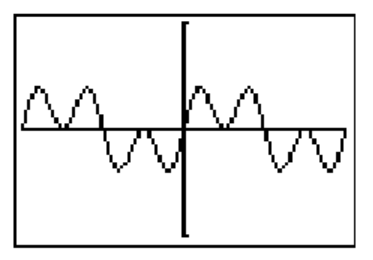
If we graph
for we see that they have the same graph, as shown in the figure.
Rewrite as an expression in .
Verify your identity by graphing.
Replace by to get and apply the distributive law to get .
Tangent Identity
There is also a relationship between the tangent ratio and the sine and cosine. Complete the following table with exact values. You should find that the entries in the last two columns are identical.
For the angles in the table,
Because , the quotient is undefined for , and is undefined, too. The same is true for . For all other angles between and , . A proof of the tangent identity is outlined in Homework Problem 78.
Now we can see how to use identities to simplify trigonometric expressions. One strategy for simplifying a trigonometric expression is to reduce the number of different trig ratios involved. We can use the tangent identity to replace the tangent ratio by sines and cosines.
cosθ·tanθ + sinθ = 2sinθ, certified ✓ Computed · mojocas 0.1.0✓ Agrees with the text cosθ·tanθ + sinθ = 2sinθ, certified, computed exactly by mojocas 0.1.0, and confirmed to agree with the result stated in the text.The strategy in action: replacing tanθ by sinθ/cosθ collapses cosθ·tanθ + sinθ to 2sinθ, the simplification the example derives. The CAS certifies the equivalence at build time (wherever tanθ is defined — the identity's own proviso), so the printed simplification carries a machine check that survives every rebuild.
Simplify the expression .
Multiply the binomials to obtain
Because , we can replace the second by , leaving us with
Finally, because , we are left with .
Trig Ratios are Related
All three of the trigonometric functions of an angle are related. If we know the value of one of the three, we can calculate the other two (up to sign) by using the Pythagorean and tangent identities. We do not need to find the angle itself in order to do this. We need only know in which quadrant the angle lies to determine the correct sign for the trig ratios.
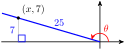
We can also work the previous Example by sketching an appropriate triangle. We begin by drawing an obtuse angle and its reference triangle. Because , we can choose a point on the terminal side to have -coordinate 7 and , as shown below. In order to calculate and , we must find the -coordinate of the point. By the Pythagorean theorem,
Note that is negative because the point is in the second quadrant. Then
If and find and .
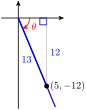
Find and by using an appropriate sketch.
, so . Thus, , and
Solving Equations
Now we'll see how identities are useful for solving trigonometric equations. So far we have only solved equations that involve a single trigonometric ratio. If the equation involves more than one trig function, we use identities to rewrite the equation in terms of a single trig function.
Solve for .
Replace by to get the equation
Solve this quadratic equation by factoring to find and . The solutions are , , and
Like the Pythagorean identity, the tangent identity can be helpful in solving trigonometric equations.
Solve for .
Because , the equation reduces to . The solutions are and .
Proving Identities
When we show that one trigonometric expression is equivalent to another expression, we have proved a trigonometric identity. In a previous example we proved that the equation
is an identity; it is true for all values of . A common strategy for proving an identity is to transform one side of the equation using equivalent expressions until it is identical to the other side. To help us choose the transformations at each step of the proof, we try to match the algebraic form of the final expression.
When you write out the proof of an identity, you should transform the expression on one side of the identity into the expression on the other side, showing one step of the calculation on each line of your proof. You can provide a justification for each step to the right of the calculation. The proof of the identity in the previous example would look like this:
Prove the identity
Review the following skills you will need for this section.
Section 5.3 Summary
Vocabulary
Conditional equation
Identity
Equivalent expressions
Concepts
An equation that is true only for certain values of the variable, and false for others, is called a conditional equation. An equation that is true for all legitimate values of the variables is called an identity.
The expressions on either side of the equal sign in an identity are called equivalent expressions, because they have the same value for all values of the variable.
We often use identities to replace one form of an expression by a more useful form.
To check to whether an equation is an identity we can compare graphs of (left side of the equation) and (right side of the equation). If the two graphs agree, the equation is an identity. If the two graphs are not the same, the equation is not an identity.
To solve an equation involving more than one trig function, we use identities to rewrite the equation in terms of a single trig function.
To prove an identity, we write one side of the equation in equivalent forms until it is identical to the other side of the equation.
Study Questions
What is the difference between a conditional equation and an identity? Give an example of each.
What happens when you try to "solve" an identity?
Explain how to use graphs to verify an identity.
Delbert claims that since , we can take the square root of both sides to get the simpler form . Is he correct? Why or why not?
If , is it necessarily true that and ? Explain. If , is it true that and ?
Skills
Recognize identities #1–16, 41–46
Verify identities #17–26, 73–78
Rewrite expressions using identities #27–34, 47–50
Use identities to evaluate expressions #35–40
olve trigonometric equations #51–58, 67–72
Given one trig ratio, find the others #59–72
Homework 5.3
For Problems 1–8, decide which of the following equations are identities. Explain your reasoning.
not an identity
not an identity
identity
not an identity
For Problems 9–16, use graphs to decide which of the following equations are identities.
not an identity
not an identity
identity
identity
For Problems 17–26, show that the equation is an identity by transforming the left side into the right side.
Multiply numerator and denominator of the left side by .
Multiply numerator and denominator of the left side by .
For Problems 27–34, simplify, using identities as necessary.
For Problems 35–40, evaluate without using a calculator.
For Problems 41–46, one side of an identity is given. Graph the expression, and make a conjecture about the other side of the identity.
For Problems 47–50, use identities to rewrite each expression.
as an expression in only
as an expression in only
as an expression in only
as an expression in only
For Problems 51–58, solve the equation for . Round angles to three decimal places if necessary.
For Problems 59–62, use identities to find exact values for the other two trig ratios.
and
and
and
and
For Problems 63–66, use the identity below to find the sine and cosine of the angle.
and
,
and
and
,
and
For Problems 67–72, find exact values for the sine, cosine, and tangent of the angle.
and
, ,
and
and
, ,
and
and
and
For Problems 73–76, prove the identity by rewriting tangents in terms of sines and cosines. (These problems involve simplifying complex fractions. See the Algebra Refresher to review this skill.)
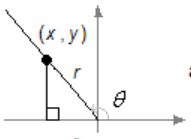
Prove the Pythagorean identity by carrying out the following steps. Sketch an angle in standard position, and label a point on the terminal side, at a distance from the vertex.
Begin with the equation , and square both sides.
Divide both sides of your equation from part (a) by .
Write the left side of the equation as the sum of the squares of two fractions.
Substitute the appropriate trigonometric ratio for each fraction.
By the distance formula, , or .
Prove the tangent identity by carrying out the following steps. Sketch an angle in standard position, and label a point on the terminal side, at a distance from the vertex.
Write in terms of and , and solve for .
Write in terms of and , and solve for .
Write in terms of and , then substitute your results from parts (a) and (b).
Simplify your fraction in part (c).
Trigonometry by Katherine Yoshiwara (yoshiwarabooks.org), GNU Free Documentation License 1.2 or later. Adapted for the XYZ HTML edition with the authors' permission (recorded 2026-07-04). License: GFDL-1.2-or-later.
These eBooks are a prerelease and are not yet certified conformant with WCAG 2.1 AA or ADA Title II. Every page is built against an automated accessibility gate, and the published editions will meet ADA Title II requirements when they release in late September 2026. If something is unusable, please tell us.