Now that we understand that trigonometric functions can be used to model rotations and cyclical behavior, we can begin to consider some applications. An important part of any model involves solving equations. In Chapter 4 we solved simple trigonometric equations, and now we are equipped to tackle more challenging ones.
You already know several algebraic techniques for solving equations of different types. But sometimes simple trial and error is the best approach.
Use trial and error to find a solution of the equation
Try small integer values for .
Another useful equation-solving method uses graphs.
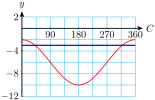
Use a graph to show that the equation has no real-valued solutions.
The graph does not cross the line .
Trigonometric Equations
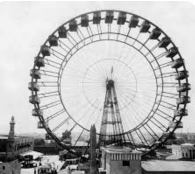
The first Ferris wheel was built for the Chicago World's Fair in 1893. It had a diameter of 250 feet and could carry 2160 people in 36 carriages. From the top of the wheel, passengers could see into four states. After loading all the passengers, the wheel made one revolution in nine minutes.
If you are in the bottom carriage of the Ferris wheel at the start of its revolution, your height after seconds is given by
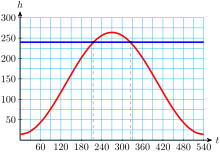
For how long are you more than 240 feet above the ground?
The figure below shows a graph of the height function and a horizontal line at .
From the graph, we see that at approximately 215 seconds (or 3 minutes and 35 seconds) and 325 seconds (or 5 minutes and 25 seconds) into the ride. Your height is more than 240 feet between those two times, or for about 110 seconds.
Solving Trigonometric Equations
In the example above, we used a graph to solve the equation , or
To find a more precise solution, we can use algebraic methods. To start, we'll solve the slightly simpler equation
We'll look for all solutions for between and . We begin by isolating the trigonometric ratio on one side of the equation.
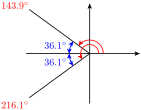
We have solved equations like this one before: we use the inverse cosine to solve for . Remember that there are two angles between and that have a cosine of , one in the second quadrant and one in the third quadrant. The calculator will give us only the second quadrant solution.
To find the second solution, we need the third-quadrant angle whose cosine is .
Now, the reference angle for is
and the angle in the third quadrant with the same reference angle is
(See the figure at right.) Thus, the other solution is .
To solve simple equations involving a single trigonometric ratio (either or ), we can follow the steps below.
To finish up our Ferris wheel example, we can replace by to get two equations:
Your height is above 240 feet between 215.35 seconds and 324.15 seconds. Our estimates from the graphical solutions were pretty good.
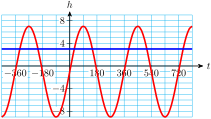
In the previous Example, we found two solutions of the equation . The equation actually has infinitely many solutions, as you can see in the figure below, which shows a graph of and the horizontal line . The line intersects the sine graph infinitely many times, twice in each cycle.
Each intersection represents a solution of the equation. Thus, all of the angles coterminal with and are also solutions. We can easily find these solutions by adding integer multiples of to or . This is why, when solving a trigonometric equation, we usually list only the solutions in one cycle, typically those between and .
Solve the equation for .
We first isolate the trig ratio to get . We recognize the special angle . Because the tangent is negative in the second and fourth quadrants, we find the solutions .
We can use a calculator to help us solve equations that do not involve special angles.
Solve the equation , for . Round your solutions to three decimal places.
We isolate the trig ratio to find , and . The second solution lies in the fourthe quadrant at .
Some trigonometric equations have no solution. As we can observe from their graphs or from their definitions, the sine and cosine functions only have values ranging from to .
Solve for .
Because cannot equal , there is no solution.
Graphical Solutions
Sometimes it is helpful to have a visual image of an equation, and we can use graphs to find approximate solutions.
Use a graph to verify your solutions to from Exercise.
The graphs intersect at about and about .
Equations with Squares of Trig Ratios
You know several techniques for solving quadratic equations. Simple quadratic equations can be solved by extracting roots. For example, to solve the equation
we first isolate :
and then take square roots of both sides to find
Recall that a quadratic equation may have two real solutions, one (repeated) real solution, or no real solutions. We can use extraction of roots to solve trigonometric equations as well.
Solve the equation for .
, , , or
Other quadratic equations can be solved by factoring. For example, we can solve the equation
by factoring the left side to get
Then we apply the Zero Factor Principle to set each factor equal to zero, and solve each equation.
The solutions are and .
Solve for . Round your answers to the nearest degree.
We first solve the equation by factoring:
,
so or . From the first equation we find and , and from the second euqtion we find and .
Snell's Law
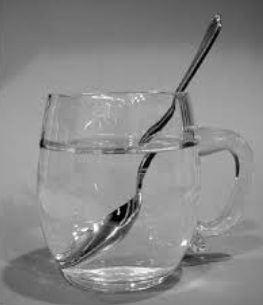
When you view an object through a liquid, such as a spoon in a glass of water, or a fish in an aquarium, the object may look distorted or bent. This distortion is caused by refraction of light. Light rays bend when they pass from one medium to another, for instance from water to glass or from glass to air.
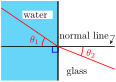
A light ray enters the boundary between the two media at a certain angle, called the angle of incidence, but leaves the boundary at a different angle, the angle of refraction. Both angles are acute angles measured from the normal line perpendicular to the boundary, as shown below.
The change of angle is caused by the fact that light travels at different speeds in different media. The relationship between the angle of incidence and the angle of refraction is given by Snell's Law:
where is the angle in the medium where light travels at speed , and is the angle where light travels at speed . The ratio of the speeds is called the index of refraction.
A light ray passes from water to glass with an angle of incidence. What is the angle of refraction?
Review the following skills you will need for this section.
Section 5.2 Summary
Vocabulary
Equation
Solve
Zero Factor Principle
Angle of incidence
Angle of refraction
Normal
Concepts
An equation is a statement that two algebraic expressions are equal. It may be true or false.
We can solve equations by trial and error, by using graphs, or by algebraic techniques.
To solve a trigonometric equation, we first isolate the trigonometric ratio on one side of the equation.
We use reference angles to find all the solutions between and .
We can use factoring or extraction of roots to solve some quadratic equations.
Study Questions
How many solutions between and does the equation have for each value of between -1 and 0?
How many solutions between and does the equation have for each value of greater than 1?
How many solutions between and does the equation have for each value of between -1 and 0?
Skills
Use reference angles #1–8
Solve equations by trial and error #9–14
Use graphs to solve equations #15–18, #39–52
Solve trigonometric equations for exact values #19–32, 39–46
Use a calculator to solve trigonometric equations #33–38, 47–52, 65–68
Solve trigonometric equations that involve factoring #53–64
Homework 5.2
For Problems 1–4, find the reference angle. (If you would like to review reference angles, see Section 4.1.)
For Problems 5–8, find an angle in each quadrant with the given reference angle.
I: II: III: IV:
I: II: III: IV:
For Problems 9–14,
Evaluate the expression at the given values of the variable.
Give one solution of the equation.
For Problems 15–18, use a graph to solve the equation. Check your solution by
substitution.
For Problems 19–32, solve the equation exactly for .
or
or
or
or
or
or
or
For Problems 33–38, solve the equation for . Round your answers to two decimal places.
or
or
or
For Problems 39–46,
Use a graph to estimate the solutions for angles between and .
Solve the equation algebraically.
or
or
or
For Problems 47–52,
Use a graph to estimate the solutions for angles between and .
Solve the equation algebraically, rounding angles to the nearest degree.
or
or
For Problems 53–64, solve the equation for . Round angles to two decimal places.
or
, , or
, , or
, , , or
, , , or
For Problems 65–68, use Snell's Law to answer the question.
A light ray passes from water to glass, with a angle of incidence. What is the angle of refraction?
A light ray passes from water to glass, with an angle of incidence. What is the angle of refraction?
A light ray passes from water to glass, with a angle of refraction. What is the angle of incidence?
A light ray passes from water to glass, with a angle of refraction. What is the angle of incidence?
Use your calculator to graph the function in the ZTrig window (press ), along with the horizontal line . Use the intersect feature to verify that the solutions of the equation differ by .
Repeat part (a) with the horizontal line to verify that the solutions of the equation differ by .
What is the angle in the third quadrant with reference angle ? Show this angle differs from by . Explain how this fact shows that the solutions of , for , differ by .
What is the angle in the second quadrant with reference angle ? What is the angle in the fourth quadrant with reference angle ? Show that these two angles differ by . Explain how this fact shows that the solutions , for , differ by .
Trigonometry by Katherine Yoshiwara (yoshiwarabooks.org), GNU Free Documentation License 1.2 or later. Adapted for the XYZ HTML edition with the authors' permission (recorded 2026-07-04). License: GFDL-1.2-or-later.
These eBooks are a prerelease and are not yet certified conformant with WCAG 2.1 AA or ADA Title II. Every page is built against an automated accessibility gate, and the published editions will meet ADA Title II requirements when they release in late September 2026. If something is unusable, please tell us.