
4.1 Angles and Rotation
Introduction
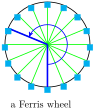
So far we have studied angles as parts of triangles, but we can also use angles to describe rotation. For example, think of the minute hand on a clock. Every hour, the minute hand moves through one complete rotation, or . In two hours, the minute hand rotates through .
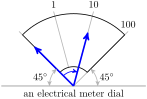
The volume control on an amplifier is a dial with ten settings, as shown at right. Through how many degrees would you rotate the dial to increase the volume level from 0 to 7?
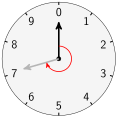
of , or
Angles in Standard Position
The degree measure of an angle depends only on the fraction of a whole rotation between its sides, and not on the location or position of the angle. To compare and analyze angles, we place them in standard position, so that the vertex of the angle is located at the origin and its initial side lies on the positive -axis. If the terminal side rotates counter-clockwise, the degree measure of the angle is positive; it is negative if the terminal side rotates clockwise. The figure below shows four angles and how each appears in standard position.
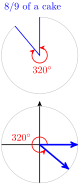
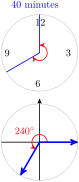
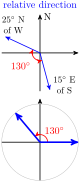
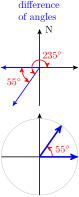
One-half a complete revolution is , and three-quarters of one revolution is . Thus, for angles between and in standard position, the terminal side lies in the third quadrant, and for angles between and , the terminal side lies in the fourth quadrant.
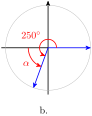
Find the degree measure of each angle below, and sketch the angle in standard position.
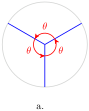
a.

b.

Trigonometric Ratios for All Angles
In Chapter 3 we defined the sine, cosine, and tangent for obtuse angles by placing the angle in a Cartesian coordinate system. We can do the same for angles that represent rotations.
- First, we place the angle in standard position, with its vertex at the origin. We picture the terminal side sweeping counter-clockwise around a circle to form the angle.
- Next, we choose a point with coordinates on the terminal side, as shown at right. The distance from the origin to is then . The trigonometric ratios of are defined as follows.
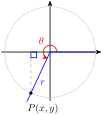
We can choose any point on the terminal side of the angle, and the trig ratios defined by its coordinates will be the same. (Can you explain why? Think about similar triangles.) And, as we noted when we first defined the trig ratios, they are functions of the input angle, so there is only one sine, cosine, or tangent for a given angle.
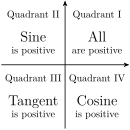
Because it is the distance from the origin to , is always positive. However, and can be positive or negative (or zero), depending on the angle . For example, in the second quadrant, is negative but is positive, so the cosine and the tangent of angles between and are negative, but their sines are positive.
For angles in each of the four quadrants shown below, explain why the indicated trig ratios are positive. Then complete the table.
| Quadrant | Degrees | Sine | Cosine | Tangent |
|---|---|---|---|---|
| First | positive | positive | positive | |
| Second | ||||
| Third | ||||
| Fourth |
| Quadrant | Degrees | Sine | Cosine | Tangent |
|---|---|---|---|---|
| First | positive | positive | positive | |
| Second | positive | negative | negative | |
| Third | negative | negative | positive | |
| Fourth | negative | positive | negative |
Find the sine, cosine, and tangent of the angle shown at right. The circle has radius 4.

We know that and , so
Thus,
Reference Angles
In Section 3.1 we learned that the trig ratios for angles in the second quadrant are the same as the trig ratios for their supplements, except for sign. For example, you can use your calculator to verify that
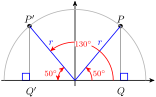
The trig ratios for and have the same absolute value because the two triangles formed by the angles are congruent, as shown above.
is called a reference triangle for , and is called the reference angle.
The trig ratios for angles between and , whose terminal sides lie in the third and fourth quadrants, are also related to the trig ratios of familiar angles in the first quadrant. We "refer" the angle to a first quadrant angle with a congruent reference triangle.
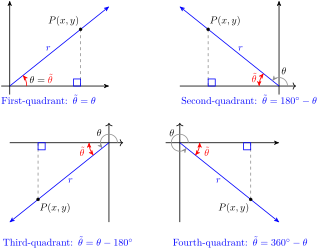
We can construct reference triangles for angles in any of the four quadrants, and the trig ratios of the angle are the same as the trig ratios of its reference angle, up to sign. Here is how to construct a reference triangle for an angle:
The figure below shows angles between and , and the reference angle, , for each. Study the figures, and make sure you understand the formula for finding the reference angle in each quadrant.
- Find the reference angle for .
- Sketch and its reference angle in standard position, along with their reference triangles. Verify that both angles have the same trigonometric ratios, up to sign.
- The terminal side of an angle of lies in the fourth quadrant, so its reference angle is
Using Reference Angles
Here is a summary of our discussion about reference angles.
Any acute angle is the reference angle for four angles between and , one in each quadrant. The figure below shows the four angles in standard position whose reference angle is . Note that each angle is found by measuring from the -axis in the appropriate quadrant, and that the four angles together make a “bow-tie” shape.
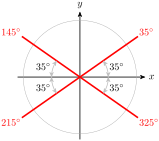
From the figure, you can see that the angles in each quadrant with a given reference angle are computed as follows.
- Find an angle in the third quadrant whose tangent is . Round your answer to the nearest tenth of a degree.
- Use reference angles to find two angles whose tangent is .
- . The angle in the third quadrant with reference angle is
- The tangent is negative in the second and fourth quadrants, and the angles in those quadrants with reference angle are and
The Special Angles
Recall that the angles and are called the special angles because we can express the exact values of their trigonometric ratios in terms of radicals. There are special angles in all four quadrants; namely, those whose reference angles are and .
- Sketch an angle of in standard position, and its reference triangle. Find the reference angle for .
- Find exact values for the sine, cosine, and tangent of .
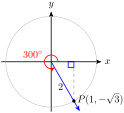
Reference angle:
- , ,
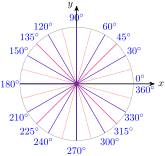
All of the special angles are shown at right. In the Homework Problems you will calculate the three trigonometric ratios for all the special angles, and it will be useful to be familiar with these values, and be able to calculate them quickly. You may want to review the two "special triangles" in Section 2.3.
Coterminal Angles
Because represents one complete revolution, we can add or subtract a multiple of to any angle, and the terminal side will arrive at the same position. For example, the angles and have the same terminal side because . Such angles are called coterminal.
The angle is also coterminal with , because if we add two revolutions to , we get , as shown below.
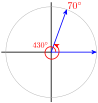
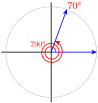
Because coterminal angles have the same standard position, their trigonometric ratios are equal. For example, you can verify that, to four decimal places,
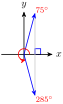
If the direction of rotation is important, we let positive angles represent rotation in the counter-clockwise direction, and negative angles represent rotation in the clockwise direction. For example, the angle shown at right lies in the fourth quadrant. It is coterminal with .

Find two angles coterminal with , one positive and one negative.
Add to get , and subtract to get
Review the following skills you will need for this section.
Section 4.1 Summary
Vocabulary
- Standard position
- Reference angle
- Reference triangle
- Coterminal angle
Concepts
- We can use angles to describe rotation. Positive angles indicate rotation in the counter-clockwise direction; negative angles describe clockwise rotation.
- We define the trigonometric ratios of any angle by placing the angle in standard position and choosing a point on the terminal side, with .
- To construct a reference triangle for an angle:
- Choose a point on the terminal side.
- Draw a line from point perpendicular to the -axis.
- The reference angle for is the positive acute angle formed between the terminal side of and the -axis.
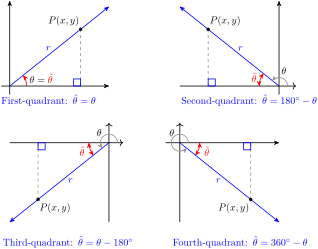
- The trigonometric ratios of any angle are equal to the ratios of its reference angle, except for sign. The sign of the ratio is determined by the quadrant.
-
>
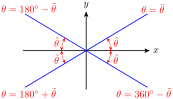
- There are always two angles between and (except for the quadrantal angles) with a given trigonometric ratio.
- Coterminal angles have equal trigonometric ratios.
Study Questions
- Explain why for any angle .
- Is it true that for any angle ? Explain.
- Sketch a figure showing how to compute the reference angle for angles in each of the four quadrants.
- True or false: If , then .
- How many angles have a cosine equal to 0.4? How many angles between and have a cosine equal to 0.4?
Skills
- Use angles to represent rotations #1-6
- Sketch angles in standard position #7-12
- Find coterminal angles #13-24
- Find and use reference angles #25-44, 55-64
- Find trigonometric ratios for the special angles #45-54
Homework 4.1
How many degrees are in each angle?
- of one rotation
- of one rotation
- of one rotation
- of one rotation
How many degrees are in each angle?
- of one rotation
- of one rotation
- of one rotation
- of one rotation
What fraction of a complete rotation is represented by each angle?
What fraction of a complete rotation is represented by each angle?
- Through what angle does the hour hand of a clock rotate between 2 pm and 10 pm?
- Through what angle does the hour hand of a clock rotate between 2 am and 10 pm?
- Through what angle does the minute hand of a clock rotate between 3:25 am and 3:50 am?
- Through what angle does the minute hand of a clock rotate between 4:10 pm and 6:25 pm?
For Problems 7–12, calculate the degree measure of the unknown angle, and sketch the angle in standard position.
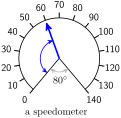
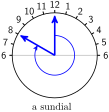
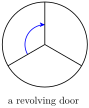
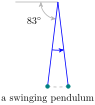
For Problems 13–18, find two angles, one positive and one negative, that are coterminal with the given angle.
and (Answers vary.)
and (Answers vary.)
and (Answers vary.)
For Problems 19–24, find a positive angle between and that is coterminal with the given angle.
For Problems 25–26, use the grid provided below.
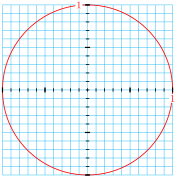
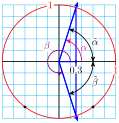
Draw two different angles and in standard position whose sine is . Note that the radius of the circle is 1,
- Use a protractor to measure and .
- Find the reference angles for both and . Draw in the reference triangles.
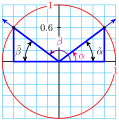
Draw two different angles and in standard position whose sine is .
- Use a protractor to measure and .
- Find the reference angles for both and . Draw in the reference triangles.
For Problems 27–28, use the grid provided below.
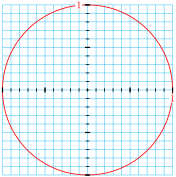
Draw two different angles and in standard position whose cosine is .
- Use a protractor to measure and .
- Find the reference angles for both and . Draw in the reference triangles.
Draw two different angles and in standard position whose cosine is .
- Use a protractor to measure and .
- Find the reference angles for both and . Draw in the reference triangles.
For Problems 29–34, find the reference angle. Make a sketch showing the angle, the reference angle, and the reference triangle.


For Problems 35–40, find three angles between and with the given reference angle, and sketch all four angles on the same grid.
, ,

, ,

, ,

For Problems 41–48, use the values given below to find the trigonometric ratio. Do not use a calculator!
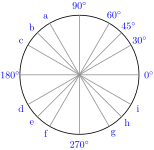
On the circle in the figure, all angles are shown in standard position. Find the measure in degrees of the angles labeled (a)-(i).
Find the reference angle for each of your answers in Problem 45.
- Draw three angles, one in each quadrant except the first, whose reference angle is .
- Find exact values for the sine, cosine, and tangent of each of the angles in part (a).

- Draw three angles, one in each quadrant except the first, whose reference angle is .
- Find exact values for the sine, cosine, and tangent of each of the angles in part (a).
- Draw three angles, one in each quadrant except the first, whose reference angle is .
- Find exact values for the sine, cosine, and tangent of each of the angles in part (a).

Complete the table with exact values.
In which two quadrants is the statement true?
- The sine is negative.
- The cosine is negative.
- The tangent is positive.
- III and IV
- II and III
- I and III
Find all angles between and for which the statement is true.
- Find two angles, , with .
- Find two angles, , with .
- Find two angles, , with .
- Find two angles, , with .
For Problems 59–64, find a second angle between and with the given trigonometric ratio.
Explain why the definitions of the trigonometric ratios for a third-quadrant angle (between and ) are independent of the point chosen on the terminal side. Illustrate with a figure.
Sides of similar triangles are proportional.
Explain why the definitions of the trigonometric ratios for a fourth-quadrant angle (between and ) are independent of the point chosen on the terminal side. Illustrate with a figure.
Trigonometry by Katherine Yoshiwara (yoshiwarabooks.org), GNU Free Documentation License 1.2 or later. Adapted for the XYZ HTML edition with the authors' permission (recorded 2026-07-04). License: GFDL-1.2-or-later.