
3.2 The Law of Sines
We have learned to use the trigonometric ratios to solve right triangles. But the trig ratios are only valid for the sides of right triangles. Can we find unknown sides or angles in an oblique triangle?
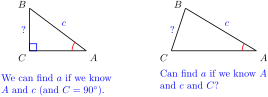
In this section and the next we find relationships among the sides and angles of oblique triangles. These relationships are called the Law of Sines and the Law of Cosines. To derive these new rules, we use what we already know about right triangles.
Consider the oblique triangle below. By drawing in the altitude of the triangle, we create two right triangles, and , as shown in the figure. Now we can write expressions in terms of for and for .
Looking at , we see that
Looking at , we see that
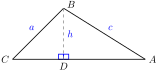
Now we solve each of these equations for :
We have derived a relationship between the angles and and their opposite sides, and . If we know any three of these quantities, we can find the fourth.
In a similar way, by drawing in the altitude from the vertex , we can show that
Putting both results together, we have the Law of Sines. The Law of Sines is true for any triangle, whether it is acute, right, or obtuse.
Finding a Side
In the next example, we use the Law of Sines to find a distance.
Delbert and Francine are 40 feet apart on one side of a river. They make angle measurements to a pine tree on the opposite shore as shown below. What is the distance from Francine to the pine tree?
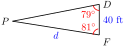
The angle at is . Now we can use the Law of Sines:
Solving for we find the distance is about 114.8 feet.
Solving Triangles with the Law of Sines
In order to apply the Law of Sines to find a side, we must know one angle of the triangle and its opposite side (either and , or and , or and ), and one other angle. Then we can find the side opposite that angle.
In the triangle at right,
Solve the triangle.
(Hint: Which side will you find first?)
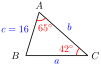
First use the Law of Sines to find .
Solving for we find . Next we find angle .
Finally, we use the Law of Sines to find .
Solving this equation, we find .
Finding an Angle
We can also use the Law of Sines to find an unknown angle of a triangle. We must know two sides of the triangle and the angle opposite one of them.
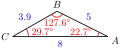
Sketch a triangle with , and .
- Use the Law of Sines to find another angle of the triangle.
- Solve the triangle, and label your sketch with the results.
- We can use the Law of Sines to find angle . Solve for to find , so . (Note that the supplement of , or , is too large to fit in the triangle because .)
- Now we can find angle , and use the Law of Sines again to find .
Suppose that , and .
- Find two possible values for angle .
- Solve the triangle for both values of , and sketch both solutions.
- From the Law of Sines we find so and or
- In each case, we find angle and then use the Law of Sines to find side .

or
Applications
In the next example, we use two triangles to solve the problem.
Solve the problem in the previous example again, but instead of finding , find the length , and then use to find .
We know that angle is the supplement of angle , or . We can use the Law of Sines to find side , and then use the tangent of to find . The castle is about 38.33 yards tall.
Measuring Astronomical Distances
If you look at a nearby object and alternately close your left and right eyes, the object seems to jump in position. This apparent change occurs because your eyes are viewing the object from two different positions spaced several centimeters apart. If the object at point is straight ahead of one eye, it appears to be at some angle away from the line of sight of the other eye. The angle is called the parallax of the object.
Use the figure below to see that is also the angle between the directions to your two eyes when viewed from point . (What fact from geometry justifies this statement?)
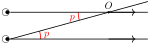
Astronomers use parallax to determine the distance from earth to stars and other celestial objects. Two observers on Earth at a known distance apart both measure the direction to the star. The difference in angle between those two directions is the parallax.
Two observers 800 kilometers apart observe an object with a parallax of . How far is the object from Earth?
The base angles of the parallax triangle are both . Now use the Law of Sines to find the equal sides of the triangle. The object is about 91,673,247 km from Earth.
Small Angles: Minutes and Seconds
To obtain the most accurate parallax measurements, the distance between the two observers should be as large as possible. But even measured from opposite sides of Earth's orbit, stars outside the solar system have parallaxes much smaller than .
In order to handle such small angles, we divide degrees into smaller units called minutes and seconds. One minute is of a degree, and 1 second is of a minute, or of a degree. We use the following notation for minutes and seconds.
When describing large distances, astronomers sometimes use the distance from Earth to the Sun, about 93 million miles, as the unit of measurement. This distance is called 1 Astronomical Unit, or 1 AU. For example, an object that is three times as far away as the Sun would be at a distance of 3 AU.
Two observers are 1 AU (astronomical unit) apart. They find that the parallax to a distant star is . What is the distance to the star, in astronomical units?
(This distance is called a parsec. In other words, a parsec is the distance at which the parallax from observations 1 AU apart is . In this Exercise, you are calculating the number of astronomical units in 1 parsec.)
1 parsec AU
Review the following skills you will need for this section.
Section 3.2 Summary
Vocabulary
- Parallax
- Minute
- Second
Concepts
- We can use the Law of Sines to find an unknown side in an oblique triangle. We must know the angle opposite the unknown side, and another side-angle pair.
- We can also use the Law of Sines to find an unknown angle of a triangle. We must know two sides of the triangle and the angle opposite one of them.
- Remember that there are two angles with a given sine. When using the Law of Sines, we must check whether both angles result in possible triangles.
- We use minutes and seconds to measure very small angles.
Study Questions
- Can we use the Law of Sines to solve a right triangle?
- Explain why we cannot use the Law of Sines to solve the triangle with and .
- Francine says "I'm thinking of an angle whose sine is (rounded to four decimal places)." Delbert says "The angle must be (rounded to the nearest degree)." Is he correct? Why or why not?
- Sketch two possible triangles with , and .
- Try to sketch a triangle with , and . What went wrong?
Skills
- Use the Law of Sines to find a side #1-6
- Use the Law of Sines to find an angle #7-12
- Use the Law of Sines to solve an oblique triangle #13-18
- Solve problems using the Law of Sines #19-28
- Compute distances using parallax #29-32
- Solve problems involving the ambiguous case #33-46
Homework 3.2
For Problems 1–6, use the Law of Sines to find the indicated side. Round to two decimal places.


For Problems 7–12, use the Law of Sines to find the indicated angle. Round to two decimal places.
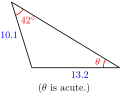
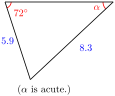
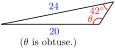
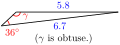


For Problems 13–18, sketch the triangle and solve. Round answers to two decimal places.

, ,

, ,

, ,
For Problems 19–26,
- Sketch and label a triangle to illustrate the problem.
- Solve the problem.
Maryam wants to know the height of a cliff on the other side of a ravine. The angle of elevation from her edge of the ravine to the cliff top is . When she moves 30 feet back from the ravine, the angle of elevation is . How tall is the cliff?
a.

b. 808.1 ft
Amir wants to know the height of a tree in the median strip of a highway. The angle of elevation from the highway shoulder to the treetop is . When he moves 10 feet farther away from the tree, the angle of elevation is . How tall is the tree?
Delbert and Francine are 10 kilometers apart, both observing a satellite that passes directly over their heads. At a moment when the satellite is between them, Francine measures its angle of elevation as , and Delbert measures an angle of . How far is the satellite from Delbert?
a.

b. 68.2 km
Megan rows her kayak due east. When she began, she spotted a lighthouse 2000 meters in the distance at an angle of south of east. After traveling for of an hour, the lighthouse was at an angle of south of east. How far did Megan travel, and what was her average speed?
Chad is hiking along a straight path but needs to detour around a large pond. He turns from his path until clear of the pond, then walks back to his original path, intercepting it at an angle of and at a distance of 2 miles from where he had left the path. How far did Chad walk in each of the two segments of his detour, and how much farther did his detour require compared with a straight line through the pond?
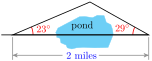
a.

b. 1.23 mi 0.99 mi; 0.22 mi
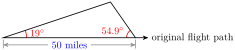
Bob is flying to Monterey but must change course to avoid a storm. He flies off from his original direction until he clears the storm, then turns again to return back to his original flight path, intercepting it at an angle of and at a distance of 50 miles from where he had left it. How much farther did his detour require compared with his original course?
Geologists find an outcropping from an underground rock formation that normally indicates the presence of oil. The outcropping is on a hillside, and the formation itself dips another from the surface. If an oil well is placed 1000 meters downhill from the outcropping, how far will the well have to drill before it reaches the formation?
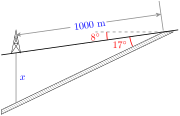
a.
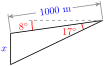
b. 322.6 m
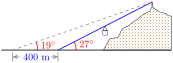
A proposed ski lift will rise from point near the base of the slope with an angle of . At a distance of 400 meters further from the slope, the angle of elevation to the top of the ski lift is . How long is the ski lift?
Thelma wants to measure the height of a hill. She first plants a 50 foot tall antenna at the hill's peak. Then she descends the hill and finds a point where she can see the top and the bottom of the antenna. The angle of elevation to the bottom of the antenna is , and the angle of elevation to the top of the antenna is .
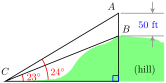
- Find .
- Find, at the top of the antenna.
- How long is , the distance from the bottom of the antenna to ?
- How tall is the hill?
- 2617.2 ft
- 1022.6 ft
A billboard of California's gubernatorial candidate Angelyne is located on the roof of a building. At a distance of 180 feet from the building, the angles of elevation to the bottom and top of the billboard are respectively and . How tall is the billboard?
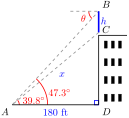
For Problems 29–32, compute the following distances in Astronomical Units. Then convert to kilometers, using the fact that 1 AU km.
When observed from opposite sides of Earth's orbit, the star Alpha Centauri has a parallax of . How far from the Sun is Alpha Centauri?
540,000 AU km
How far from the Sun is Barnard's star, which has a parallax of when observed at opposite ends of Earth's orbit?
How far from the Sun is Tau Ceti, which has a parallax of when observed from opposite ends of Earth's orbit?
750,000 AU km
How far from the Sun is Sirius, which has a parallax of when observed from opposite ends of Earth's orbit?
Problems 33–38 consider the ambiguous case of the Law of Sines, when two sides and an angle opposite one of them are known.
In the right triangle shown, , and inches.
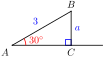
- Use the definition of to solve for (the length of side ).
- Can you draw a triangle with and if ? Why or why not?
- How many triangles are possible if ?
- How many triangles are possible if ?
- No, is too short.
- 2
- 1
In this problem we show that there are two different triangles with and .
- Use a protractor to draw an angle . Mark point on one side of the angle so that is 3 inches long.
- Locate two distinct points on the other side of the angle that are each 2 inches from point . These points are both possible locations for point .
- Use the Law of Sines to find two distinct possible measures for .
In and . How many triangles are possible for each of the following lengths for side ? Sketch the solutions in each case.
- 1,
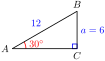
- 0,
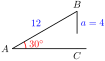
- 2,
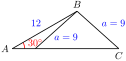
- 1,
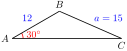
Consider the triangle shown below.
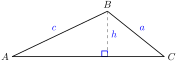
- Express the length of the altitude in terms of and .
- Now suppose we keep and side fixed, but allow to vary in length. What is the smallest value can have and still be long enough to make a triangle?
- What are the largest and smallest values that can have in order to produce two distinct triangles (without changing and side )?
For the triangle in Problem 36, suppose and .
- Sketch and solve the triangle if .
- Sketch and solve the triangle if .
- Sketch and solve the triangle if .
- For what value of is the hypotenuse of a right triangle?
- or
- no solution
- 5.14
For the figure in Problem 36, suppose and .
- For what value of is the triangle a right triangle?
- For what values of are there two solutions for the triangle?
- For what values of is there one obtuse solution for the triangle?
- For what value of is there no solution?
For Problems 39–42, find the remaining angles of the triangle. Round answers to two decimal places. (These problems involve the ambiguous case.)
or
Delbert and Francine are 1000 yards apart. The angle Delbert sees between Francine and a certain tree is . If the tree is 800 yards from Francine, how far is it from Delbert? (There are two possible answers.)
1299 yd or 277.2 yd
From the lookout point on Fabrick Rock, Ann can see not only see the famous "Crooked Spire" in Chesterfield, which is 8 miles away, but also the red phone box in the village of Alton. Chesterfield and Alton are 7 miles apart. Fabrick Rock has a plaque that shows directions to famous sites, and from the plaque Ann determines that the angle between the lines to the spire and the phone box measures . How far is Fabrick Rock from the phone box? (There are two possible answers.)
- Sketch a triangle with , and .
- Use the Law of Sines to find .
- Use the Law of Sines to find .
- Find without using the Law of Sines. (Hint: Sketch the altitude, , from to make two right triangles. Find , then use to find .)
- 11.79
- 24.16
- 24.16
- Sketch a triangle with , and .
- Use the Law of Sines to find .
- Find without using the Law of Sines.
Problems 47–48 prove the Law of Sines using the formula for the area of a triangle. (See Section 3.1 for the appropriate formula.)
Sketch a triangle with angles and and opposite sides of lengths respectively and .
- Write the area of the triangle in terms of , and angle .
- Write the area of the triangle in terms of , and angle .
- Write the area of the triangle in terms of , and angle .

Equate the three different expressions from Problem 47 for the area of the triangle. Multiply through by and simplify to deduce the Law of Sines.
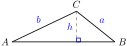
Here is a method for solving certain oblique triangles by dividing them into two right triangles. In the triangle shown, we know two angles, and , and the side opposite one of them, say . We would like to find side .
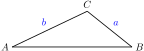
- Draw the altitude from angle .
- Write an expression for in terms of and angle .
- Write an expression for in terms of angle .
- Substitute your expression for into your expression for .
- Which of the following is equivalent to the formula you wrote in part (d)?
- ii
Trigonometry by Katherine Yoshiwara (yoshiwarabooks.org), GNU Free Documentation License 1.2 or later. Adapted for the XYZ HTML edition with the authors' permission (recorded 2026-07-04). License: GFDL-1.2-or-later.