
3.1 Obtuse Angles
The town of Avery lies 48 miles due east of Baker, and Clio is 34 miles from Baker, in the direction west of north. How far is it from Avery to Clio?
We know how to solve right triangles using the trigonometric ratios. But the triangle formed by the three towns is not a right triangle, because it includes an obtuse angle of at , as shown in the figure.
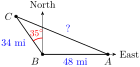
A triangle that is not a right triangle is called an oblique triangle. In this chapter we learn how to solve oblique triangles using the laws of sines and cosines. But first we must be able to find the sine, cosine, and tangent ratios for obtuse angles.
Angles in Standard Position
To extend our definition of the trigonometric ratios to obtuse angles, we use a Cartesian coordinate system. We put an angle in standard position as follows:
- Place the vertex at the origin with the initial side on the positive -axis;
- the terminal side opens in the counter-clockwise direction.
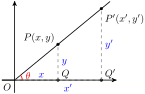
- We choose a point on the terminal side of the angle, and form a right triangle by drawing a vertical line from to the -axis.
The length of the side adjacent to is the -coordinate of point , and the length of the side opposite is the -coordinate of . The length of the hypotenuse is the distance from the origin to , which we call . With this notation, our definitions of the trigonometric ratios are as follows.
It doesn't matter which point on the terminal side we use to calculate the trig ratios. If we choose some other point, say , with coordinates , as shown at right, we will get the same values for the sine, cosine and tangent of . The new triangle formed is similar to the first one, so the ratios of the sides of the new triangle are equal to the corresponding ratios in the first triangle.
- Find the equation of the terminal side of the angle in the previous example. (Hint: The terminal side lies on a line that goes through the origin and the point .)
- Show that the point also lies on the terminal side of the angle.
- Compute the trig ratios for using the point instead of .
- satisfies , that is, the equation is true.
- , so Then
Trigonometric Ratios for Obtuse Angles
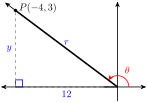
Our new definitions for the trig ratios work just as well for obtuse angles, even though is not technically “inside” a triangle, because we use the coordinates of instead of the sides of a triangle to compute the ratios.
Notice first of all that because -coordinates are negative in the second quadrant, the cosine and tangent ratios are both negative for obtuse angles. For example, in the figure below, the point lies on the terminal side of the angle . We see that , so
- Sketch an obtuse angle whose cosine is .
- Find the sine and the tangent of .
By the Pythagorean theorem,
, so .

Using a Calculator
In the Examples above, we used a point on the terminal side to find exact values for the trigonometric ratios of obtuse angles. Scientific and graphing calculators are programmed with approximations for these trig ratios.
Use your calculator to fill in the table. Round to four decimal places.
Trigonometric Ratios for Supplementary Angles
The Examples above illustrate the following equations for supplementary angles. These three equations are called identities, which means that they are true for all values of the variable .
Find two different angles that satisfy .
One angle is . The second angle is the supplement of , or .
Because there are two angles with the same sine, it is easier to find an obtuse angle if we know its cosine instead of its sine.
- Find the cosine of an obtuse angle with .
- Find the angle in part (a).
- The point lies on the terminal side of the angle, so and . Then .
Supplements of the Special Angles
In Chapter 2 we learned that the angles and are useful because we can find exact values for their trigonometric ratios. The same is true for the supplements of these angles in the second quadrant, shown at right.
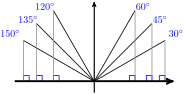
Find exact values for the trigonometric ratios of and .
is the supplement of , and is the supplement of .
We can also find the trig ratios for the quadrantal angles. These are the angles, including , and , whose terminal sides lie on one of the axes.
Find exact values for the trigonometric ratios of .
The point lies on the terminal side of the angle . Thus
The Area of a Triangle
The figure below shows part of the map for a new housing development, Pacific Shores. You are interested in the corner lot, number 86, and you would like to know the area of the lot in square feet. The sales representative for Pacific Shores provides you with the dimensions of the lot, but you don't know a formula for the area of an irregularly shaped quadrilateral.
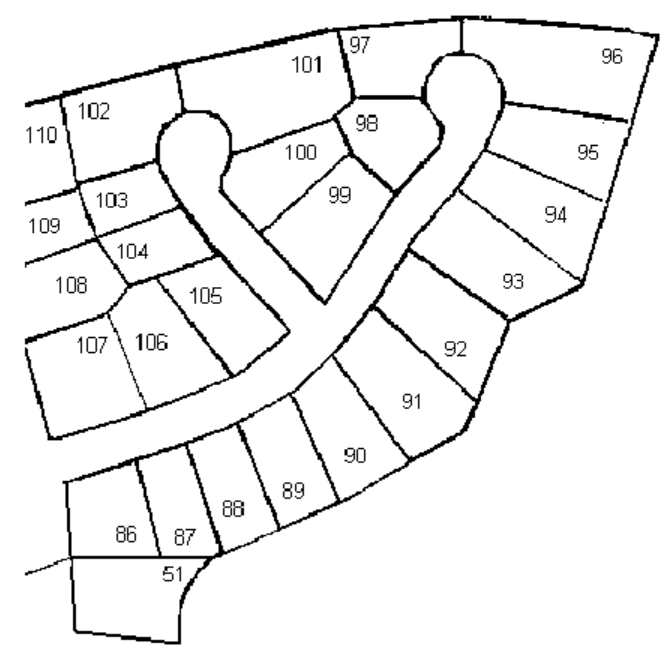
It occurs to you that you can divide the quadrilateral into two triangles, and find the area of each. Now, you know a formula for the area of a triangle in terms of its base and height, namely,
,
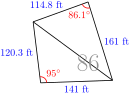
but unfortunately, you don't know the height of either triangle.
However, you can easily measure the angles at the corners of the lot using the plot map and a protractor. You can check the values on the plot map for lot 86 shown above.
Using trigonometry, we can find the area of a triangle if we know two of its sides, say and , and the included angle, . The figure below shows three possibilities, depending on whether the angle is acute, obtuse, or .
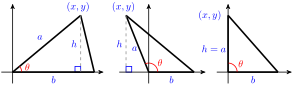
In each case, is the base of the triangle, and its altitude is . Our task is to find an expression for in terms of the quantities we know: , , and . You should check that in all three triangles
Solving for gives us . Finally, we substitute this expression for into our old formula for the area to get
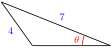
A triangle has sides of length 6 and 7, and the angle between those sides is . Find the area of the triangle.
The area is given by
Review the following skills you will need for this section.
Section 3.1 Summary
Vocabulary
- Standard position
- Initial side
- Terminal side
- Quadrantal angle
- Oblique triangle
- Quadrilateral
- Identity
Concepts
- We put an angle in standard position by placing its vertex at the origin and the initial side on the positive -axis.
- There are always two (supplementary) angles between and that have the same sine. Your calculator will only tell you one of them.
Study Questions
- Delbert says that in the figure. Is he correct? Why or why not?
- Give the lengths of the legs of each right triangle.
a.

b.

- Explain why the length of the horizontal leg of the right triangle is .
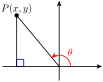
- Why are the sines of supplementary angles equal, but the cosines are not? What about the tangents of supplementary angles?
- Use your calculator to evaluate , then evaluate . Explain the result.
Write an expression for the area of the triangle.

Skills
Practice each skill in the Homework Problems listed.
- Use the coordinate definition of the trig ratios #3-20, 45-48
- Find the trig ratios of supplementary angles #7-10, 21-38
- Know the trig ratios of the special angles in the second quadrant #21, 41-44
- Find two solutions of the equation #29-38
- Find the area of a triangle #49-58
Homework 3.1
Without using pencil and paper or a calculator, give the supplement of each angle.
Without using pencil and paper or a calculator, give the complement of each angle.
For Problems 3–6,
- Give the coordinates of point on the terminal side of the angle.
- Find the distance from the origin to point .
- Find and


For Problems 7–10,
- Find the sine and cosine of the angle.
- Sketch the supplement of the angle in standard position. (Use congruent triangles.)
- Find the sine and cosine of the supplement.
- Find the angle and its supplement, rounded to the nearest degree.
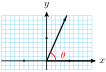
- ,
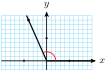
- ,
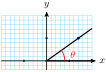
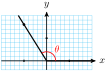
- ,
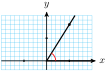
- ,
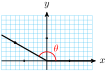
For Problems 11–20,
- Sketch an angle in standard position with the given properties.
- Find and
- Find the angle , rounded to tenths of a degree.
The point is on the terminal side.
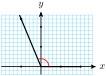
- , ,
The point is on the terminal side.
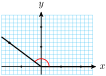
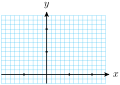
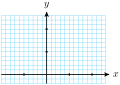
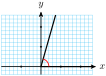
- ,
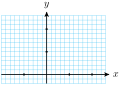
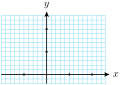
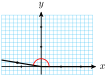
- ,
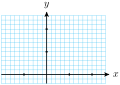
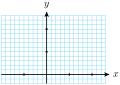
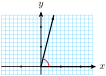
- ,
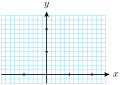
Fill in exact values from memory without using a calculator.
Use your calculator to fill in the table. Round values to four decimal places.
For each angle in the table for Problem 22, the angle is also in the table.
- What is true about and ?
- What is true about and ?
- What is true about and ?
Describe and explain any patterns of equal values you see in the table for Problem 22.
For Problems 25–28,
- Evaluate each pair of angles to the nearest , and show that they are supplements.
- Sketch both angles.
- Find the sine of each angle.
,
,
,
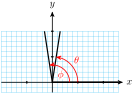
,
For Problems 29–34, find two different angles that satisfy the equation. Round to the nearest .
and
and
and
For Problems 35–38, fill in the blanks with complements or supplements.
If , then also, , and .
, ,
If , then also, , and .
If , then , and and both equal .
, ,
If , then , and and both equal .
- Sketch the line .
- Find two points on the line with positive -coordinates.
- The line makes an angle with the positive -axis. What is that angle?
- Repeat parts (a) through (c) for the line , except find two points with negative -coordinates.
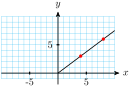
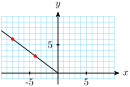
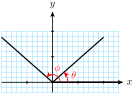
- Sketch the line .
- Find two points on the line with positive -coordinates.
- The line makes an angle with the positive -axis. What is that angle?
- Repeat parts (a) through (c) for the line , except find two points with negative -coordinates.
For Problems 41–44,
- Find exact values for the base and height of the triangle.
- Compute an exact value for the area of the triangle.
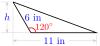
- in, in
- sq in
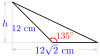
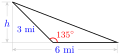
- mi, mi
- sq mi
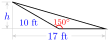
Sketch an angle of in standard position. Find the missing coordinates of the points on the terminal side.
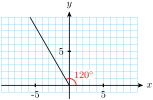
Sketch an angle of in standard position. Find the missing coordinates of the points on the terminal side.
Sketch an angle of in standard position. Find the missing coordinates of the points on the terminal side.
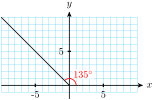
- Use a sketch to explain why .
- Use a sketch to explain why .
For Problems 49–54, find the area of the triangle with the given properties. Round your answer to two decimal places.

sq m


sq cm

m, m,
Find the area of the regular pentagon shown at right. (Hint: The pentagon can be divided into five congruent triangles.)

sq units
Find the area of the regular hexagon shown at right. (Hint: The hexagon can be divided into six congruent triangles.)

For Problems 57 and 58, lots from a housing development have been subdivided into triangles. Find the total area of each lot by computing and adding the areas of each triangle.
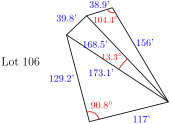
sq ft
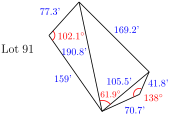
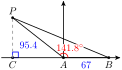
For Problems 59 and 60,
- Find the coordinates of point . Round to two decimal places.
- Find the sides and of .
- Find side .

Later we will be able to show that . What is the exact value of (Hint: Sketch both angles in standard position.)
Later we will be able to show that . What is the exact value of (Hint: Sketch both angles in standard position.)
Alice wants an obtuse angle that satisfies . Bob presses some buttons on his calculator and reports that . Explain Bob's error and give a correct approximation of accurate to two decimal places.
Bob found an acute angle. The obtuse angle is the supplement of , or .
Yaneli finds that the angle opposite the longest side of a triangle satisfies . Zelda reports that . Explain Zelda's error and give a correct approximation of accurate to two decimal places.
For Problems 65–70,
- Sketch an angle in standard position, , with the given properties.
- Find expressions for , and in terms of the given variable.
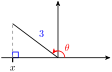
- , ,
is obtuse and
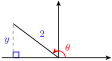
- , ,
is obtuse and
is obtuse and
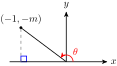
- , ,
Trigonometry by Katherine Yoshiwara (yoshiwarabooks.org), GNU Free Documentation License 1.2 or later. Adapted for the XYZ HTML edition with the authors' permission (recorded 2026-07-04). License: GFDL-1.2-or-later.