
1.2 Similar Triangles
Congruent Triangles
Two triangles are congruent if they have exactly the same size and shape. This means that their corresponding angles are equal, and their corresponding sides have the same lengths, as shown below.
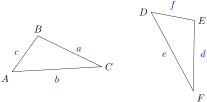
The two triangles at right are congruent. Find the values of , , and .
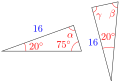
Recall that the altitude of a triangle is the segment from one vertex of the triangle perpendicular to the opposite side.
The triangles in the previous example are a special type of right triangle called –– triangles. Notice that in these triangles, the leg opposite the angle is half the length of the hypotenuse.
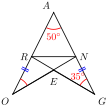
The diagonal of a parallelogram divides it into two congruent triangles, as shown at right. List the corresponding parts of the two triangles, and explain why each pair is equal.
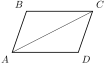
and because they are alternate interior angles. If two pairs of angles in a triangle are equal, so is the third pair, so . and because they are opposite sides of a parallelogram, and .
Similar Triangles
Two triangles are similar if they have the same shape but not necessarily the same size. The corresponding angles are equal, and the corresponding sides are proportional. We can think of one similar triangle as an enlargement or a reduction of the other. (See the figures below.)
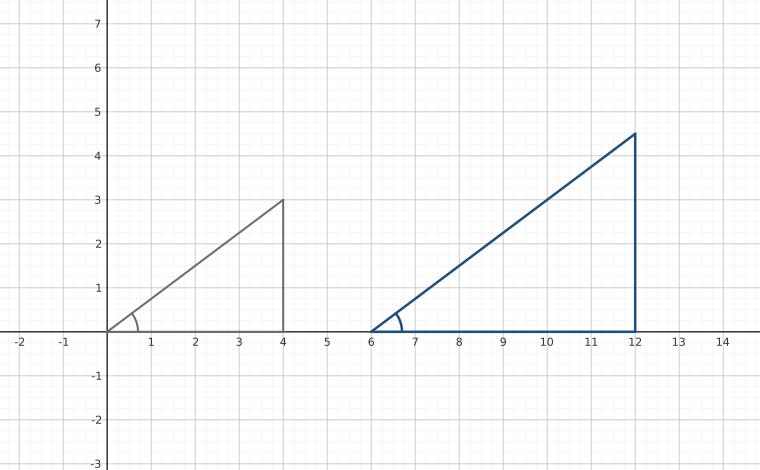
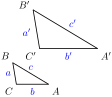
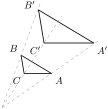
To decide whether two triangles are similar, it turns out that we need to verify only one of the two conditions for similarity, and the other condition will be true automatically.
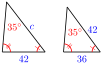
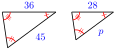
Are the triangles below similar? Explain why or why not in each case.
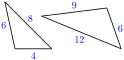

a. The triangles are similar because , so the sides are proportional.
b. The third angle in both triangles is , so the triangles are similar because their corresponding angles are equal.
Using Proportions with Similar Triangles
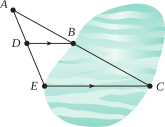
The figure in the next example shows a parallelogram and two triangles, and . Can we find the unknown lengths and in the larger triangle?
First note that two pairs of corresponding angles in the triangles are equal: and are vertical angles, and and are alternate interior angles. But if two pairs of corresponding angles are equal, then the third pair must be equal also. This means that the two triangles are similar, and we can use the fact that their corresponding sides are proportional to find and .
Find the value of in the previous example.
Setting the ratios of corresponding sides equal, we find , and solving for yields .
Similar Right Triangles
If two right triangles have one pair of corresponding acute angles with the same measure, then the triangles are similar. We can use this fact about right triangles to make indirect measurements.
In Example 1.19 we created a 30°-60°-90° triangle in which the shorter leg was 4 inches and the hypotenuse was 8 inches. The hypotenuse of another 30°-60°-90° triangle is 5 feet. What is the length of the side opposite the 30° angle?
The side opposite the 30° angle is the shorter leg, which is half the length of the hypotenuse. So the its length is 2.5 feet.
Overlapping Triangles
In some applications, similar triangles may share a side or an angle.
Heather wants to know the height of a street lamp. She discovers that when she is 12 feet from the lamp, her shadow is 6 feet long. Find the height of the street lamp.
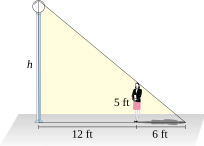
Because the two triangles are similar, . Solving for gives a height of 15 feet.
Review the following skills you will need for this section.
Section 1.2 Summary
Vocabulary
Look up the definitions of new terms in the Glossary.
- Congruent
- Altitude
- Leg
- Hypotenuse
- Parallelogram
- Similar
- Proportional
Concepts
- Two triangles are congruent if they have exactly the same size and shape.
- The altitude of an equilateral triangle divides it into two congruent right triangles.
- In a 30°-60°-90° right triangle, the leg opposite the 30° angle is half the length of the hypotenuse.
- Two triangles are similar if they have the same shape but not necessarily the same size. The corresponding angles are equal, and the corresponding sides are proportional.
- If two right triangles have one pair of corresponding acute angles with the same measure, then the triangles are similar.
Study Questions
- What is the difference between congruent triangles and similar triangles?
- What is the name of the short-cut method for solving proportions? Why does the method work?
- In two triangles, if two corresponding pairs of angles are equal, are the triangles similar? How do you know?
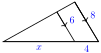
For the triangles shown, which of the following equations is true? Explain why.
Skills
Practice each skill in the Homework Problems listed.
- Identify congruent triangles and find unknown parts #1-6
- Identify similar triangles #7-10
- Find unknown parts of similar triangles #11-20
- Solve problems using proportions and similar triangles #21-26
- Use proportions to relate sides of similar triangles #27-38
Homework 1.2
In Problems 1–4, name two congruent triangles and find the unknown quantities.
is an isosceles trapezoid.
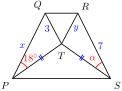
, ,
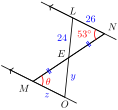
is isosceles.
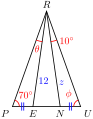
, ,
is isosceles and . Find and .
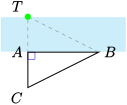
Delbert and Francine want to measure the distance across a stream. They mark point directly across the stream from a tree at point on the opposite bank. Delbert walks from point down the bank a short distance to point and sights the tree. He measures the angle between his line of sight and the streambank.
- Draw a figure showing the stream, the tree, and right triangle .
- Meanwhile Francine, who was still standing at point , walks away from the stream at right-angles to Delbert's path. Delbert watches her progress, and tells her to stop at point when the angle between the stream bank and his line of sight to Francine is the same as the angle from the stream bank to the tree. Add triangle to your figure.
- Delbert now measures the distance from point to Francine at point . Explain why this distance is the same as the distance across the stream.
so
If you have a baseball cap, here is another way to measure the distance across a river. Stand at point directly across the river from a convenient landmark, say a large rock, on the other side. Tilt your head down so that the brim of the cap points directly at the base of the rock, .
- Draw a figure showing the river, the rock, and right triangle , where is the location of your baseball cap on your head.
- Now, without changing the angle of your head, rotate and sight along the bank on your side of the river. Have a friend mark the spot on the ground where the brim of your cap points. Add triangle to your figure.
- Finally, you can measure the distance from point to point . Explain why this distance is the same as the distance across the river.
For Problems 7–10, decide whether the triangles are similar, and explain why or why not.

Similar. Corresponding sides are proportional.
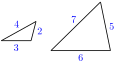

Similar. Corresponding angles are equal.

Assume the triangles in Problems 11–14 are similar. Solve for the variables. (Figures are not drawn to scale.)


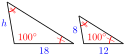
In Problems 15–20, use properties of similar triangles to solve for the variable.


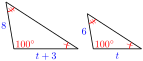


For Problems 21–26, use properties of similar triangles to solve.
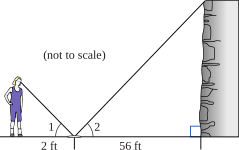
A rock climber estimates the height of a cliff she plans to scale as follows. She places a mirror on the ground so that she can just see the top of the cliff in the mirror while she stands straight.
The angles 1 and 2 formed by the light rays are equal, as shown in the figure. She then measures the distance to the mirror (2 feet) and the distance from the mirror to the base of the cliff (56 feet). If she is 5 feet 6 inches tall, how high is the cliff?
154 feet
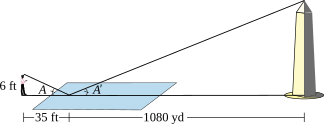
Edo estimates the height of the Washington Monument as follows. He notices that he can see the reflection of the top of the monument in the reflecting pool. He is 35 feet from the tip of the reflection, and that point is 1080 yards from the base of the monument, as shown below. From his physics class, Edo knows that the angles marked and are equal. If Edo is 6 feet tall, what is his estimate for the height of the Washington Monument?
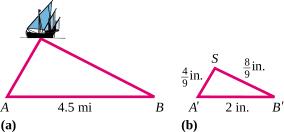
In the sixth century BC, the Greek philosopher and mathematician Thales used similar triangles to measure the distance to a ship at sea. Two observers on the shore at points and would sight the ship and measure the angles formed, as shown in figure (a). They would then construct a similar triangle as shown in figure (b), with the same angles at and , and measure its sides. (This method is called triangulation.) Use the lengths given in the figures to find the distance from observer to the ship.
1 mile
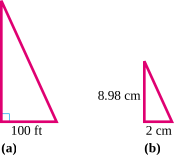
The Capilano Suspension Bridge is a footbridge that spans a 230-foot gorge north of Vancouver, British Columbia. Before crossing the bridge, you decide to estimate its length.
You walk 100 feet downstream from the bridge and sight its far end, noting the angle formed by your line of sight, as shown in figure (a). You then construct a similar right triangle with a two-centimeter base, as shown in figure (b). You find that the height of your triangle is 8.98 centimeters. How long is the Capilano Suspension Bridge?
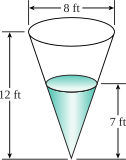
A conical tank is 12 feet deep and the diameter of the top is 8 feet. If the tank is filled with water to a depth of 7 feet as shown in the figure at right, what is the area of the exposed surface of the water?
17.1 square feet
To measure the distance across the lake shown in the figure at right, stand at and sight point across the lake, then mark point . Then sight to point and mark point so that is parallel to . If yards, yards, and yards, how wide is the lake?
In Problems 27–28, the pairs of triangles are similar. Solve for in terms of . (The figures are not drawn to scale.)
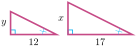

For Problems 29–34, use properties of similar triangles to solve for the variable.
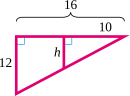
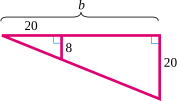
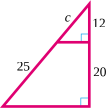
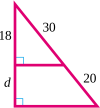
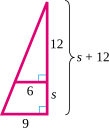
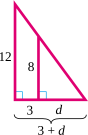
In Problems 35–38,solve for in terms of .
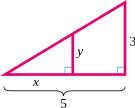
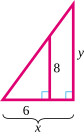
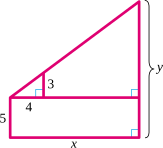
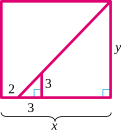
Triangle is a right triangle, and meets the hypotenuse at a right angle.
- If , find , and .
- Find two triangles similar to . List the corresponding sides in each of the triangles.
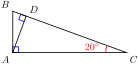
- , ,
- and The hypotenuse is in , in , and in . The short leg is in , in , and in . The longer leg is in , in , and in .
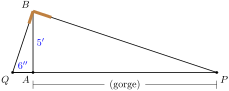
Here is a way to find the distance across a gorge using a carpenter's square and a five-foot pole. Plant the pole vertically on one side of the gorge at point and place the angle of the carpenter's square on top of the pole at point , as shown in the figure. Sight along one side of the square so that it points to the opposite side of the gorge at point . Without moving the square, sight along the other side and mark point . If the distance from to is six inches, calculate the width of the gorge. Explain your method.
Trigonometry by Katherine Yoshiwara (yoshiwarabooks.org), GNU Free Documentation License 1.2 or later. Adapted for the XYZ HTML edition with the authors' permission (recorded 2026-07-04). License: GFDL-1.2-or-later.