
1.1 Angles and Triangles
Historically, trigonometry began as the study of triangles and their properties. Let's review some definitions and facts from geometry.
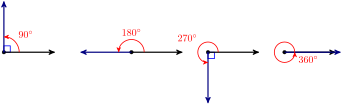
- We measure angles in degrees.
- One full rotation is , as shown below.
- Half a full rotation is and is called a straight angle.
- One quarter of a full rotation is and is called a right angle.
Triangles
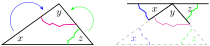
If you tear off the corners of any triangle and line them up, as shown below, they will always form a straight angle.
Find each of the angles in the triangle at right.
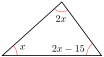
Because the sum of the angles is , we know that . Solving this equation gives
Some special categories of triangles are particularly useful. Most important of these are the right triangles.
Two angles of a triangle are and . Can it be a right triangle?
No, the third angle must be .
An equilateral triangle has all three sides the same length.
Find , , and in the triangle at right.

The third angle is , so the triangle is equilateral and .
An isosceles triangle has two sides of equal length. The angle between the equal sides is the vertex angle. The other two angles are the base angles.
Find and in the figure at right.
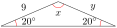
The vertex angle is , and the triangle is isosceles so .
Angles
In addition to the facts about triangles reviewed above, there are several useful properties of angles.
- Two angles that add to are called supplementary.
- Two angles that add to are called complementary.
- Angles between and are called acute.
- Angles between and are called obtuse.

In trigonometry we often use lower-case Greek letters to represent unknown angles (or, more specifically, the measure of the angle in degrees). In the next exercise, we use the Greek letters (alpha), (beta), and (gamma).
In the figure, , , and denote the measures of the angles in degrees.
- Find the measure of angle .
- Find the measure of angle .
- Find the measure of angle .
- What do you notice about the measures of the angles?
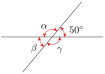
Angle is supplementary to so . Then is supplementary to and is supplementary to , giving us
Non-adjacent angles formed by the intersection of two straight lines are called vertical angles. In the previous exercise, the angles labeled and are vertical angles, as are the angles labeled and .
Find all the unknown angles in the figure at right. (You will find a list of all the Greek letters and their names at the end of this section.)
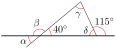
because of vertical angles, and is its supplement at . , the supplement of , and .
A line that intersects two parallel lines forms eight angles, as shown in the figure below. There are four pairs of vertical angles, and four pairs of corresponding angles, or angles in the same position relative to the transversal on each of the parallel lines.
For example, the angles labeled 1 and 5 are corresponding angles, as are the angles labeled 4 and 8. Finally, angles 3 and 6 are called alternate interior angles, and so are angles 4 and 5.
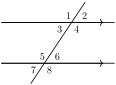
Show that the adjacent angles of a parallelogram are supplementary. (You can use angles 1 and 4 in the parallelogram of the previous example.)
Note that angles 2 and 6 are supplementary because they form a straight angle. Angle 1 equals angle 2 because they are alternate interior angles, and similarly angle 4 equals angle 5. Angle 5 equals angle 6 because they are corresponding angles. Thus, angle 4 equals angle 6, and angle 1 equals angle 2. So angles 4 and 1 are supplementary because 2 and 6 are.
Lower Case Letters in the Greek Alphabet
| Greek Alphabet | ||
Review the following skills you will need for this section.
Section 1.1 Summary
Vocabulary
- Right angle
- Straight angle
- Right triangle
- Equilateral triangle
- Isosceles triangle
- Vertex angle
- Base angle
- Supplementary
- Complementary
- Acute
- Obtuse
- Vertical angles
- Transversal
- Corresponding angles
- Alternate interior angles
Concepts
Study Questions
- Is it possible to have more than one obtuse angle in a triangle? Why or why not?
- Draw any quadrilateral (a four-sided polygon) and divide it into two triangles by connecting two opposite vertices by a diagonal. What is the sum of the angles in your quadrilateral?
- What is the difference between a vertex angle and vertical angles?
- Can two acute angles be supplementary?
- Choose any two of the eight angles formed by a pair of parallel lines cut by a transversal. Those two angles are either equal or _______.
Skills
Practice each skill in the Homework Problems listed.
- Sketch a triangle with given properties #1–6
- Find an unknown angle in a triangle #7–12, 17–20
- Find angles formed by parallel lines and a transversal #13–16, 35–44
- Find exterior angles of a triangle #21–24
- Find angles in isosceles, equilateral, and right triangles #25–34
- State reasons for conclusions #45–48
Homework 1.1
For Problems 1–6, sketch and label a triangle with the given properties.
An isosceles triangle with vertex angle 30°

A scalene triangle with one obtuse angle (Scalene means three unequal sides.)
A right triangle with legs 4 and 7

An isosceles right triangle
An isosceles triangle with one obtuse angle

A right triangle with one angle 20°
For Problems 7–20, find each unknown angle.

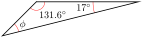


In Problems 21 and 22, the angle labeled is called an exterior angle of the triangle, formed by one side and the extension of an adjacent side. Find .


In parts (a) and (b), find the exterior angle .


- Find an algebraic expression for .

- Use your answer to part (c) to write a rule for finding an exterior angle of a triangle.
- An exterior angle is equal to the sum of the opposite interior angles.
Find the three exterior angles of the triangle. What is the sum of the exterior angles?

Write an algebraic expression for each exterior angle in terms of one of the angles of the triangle. What is the sum of the exterior angles?

In Problems 25 and 26, the figures inscribed are regular polygons, which means that all their sides are the same length, and all the angles have the same measure. Find the angles and .


In problems 27 and 28, is equilateral. Find the unknown angles.

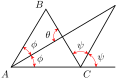
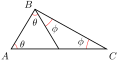
- ________
- ________
- is________
- a right triangle
Find and .
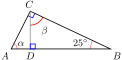

- Explain why and are equal in measure.
- Explain why and are equal in measure.
- Explain why is a right angle. (Hint: Use Problem 29.)
- They are base angles of an isosceles triangle.
- They are base angles of an isosceles triangle.
- corresponds to of Problem 29, and corresponds to of Problem 29.

- Compare with . (Hint: What do you know about supplementary angles and the sum of angles in a triangle?
- Compare and .
- Explain why the inscribed angle is half the size of the central angle .
Find and .

Find and .

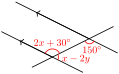
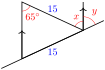
In Problems 35–44, arrows on a pair of lines indicate that they are parallel. Find and .


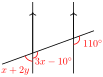

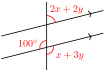
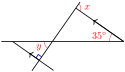
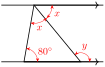

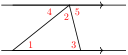
Among the angles labeled 1 through 5 in the figure at right, find two pairs of equal angles.
- ________
- Use parts (a) and (b) to explain why the sum of the angles of a triangle is
- In the equation substitute for , and substitute for to conclude that the sum of the angles in the triangle is .
- In the figure below, find , and justify your answer.
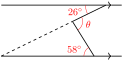
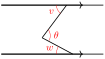
- Write an algebraic expression for in the figure below.
is a rectangle. The diagonals of a rectangle bisect each other. In the figure, . Find the angles labeled 1 through 5 in order, and give a reason for each answer.
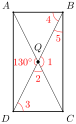
because vertical angles are equal. because it makes a straight angle with a angle. because it is a base angle of an isosceles triangle whose vertex angle is . for the same reason. because it is complementary to .
A tangent meets the radius of a circle at a right angle. In the figure,. Find the angles labeled 1 through 5 in order, and give a reason for each answer.
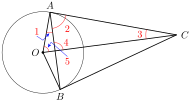
Trigonometry by Katherine Yoshiwara (yoshiwarabooks.org), GNU Free Documentation License 1.2 or later. Adapted for the XYZ HTML edition with the authors' permission (recorded 2026-07-04). License: GFDL-1.2-or-later.