
8.7 Systems of Non-Linear Equations and Inequalities
In this section, we study systems of non-linear equations and inequalities. Unlike the systems of linear equations for which we have developed several algorithmic solution techniques, there is no general algorithm to solve systems of non-linear equations. Moreover, all of the usual hazards of non-linear equations like extraneous solutions and unusual function domains are once again present. Along with the tried and true techniques of substitution and elimination, we shall often need equal parts tenacity and ingenuity to see a problem through to the end. You may find it necessary to review topics throughout the text which pertain to solving equations involving the various functions we have studied thus far. To get the section rolling we begin with a fairly routine example.
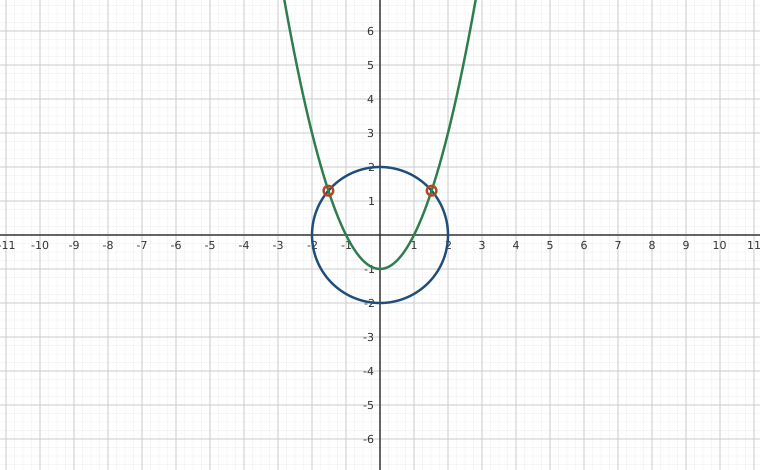
A couple of remarks about Example 8.7.1 are in order. First note that, unlike systems of linear equations, it is possible for a system of non-linear equations to have more than one solution without having infinitely many solutions. In fact, while we characterize systems of nonlinear equations as being `consistent' or `inconsistent,' we generally don't use the labels `dependent' or `independent'. Secondly, as we saw with number 4, sometimes making a quick sketch of the problem situation can save a lot of time and effort. While in general the curves in a system of non-linear equations may not be easily visualized, it sometimes pays to take advantage when they are. Our next example provides some considerable review of many of the topics introduced in this text.
Example 8.7.2 showcases some of the ingenuity and tenacity mentioned at the beginning of the section. Sometimes you just have to look at a system the right way to find the most efficient method to solve it. Sometimes you just have to try something.
We close this section discussing how non-linear inequalities can be used to describe regions in the plane which we first introduced in Section 2.4. Before we embark on some examples, a little motivation is in order. Suppose we wish to solve . If we mimic the algorithms for solving nonlinear inequalities in one variable, we would gather all of the terms on one side and leave a on the other to obtain . Then we would find the zeros of the left hand side, that is, where is , or . Instead of obtaining a few numbers which divide the real number line into intervals, we get an equation of a curve, in this case, a circle, which divides the plane into two regions - the `inside' and `outside' of the circle - with the circle itself as the boundary between the two. Just like we used test values to determine whether or not an interval belongs to the solution of the inequality, we use test points in the each of the regions to see which of these belong to our solution set.3 We choose to represent the region inside the circle and to represent the points outside of the circle. When we substitute into , we get which is true. This means and all the other points inside the circle are part of the solution. On the other hand, when we substitute into the same inequality, we get which is false. This means along with all other points outside the circle are not part of the solution. What about points on the circle itself? Choosing a point on the circle, say , we get , which means the circle itself does not satisfy the inequality.4 As a result, we leave the circle dashed in the final diagram.

The solution to
We put this technique to good use in the following example.
Exercises
In Exercises -, solve the given system of nonlinear equations. Sketch the graph of both equations on the same set of axes to verify the solution set.
-
Answer
,
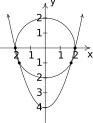
Figure 8.33 -
Answer
No solution
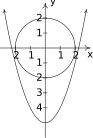
Figure 8.34 -
Answer
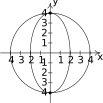
Figure 8.35 -
Answer
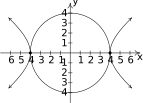
Figure 8.36 -
Answer
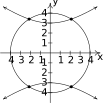
Figure 8.37 -
Answer
,
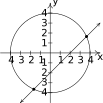
Figure 8.38
In Exercises -, solve the given system of nonlinear equations. Use a graph to help you avoid any potential extraneous solutions.
-
Answer
-
Answer
-
Answer
-
Answer
-
Answer
-
Answer
-
Answer
-
Answer
,
-
Answer
- A certain bacteria culture follows the Law of Uninbited Growth, Equation 6.4. After 10 minutes, there are 10,000 bacteria. Five minutes later, there are 14,000 bacteria. How many bacteria were present initially? How long before there are 50,000 bacteria?
Answer
Initially, there are bacteria. It will take minutes for the colony to grow to 50,000 bacteria.
Consider the system of nonlinear equations below
If we let and then the system becomes
This associated system of linear equations can then be solved using any of the techniques presented earlier in the chapter to find that and . Thus and .
We say that the original system is linear in form because its equations are not linear but a few substitutions reveal a structure that we can treat like a system of linear equations. Each system in Exercises - is linear in form. Make the appropriate substitutions and solve for and .
-
Answer
-
Answer
No solution
-
Answer
Solve the following system
Answer
In Exercises -, sketch the solution to each system of nonlinear inequalities in the plane.
-
Answer

Figure 8.39 -
Answer
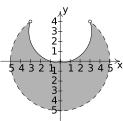
Figure 8.40 -
Answer
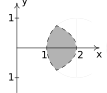
Figure 8.41 -
Answer
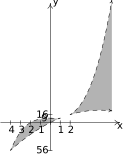
Figure 8.42 -
Answer

Figure 8.43 -
Answer

Figure 8.44 Systems of nonlinear equations show up in third semester Calculus in the midst of some really cool problems. The system below came from a problem in which we were asked to find the dimensions of a rectangular box with a volume of 1000 cubic inches that has minimal surface area. The variables , and are the dimensions of the box and is called a Lagrange multiplier. With the help of your classmates, solve the system.5
Answer
According to Theorem 3.16 in Section 3.4, the polynomial can be factored into the product linear and irreducible quadratic factors. In this exercise, we present a method for obtaining that factorization.
- Show that has no real zeros.
- Because has no real zeros, its factorization must be of the form where each factor is an irreducible quadratic. Expand this quantity and gather like terms together.
- Create and solve the system of nonlinear equations which results from equating the coefficients of the expansion found above with those of . You should get four equations in the four unknowns , , and . Write in factored form.
Answer
- Factor .
Answer
Adapted from Precalculus, 3rd corrected edition, by Carl Stitz and Jeff Zeager (stitz-zeager.com), licensed under CC BY-NC-SA 3.0. Changes were made: reformatted as an accessible XYZ web edition. License: CC-BY-NC-SA-3.0.