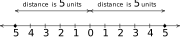
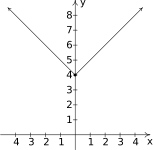
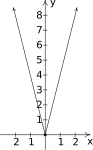
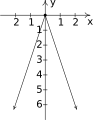
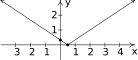
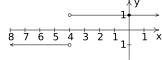
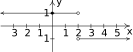
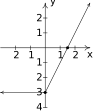
There are a few ways to describe what is meant by the absolute value of a real number . You may have been taught that is the distance from the real number to on the number line. So, for example, and , since each is units from on the number line.
Figure 2.25
Another way to define absolute value is by the equation . Using this definition, we have and . The long and short of both of these procedures is that takes negative real numbers and assigns them to their positive counterparts while it leaves positive numbers alone. This last description is the one we shall adopt, and is summarized in the following definition.
In Definition 2.4, we define using a piecewise-defined function. (See page in Section 1.4.) To check that this definition agrees with what we previously understood as absolute value, note that since , to find we use the rule , so . Similarly, since , we use the rule , so that . This is one of the times when it's best to interpret the expression `' as `the opposite of ' as opposed to `negative '. Before we begin studying absolute value functions, we remind ourselves of the properties of absolute value.
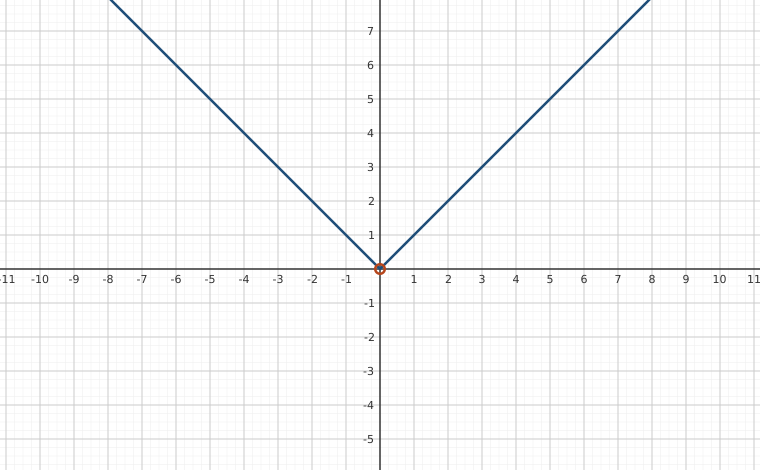
Interactive figurey = a|x − h| + k: the V keeps its corner at (h, k)Drag the Steepness a, Corner x-coordinate h and Corner y-coordinate k sliders.
XYZ Graph · viewer build 5edf91b
The dashed gray V is y = |x|, the parent of every absolute value function in this section, with its corner at the origin. The solid V is a|x − h| + k: the marked corner sits at (h, k), so h and k relocate it, a changes the steepness of both arms, and a negative a turns the V upside down. Because |x − h| is a distance, the graph is symmetric about the vertical line x = h no matter how the other dials are set, which is the picture behind solving |x − h| = c by walking c units to either side of h.
The proofs of the Product and Quotient Rules in Theorem 2.1 boil down to checking four cases: when both and are positive; when they are both negative; when one is positive and the other is negative; and when one or both are zero.
For example, suppose we wish to show that . We need to show that this equation is true for all real numbers and . If and are both positive, then so is . Hence, , and . Hence, the equation is the same as which is true. If both and are negative, then is positive. Hence, , and . The equation becomes , which is true. Suppose is positive and is negative. Then is negative, and we have , and . The equation reduces to which is true. A symmetric argument shows the equation holds when is negative and is positive. Finally, if either or (or both) are zero, then both sides of are zero, so the equation holds in this case, too. All of this rhetoric has shown that the equation holds true in all cases.
The proof of the Quotient Rule is very similar, with the exception that . The Power Rule can be shown by repeated application of the Product Rule. The `Equality Properties' can be proved using Definition 2.4 and by looking at the cases when , in which case , or when , in which case . For example, if , and , then if , we have . If, on the other hand, , then , so . The remaining properties are proved similarly and are left for the Exercises. Our first example reviews how to solve basic equations involving absolute value using the properties listed in Theorem 2.1.
Next, we turn our attention to graphing absolute value functions. Our strategy in the next example is to make liberal use of Definition 2.4 along with what we know about graphing linear functions (from Section 2.1) and piecewise-defined functions (from Section 1.4).
Note that all of the functions in the previous example bear the characteristic `' shape of the graph of . We could have graphed the functions , and in Example 2.2.2 starting with the graph of and applying transformations as in Section 1.7 as our next example illustrates.
While the methods in Section 1.7 can be used to graph an entire family of absolute value functions, not all functions involving absolute values posses the characteristic `' shape. As the next example illustrates, often there is no substitute for appealing directly to the definition.
Many of the applications that the authors are aware of involving absolute values also involve absolute value inequalities. For that reason, we save our discussion of applications for Section 2.4.
Exercises
In Exercises -, solve the equation.
Prove that if then either or . Use that result to solve the equations in Exercises -.
In Exercises -, graph the function. Find the zeros of each function and the - and -intercepts of each graph, if any exist. From the graph, determine the domain and range of each function, list the intervals on which the function is increasing, decreasing or constant, and find the relative and absolute extrema, if they exist.
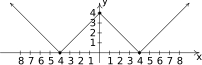
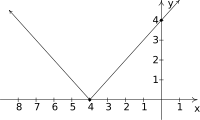
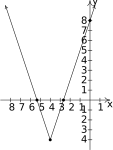
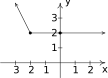
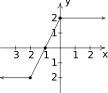
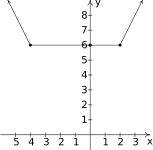
With the help of your classmates, find an absolute value function whose graph is given below.
Figure 2.41
With help from your classmates, prove the second, third and fifth parts of Theorem 2.1.
Prove The Triangle Inequality: For all real numbers and
.
Answers
or
or
or
or
or
no solution
or
or
or
no solution
, or
or
or
or
or
or
or
-intercept
-intercept Domain Range Decreasing on Increasing on Relative and absolute min. at No relative or absolute maximum
Figure 2.42
No zeros No -intercepts -intercept Domain Range Decreasing on Increasing on Relative and absolute minimum at No relative or absolute maximum
Figure 2.43
-intercept
-intercept Domain Range Decreasing on Increasing on Relative and absolute minimum at No relative or absolute maximum
Figure 2.44
-intercept
-intercept Domain Range Increasing on Decreasing on Relative and absolute maximum at No relative or absolute minimum
Figure 2.45
,
-intercepts ,
-intercept Domain Range Decreasing on Increasing on Relative and absolute min. at No relative or absolute maximum
Figure 2.46
-intercepts
-intercept Domain Range Decreasing on Increasing on Relative and absolute min. at No relative or absolute maximum
Figure 2.47
No zeros No -intercept -intercept Domain Range Constant on Constant on Absolute minimum at every point where Absolute maximum at every point where Relative maximum AND minimum at every point on the graph
Figure 2.48
No zeros No -intercept -intercept Domain Range Constant on Constant on Absolute minimum at every point where Absolute maximum at every point where Relative maximum AND minimum at every point on the graph
Figure 2.49
Re-write as
-intercept
-intercept Domain Range Increasing on Constant on Absolute minimum at every point where No absolute maximum Relative minimum at every point where Relative maximum at every point where
Figure 2.50
Re-write as No zeros No -intercepts -intercept Domain Range Decreasing on Constant on Absolute minimum at every point where No absolute maximum Relative minimum at every point where Relative maximum at every point where
Figure 2.51
Re-write as
-intercept
-intercept Domain Range Increasing on Constant on Constant on Absolute minimum at every point where Absolute maximum at every point where Relative minimum at every point where and at every point where Relative maximum at every point where and at every point where
Figure 2.52
Re-write as No zeros No -intercept -intercept Domain Range Decreasing on Constant on Increasing on Absolute minimum at every point where No absolute maximum Relative minimum at every point where Relative maximum at every point where
Figure 2.53
Adapted from Precalculus, 3rd corrected edition, by Carl Stitz and Jeff Zeager (stitz-zeager.com), licensed under CC BY-NC-SA 3.0. Changes were made: reformatted as an accessible XYZ web edition. License: CC-BY-NC-SA-3.0.
These eBooks are a prerelease and are not yet certified conformant with WCAG 2.1 AA or ADA Title II. Every page is built against an automated accessibility gate, and the published editions will meet ADA Title II requirements when they release in late September 2026. If something is unusable, please tell us.