
9.6 Solve Geometry Applications: Volume and Surface Area
In this section, we will finish our study of geometry applications. We find the volume and surface area of some three-dimensional figures. Since we will be solving applications, we will once again show our Problem-Solving Strategy for Geometry Applications.
- Read the problem and make sure you understand all the words and ideas. Draw the figure and label it with the given information.
- Identify what you are looking for.
- Name what you are looking for. Choose a variable to represent that quantity.
- Translate into an equation by writing the appropriate formula or model for the situation. Substitute in the given information.
- Solve the equation using good algebra techniques.
- Check the answer in the problem and make sure it makes sense.
- Answer the question with a complete sentence.
Find Volume and Surface Area of Rectangular Solids
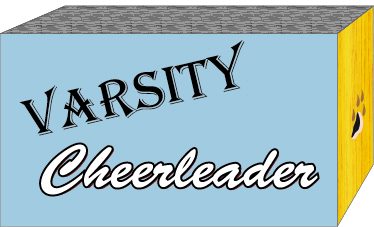
A cheerleading coach is having the squad paint wooden crates with the school colors to stand on at the games. (See Figure 9.33). The amount of paint needed to cover the outside of each box is the surface area, a square measure of the total area of all the sides. The amount of space inside the crate is the volume, a cubic measure.
Each crate is in the shape of a rectangular solid. Its dimensions are the length, width, and height. The rectangular solid shown in Figure 9.34 has length units, width units, and height units. Can you tell how many cubic units there are altogether? Let’s look layer by layer.
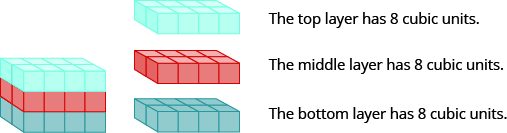
Altogether there are cubic units. Notice that is the
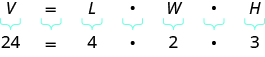
The volume, of any rectangular solid is the product of the length, width, and height.
We could also write the formula for volume of a rectangular solid in terms of the area of the base. The area of the base, is equal to
We can substitute for in the volume formula to get another form of the volume formula.
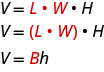
We now have another version of the volume formula for rectangular solids. Let’s see how this works with the rectangular solid we started with. See Figure 9.34.
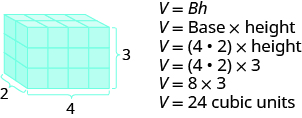
To find the surface area of a rectangular solid, think about finding the area of each of its faces. How many faces does the rectangular solid above have? You can see three of them.
Notice for each of the three faces you see, there is an identical opposite face that does not show.
The surface area of the rectangular solid shown in Figure 9.35 is square units.
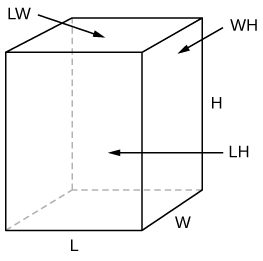
In general, to find the surface area of a rectangular solid, remember that each face is a rectangle, so its area is the product of its two dimensions, either length and width, length and height, or width and height (see Figure 9.36). Find the area of each face that you see and then multiply each area by two to account for the face on the opposite side.
Volume and Surface Area of a Cube
A cube is a rectangular solid whose length, width, and height are equal. See Volume and Surface Area of a Cube, below. Substituting, s for the length, width and height into the formulas for volume and surface area of a rectangular solid, we get:
So for a cube, the formulas for volume and surface area are and
Find the Volume and Surface Area of Spheres
A sphere is the shape of a basketball, like a three-dimensional circle. Just like a circle, the size of a sphere is determined by its radius, which is the distance from the center of the sphere to any point on its surface. The formulas for the volume and surface area of a sphere are given below.
Showing where these formulas come from, like we did for a rectangular solid, is beyond the scope of this course. We will approximate with
Find the Volume and Surface Area of a Cylinder
If you have ever seen a can of soda, you know what a cylinder looks like. A cylinder is a solid figure with two parallel circles of the same size at the top and bottom. The top and bottom of a cylinder are called the bases. The height of a cylinder is the distance between the two bases. For all the cylinders we will work with here, the sides and the height, , will be perpendicular to the bases.
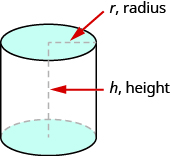
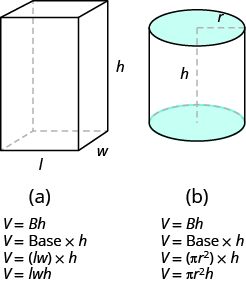
Rectangular solids and cylinders are somewhat similar because they both have two bases and a height. The formula for the volume of a rectangular solid, , can also be used to find the volume of a cylinder.
For the rectangular solid, the area of the base, , is the area of the rectangular base, length × width. For a cylinder, the area of the base, is the area of its circular base, Figure 9.38 compares how the formula is used for rectangular solids and cylinders.
To understand the formula for the surface area of a cylinder, think of a can of vegetables. It has three surfaces: the top, the bottom, and the piece that forms the sides of the can. If you carefully cut the label off the side of the can and unroll it, you will see that it is a rectangle. See Figure 9.39.
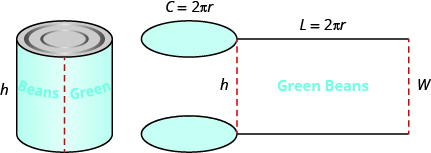
The distance around the edge of the can is the circumference of the cylinder’s base it is also the length of the rectangular label. The height of the cylinder is the width of the rectangular label. So the area of the label can be represented as

To find the total surface area of the cylinder, we add the areas of the two circles to the area of the rectangle.
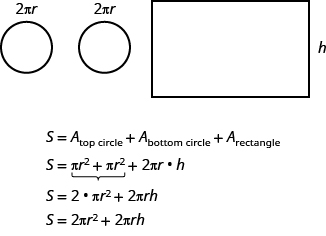
The surface area of a cylinder with radius and height is
Find the Volume of Cones
The first image that many of us have when we hear the word ‘cone’ is an ice cream cone. There are many other applications of cones (but most are not as tasty as ice cream cones). In this section, we will see how to find the volume of a cone.
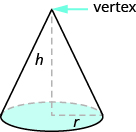
In geometry, a cone is a solid figure with one circular base and a vertex. The height of a cone is the distance between its base and the vertex.The cones that we will look at in this section will always have the height perpendicular to the base. See Figure 9.40.
Earlier in this section, we saw that the volume of a cylinder is We can think of a cone as part of a cylinder. Figure 9.41 shows a cone placed inside a cylinder with the same height and same base. If we compare the volume of the cone and the cylinder, we can see that the volume of the cone is less than that of the cylinder.
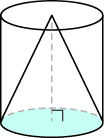
In fact, the volume of a cone is exactly one-third of the volume of a cylinder with the same base and height. The volume of a cone is

Since the base of a cone is a circle, we can substitute the formula of area of a circle, , for to get the formula for volume of a cone.

In this book, we will only find the volume of a cone, and not its surface area.
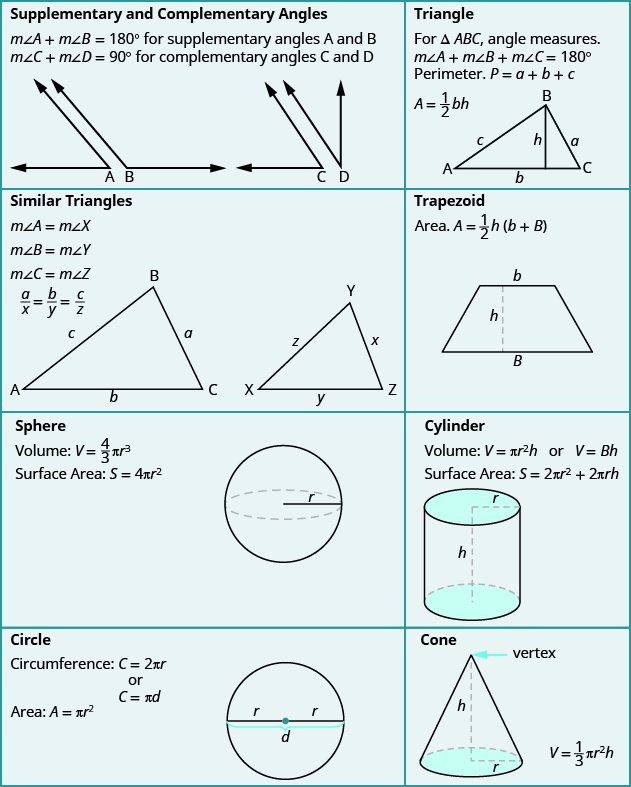
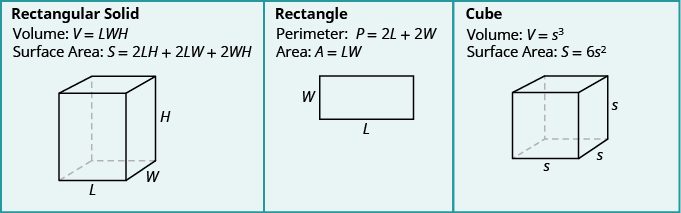
Summary of Geometry Formulas
The following charts summarize all of the formulas covered in this chapter.
Key Concepts
- Volume and Surface Area of a Rectangular Solid
- Volume and Surface Area of a Cube
- Volume and Surface Area of a Sphere
- Volume and Surface Area of a Cylinder
- Volume of a Cone
- For a cone with radius and height :
Volume:
- For a cone with radius and height :
Practice Makes Perfect
Find Volume and Surface Area of Rectangular Solids
In the following exercises, find ⓐ the volume and ⓑ the surface area of the rectangular solid with the given dimensions.
length meters, width meters, height meters
- ⓐ 9 cu. m
- ⓑ 27 sq. m
length feet, width feet, height feet
length yards, width yards, height yards
- ⓐ 17.64 cu. yd.
- ⓑ 41.58 sq. yd.
length centimeters, width centimeters, height centimeters
In the following exercises, solve.
Moving van A rectangular moving van has length feet, width feet, and height feet. Find its ⓐ volume and ⓑ surface area.
- ⓐ 1,024 cu. ft
- ⓑ 640 sq. ft
Gift box A rectangular gift box has length inches, width inches, and height inches. Find its ⓐ volume and ⓑ surface area.
Carton A rectangular carton has length cm, width cm, and height cm. Find its ⓐ volume and ⓑ surface area.
- ⓐ 3,350.49 cu. cm
- ⓑ 1,622.42 sq. cm
Shipping container A rectangular shipping container has length feet, width feet, and height feet. Find its ⓐ volume and ⓑ surface area.
In the following exercises, find ⓐ the volume and ⓑ the surface area of the cube with the given side length.
centimeters
- ⓐ 125 cu. cm
- ⓑ 150 sq. cm
inches
feet
- ⓐ 1124.864 cu. ft.
- ⓑ 648.96 sq. ft
meters
In the following exercises, solve.
Science center Each side of the cube at the Discovery Science Center in Santa Ana is feet long. Find its ⓐ volume and ⓑ surface area.
- ⓐ 262,144 cu. ft
- ⓑ 24,576 sq. ft
Museum A cube-shaped museum has sides meters long. Find its ⓐ volume and ⓑ surface area.
Base of statue The base of a statue is a cube with sides meters long. Find its ⓐ volume and ⓑ surface area.
- ⓐ 21.952 cu. m
- ⓑ 47.04 sq. m
Tissue box A box of tissues is a cube with sides 4.5 inches long. Find its ⓐ volume and ⓑ surface area.
Find the Volume and Surface Area of Spheres
In the following exercises, find ⓐ the volume and ⓑ the surface area of the sphere with the given radius. Round answers to the nearest hundredth.
centimeters
- ⓐ 113.04 cu. cm
- ⓑ 113.04 sq. cm
inches
feet
- ⓐ 1,766.25 cu. ft
- ⓑ 706.5 sq. ft
yards
In the following exercises, solve. Round answers to the nearest hundredth.
Exercise ball An exercise ball has a radius of inches. Find its ⓐ volume and ⓑ surface area.
- ⓐ 14,130 cu. in.
- ⓑ 2,826 sq. in.
Balloon ride The Great Park Balloon is a big orange sphere with a radius of feet. Find its ⓐ volume and ⓑ surface area.
Golf ball A golf ball has a radius of centimeters. Find its ⓐ volume and ⓑ surface area.
- ⓐ 381.51 cu. cm
- ⓑ 254.34 sq. cm
Baseball A baseball has a radius of inches. Find its ⓐ volume and ⓑ surface area.
Find the Volume and Surface Area of a Cylinder
In the following exercises, find ⓐ the volume and ⓑ the surface area of the cylinder with the given radius and height. Round answers to the nearest hundredth.
radius feet, height feet
- ⓐ 254.34 cu. ft
- ⓑ 226.08 sq. ft
radius centimeters, height centimeters
radius meters, height meters
- ⓐ 29.673 cu. m
- ⓑ 53.694 sq. m
radius yards, height yards
In the following exercises, solve. Round answers to the nearest hundredth.
Coffee can A can of coffee has a radius of cm and a height of cm. Find its ⓐ volume and ⓑ surface area.
- ⓐ 1,020.5 cu. cm
- ⓑ 565.2 sq. cm
Snack pack A snack pack of cookies is shaped like a cylinder with radius cm and height cm. Find its ⓐ volume and ⓑ surface area.
Barber shop pole A cylindrical barber shop pole has a diameter of inches and height of inches. Find its ⓐ volume and ⓑ surface area.
- ⓐ 678.24 cu. in.
- ⓑ 508.68 sq. in.
Architecture A cylindrical column has a diameter of feet and a height of feet. Find its ⓐ volume and ⓑ surface area.
Find the Volume of Cones
In the following exercises, find the volume of the cone with the given dimensions. Round answers to the nearest hundredth.
height feet and radius feet
37.68 cu. ft
height inches and radius inches
height centimeters and radius cm
324.47 cu. cm
height meters and radius meters
In the following exercises, solve. Round answers to the nearest hundredth.
Teepee What is the volume of a cone-shaped teepee tent that is feet tall and feet across at the base?
261.67 cu. ft
Popcorn cup What is the volume of a cone-shaped popcorn cup that is inches tall and inches across at the base?
Silo What is the volume of a cone-shaped silo that is feet tall and feet across at the base?
64,108.33 cu. ft
Sand pile What is the volume of a cone-shaped pile of sand that is meters tall and meters across at the base?
Everyday Math
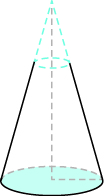
Street light post The post of a street light is shaped like a truncated cone, as shown in the picture below. It is a large cone minus a smaller top cone. The large cone is feet tall with base radius foot. The smaller cone is feet tall with base radius of feet. To the nearest tenth,
ⓐ find the volume of the large cone.
ⓑ find the volume of the small cone.
ⓒ find the volume of the post by subtracting the volume of the small cone from the volume of the large cone.
- ⓐ 31.4 cu. ft
- ⓑ 2.6 cu. ft
- ⓒ 28.8 cu. ft
Ice cream cones A regular ice cream cone is 4 inches tall and has a diameter of inches. A waffle cone is inches tall and has a diameter of inches. To the nearest hundredth,
ⓐ find the volume of the regular ice cream cone.
ⓑ find the volume of the waffle cone.
ⓒ how much more ice cream fits in the waffle cone compared to the regular cone?
Writing Exercises
The formulas for the volume of a cylinder and a cone are similar. Explain how you can remember which formula goes with which shape.
Answers will vary.
Which has a larger volume, a cube of sides of feet or a sphere with a diameter of feet? Explain your reasoning.
Self Check
ⓐ After completing the exercises, use this checklist to evaluate your mastery of the objectives of this section.
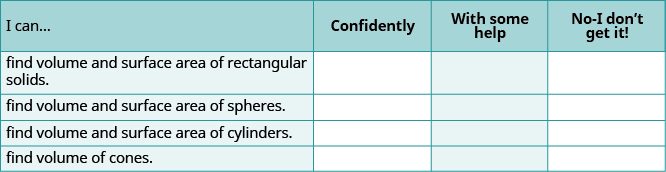
ⓑ After reviewing this checklist, what will you do to become confident for all objectives?