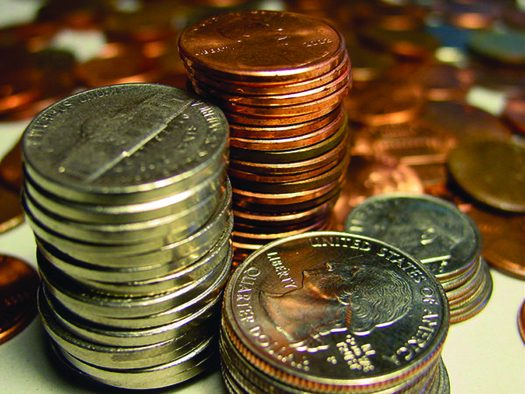
Imagine taking a handful of coins from your pocket or purse and placing them on your desk. How would you determine the value of that pile of coins?
If you can form a step-by-step plan for finding the total value of the coins, it will help you as you begin solving coin word problems.
One way to bring some order to the mess of coins would be to separate the coins into stacks according to their value. Quarters would go with quarters, dimes with dimes, nickels with nickels, and so on. To get the total value of all the coins, you would add the total value of each pile.
Figure 9.5To determine the total value of a stack of nickels, multiply the number of nickels times the value of one nickel.To determine the total value of a stack of nickels, multiply the number of nickels times the value of one nickel.(Credit: Darren Hester via ppdigital)
How would you determine the value of each pile? Think about the dime pile—how much is it worth? If you count the number of dimes, you'll know how many you have—the number of dimes.
But this does not tell you the value of all the dimes. Say you counted dimes, how much are they worth? Each dime is worth —that is the value of one dime. To find the total value of the pile of dimes, multiply by to get This is the total value of all dimes.
You could continue this process for each type of coin, and then you would know the total value of each type of coin. To get the total value of all the coins, add the total value of each type of coin.
Let's look at a specific case. Suppose there are quarters, dimes, nickels, and pennies. We'll make a table to organize the information – the type of coin, the number of each, and the value.
Table 9.1
Type
Quarters
Dimes
Nickels
Pennies
The total value of all the coins is Notice how Table 9.1 helped us organize all the information. Let's see how this method is used to solve a coin word problem.
Solve Ticket and Stamp Word Problems
The strategies we used for coin problems can be easily applied to some other kinds of problems too. Problems involving tickets or stamps are very similar to coin problems, for example. Like coins, tickets and stamps have different values; so we can organize the information in tables much like we did for coin problems.
Now we'll do one where we fill in the table all at once.
Key Concepts
Finding the Total Value for Coins of the Same Type
For coins of the same type, the total value can be found as follows:
where number is the number of coins, value is the value of each coin, and total value is the total value of all the coins.
Solve a Coin Word Problem
Read the problem. Make sure you understand all the words and ideas, and create a table to organize the information.
Identify what you are looking for.
Name what you are looking for. Choose a variable to represent that quantity.
Use variable expressions to represent the number of each type of coin and write them in the table.
Multiply the number times the value to get the total value of each type of coin.
Translate into an equation. Write the equation by adding the total values of all the types of coins.
Solve the equation using good algebra techniques.
Check the answer in the problem and make sure it makes sense.
Answer the question with a complete sentence.
Type
Practice Makes Perfect
Solve Coin Word Problems
In the following exercises, solve the coin word problems.
Jaime has in dimes and nickels. The number of dimes is more than the number of nickels. How many of each coin does he have?
8 nickels, 22 dimes
Lee has in dimes and nickels. The number of nickels is more than the number of dimes. How many of each coin does he have?
Ngo has a collection of dimes and quarters with a total value of The number of dimes is more than the number of quarters. How many of each coin does he have?
15 dimes, 8 quarters
Connor has a collection of dimes and quarters with a total value of The number of dimes is more than the number of quarters. How many of each coin does he have?
Carolyn has in her purse in nickels and dimes. The number of nickels is less than three times the number of dimes. Find the number of each type of coin.
12 dimes and 27 nickels
Julio has in his pocket in nickels and dimes. The number of dimes is less than twice the number of nickels. Find the number of each type of coin.
Chi has in dimes and quarters. The number of dimes is more than three times the number of quarters. How many dimes and nickels does Chi have?
63 dimes, 20 quarters
Tyler has in dimes and quarters. The number of quarters is more than four times the number of dimes. How many of each coin does he have?
A cash box of and bills is worth The number of bills is more than the number of bills. How many of each bill does it contain?
10 of the $1 bills, 7 of the $5 bills
Joe's wallet contains and bills worth The number of bills is more than the number of bills. How many of each bill does he have?
In a cash drawer there is in and bills. The number of bills is twice the number of bills. How many of each are in the drawer?
10 of the $10 bills, 5 of the $5 bills
John has in and bills in his drawer. The number of bills is three times the number of bills. How many of each are in the drawer?
Mukul has in quarters, dimes and nickels in his pocket. He has five more dimes than quarters and nine more nickels than quarters. How many of each coin are in his pocket?
16 nickels, 12 dimes, 7 quarters
Vina has in quarters, dimes and nickels in her purse. She has eight more dimes than quarters and six more nickels than quarters. How many of each coin are in her purse?
Solve Ticket and Stamp Word Problems
In the following exercises, solve the ticket and stamp word problems.
The play took in one night. The number of $8 adult tickets was less than twice the number of child tickets. How many of each ticket were sold?
30 child tickets, 50 adult tickets
If the number of child tickets is seventeen less than three times the number of adult tickets and the theater took in how many of each ticket were sold?
The movie theater took in one Monday night. The number of child tickets was ten more than twice the number of adult tickets. How many of each were sold?
110 child tickets, 50 adult tickets
The ball game took in one Saturday. The number of adult tickets was more than twice the number of child tickets. How many of each were sold?
Julie went to the post office and bought both stamps and postcards for her office's bills She spent The number of stamps was more than twice the number of postcards. How many of each did she buy?
40 postcards, 100 stamps
Before he left for college out of state, Jason went to the post office and bought both stamps and postcards and spent The number of stamps was more than twice the number of postcards. How many of each did he buy?
Maria spent at the post office. She bought three times as many stamps as stamps. How many of each did she buy?
30 at 49 cents, 10 at 21 cents
Hector spent at the post office. He bought four times as many stamps as stamps. How many of each did he buy?
Hilda has worth of and stock shares. The numbers of shares is more than twice the number of shares. How many of each does she have?
15 at $10 shares, 5 at $12 shares
Mario invested in and stock shares. The number of shares was less than three times the number of shares. How many of each type of share did he buy?
Everyday Math
Parent Volunteer As the treasurer of her daughter's Girl Scout troop, Laney collected money for some girls and adults to go to a camp. Each girl paid and each adult paid The total amount of money collected for camp was If the number of girls is three times the number of adults, how many girls and how many adults paid for camp?
9 girls, 3 adults
Parent Volunteer Laurie was completing the treasurer's report for her son's Boy Scout troop at the end of the school year. She didn't remember how many boys had paid the full-year registration fee and how many had paid a partial-year fee. She knew that the number of boys who paid for a full-year was ten more than the number who paid for a partial-year. If was collected for all the registrations, how many boys had paid the full-year fee and how many had paid the partial-year fee?
Writing Exercises
Suppose you have quarters, dimes, and pennies. Explain how you find the total value of all the coins.
Answers will vary.
Do you find it helpful to use a table when solving coin problems? Why or why not?
In the table used to solve coin problems, one column is labeled “number” and another column is labeled ‘“value.” What is the difference between the number and the value?
Answers will vary.
What similarities and differences did you see between solving the coin problems and the ticket and stamp problems?
Self Check
ⓐ After completing the exercises, use this checklist to evaluate your mastery of the objectives of this section.
Figure 9.6
ⓑ After reviewing this checklist, what will you do to become confident for all objectives?
Adapted from Prealgebra 2e by OpenStax (openstax.org), licensed under CC BY-NC-SA 4.0. Changes were made. License: CC-BY-NC-SA-4.0.
These eBooks are a prerelease and are not yet certified conformant with WCAG 2.1 AA or ADA Title II. Every page is built against an automated accessibility gate, and the published editions will meet ADA Title II requirements when they release in late September 2026. If something is unusable, please tell us.