
9.4 Use Properties of Rectangles, Triangles, and Trapezoids
In this section, we’ll continue working with geometry applications. We will add some more properties of triangles, and we’ll learn about the properties of rectangles and trapezoids.
Understand Linear, Square, and Cubic Measure
When you measure your height or the length of a garden hose, you use a ruler or tape measure (Figure 9.16). A tape measure might remind you of a line—you use it for linear measure, which measures length. Inch, foot, yard, mile, centimeter and meter are units of linear measure.

When you want to know how much tile is needed to cover a floor, or the size of a wall to be painted, you need to know the area, a measure of the region needed to cover a surface. Area is measured is square units. We often use square inches, square feet, square centimeters, or square miles to measure area. A square centimeter is a square that is one centimeter (cm) on each side. A square inch is a square that is one inch on each side (Figure 9.17).
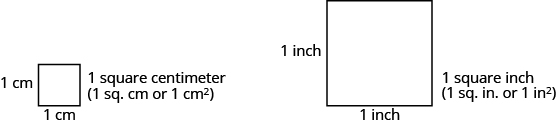
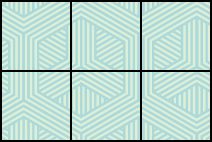
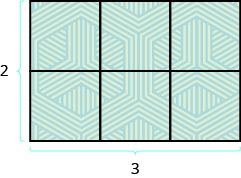
Figure 9.18 shows a rectangular rug that is feet long by feet wide. Each square is foot wide by foot long, or square foot. The rug is made of squares. The area of the rug is square feet.
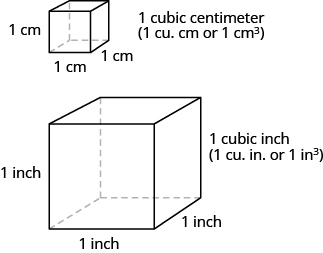
When you measure how much it takes to fill a container, such as the amount of gasoline that can fit in a tank, or the amount of medicine in a syringe, you are measuring volume. Volume is measured in cubic units such as cubic inches or cubic centimeters. When measuring the volume of a rectangular solid, you measure how many cubes fill the container. We often use cubic centimeters, cubic inches, and cubic feet. A cubic centimeter is a cube that measures one centimeter on each side, while a cubic inch is a cube that measures one inch on each side (Figure 9.19).
Suppose the cube in Figure 9.20 measures inches on each side and is cut on the lines shown. How many little cubes does it contain? If we were to take the big cube apart, we would find little cubes, with each one measuring one inch on all sides. So each little cube has a volume of cubic inch, and the volume of the big cube is cubic inches.

Many geometry applications will involve finding the perimeter or the area of a figure. There are also many applications of perimeter and area in everyday life, so it is important to make sure you understand what they each mean.
Picture a room that needs new floor tiles. The tiles come in squares that are a foot on each side—one square foot. How many of those squares are needed to cover the floor? This is the area of the floor.
Next, think about putting new baseboard around the room, once the tiles have been laid. To figure out how many strips are needed, you must know the distance around the room. You would use a tape measure to measure the number of feet around the room. This distance is the perimeter.
Figure 9.21 shows a square tile that is inch on each side. If an ant walked around the edge of the tile, it would walk inches. This distance is the perimeter of the tile.
Since the tile is a square that is inch on each side, its area is one square inch. The area of a shape is measured by determining how many square units cover the shape.
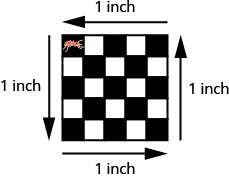
When the ant walks completely around the tile on its edge, it is tracing the perimeter of the tile. The area of the tile is 1 square inch.
Use the Properties of Rectangles
A rectangle has four sides and four right angles. The opposite sides of a rectangle are the same length. We refer to one side of the rectangle as the length, and the adjacent side as the width, See Figure 9.22.
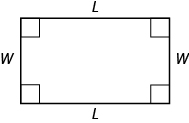
The perimeter, of the rectangle is the distance around the rectangle. If you started at one corner and walked around the rectangle, you would walk units, or two lengths and two widths. The perimeter then is
What about the area of a rectangle? Remember the rectangular rug from the beginning of this section. It was feet long by feet wide, and its area was square feet. See Figure 9.23. Since we see that the area, is the length, times the width, so the area of a rectangle is
For easy reference as we work the examples in this section, we will restate the Problem Solving Strategy for Geometry Applications here.
In the next example, the width is defined in terms of the length. We’ll wait to draw the figure until we write an expression for the width so that we can label one side with that expression.
Use the Properties of Triangles
We now know how to find the area of a rectangle. We can use this fact to help us visualize the formula for the area of a triangle. In the rectangle in Figure 9.23, we’ve labeled the length and the width so it’s area is
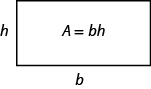
We can divide this rectangle into two congruent triangles (Figure 9.25). Triangles that are congruent have identical side lengths and angles, and so their areas are equal. The area of each triangle is one-half the area of the rectangle, or This example helps us see why the formula for the area of a triangle is
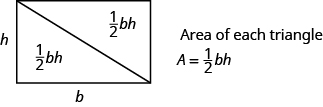
The formula for the area of a triangle is where is the base and is the height.
To find the area of the triangle, you need to know its base and height. The base is the length of one side of the triangle, usually the side at the bottom. The height is the length of the line that connects the base to the opposite vertex, and makes a angle with the base. Figure 9.26 shows three triangles with the base and height of each marked.

Isosceles and Equilateral Triangles
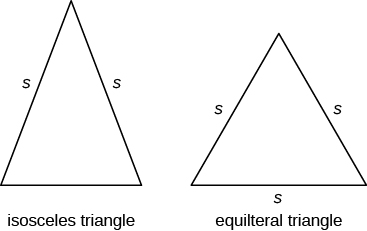
Besides the right triangle, some other triangles have special names. A triangle with two sides of equal length is called an isosceles triangle. A triangle that has three sides of equal length is called an equilateral triangle. Figure 9.27 shows both types of triangles.
Use the Properties of Trapezoids
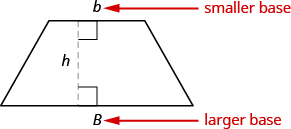
A trapezoid is four-sided figure, a quadrilateral, with two sides that are parallel and two sides that are not. The parallel sides are called the bases. We call the length of the smaller base and the length of the bigger base The height, of a trapezoid is the distance between the two bases as shown in Figure 9.28.
The formula for the area of a trapezoid is:
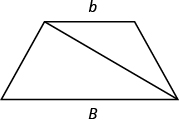
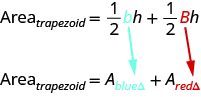
Splitting the trapezoid into two triangles may help us understand the formula. The area of the trapezoid is the sum of the areas of the two triangles. See Figure 9.29.
The height of the trapezoid is also the height of each of the two triangles. See Figure 9.30.
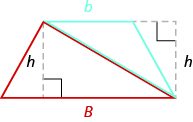
The formula for the area of a trapezoid is
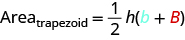
If we distribute, we get,
Key Concepts
- Properties of Rectangles
- Rectangles have four sides and four right (90°) angles.
- The lengths of opposite sides are equal.
- The perimeter, , of a rectangle is the sum of twice the length and twice the width.
- The area, , of a rectangle is the length times the width.
- Triangle Properties
- For any triangle , the sum of the measures of the angles is 180°.
- The perimeter of a triangle is the sum of the lengths of the sides.
- The area of a triangle is one-half the base, b, times the height, h.
- For any triangle , the sum of the measures of the angles is 180°.
Practice Makes Perfect
Understand Linear, Square, and Cubic Measure
In the following exercises, determine whether you would measure each item using linear, square, or cubic units.
amount of water in a fish tank
cubic
length of dental floss
living area of an apartment
square
floor space of a bathroom tile
height of a doorway
linear
capacity of a truck trailer
In the following exercises, find the ⓐ perimeter and ⓑ area of each figure. Assume each side of the square is cm.

- ⓐ 10 cm
- ⓑ 4 sq. cm


- ⓐ 8 cm
- ⓑ 3 sq. cm


- ⓐ 10 cm
- ⓑ 5 sq. cm

Use the Properties of Rectangles
In the following exercises, find the ⓐ perimeter and ⓑ area of each rectangle.
The length of a rectangle is feet and the width is feet.
- ⓐ 260 ft
- ⓑ 3825 sq. ft
The length of a rectangle is inches and the width is inches.
A rectangular room is feet wide by feet long.
- ⓐ 58 ft
- ⓑ 210 sq. ft
A driveway is in the shape of a rectangle feet wide by feet long.
In the following exercises, solve.
Find the length of a rectangle with perimeter inches and width inches.
24 inches
Find the length of a rectangle with perimeter yards and width of yards.
Find the width of a rectangle with perimeter meters and length meters.
27 meters
Find the width of a rectangle with perimeter meters and length meters.
The area of a rectangle is square meters. The length is meters. What is the width?
23 m
The area of a rectangle is square centimeters. The width is centimeters. What is the length?
The length of a rectangle is inches more than the width. The perimeter is inches. Find the length and the width.
7 in., 16 in.
The width of a rectangle is inches more than the length. The perimeter is inches. Find the length and the width.
The perimeter of a rectangle is meters. The width of the rectangle is meters less than the length. Find the length and the width of the rectangle.
17 m, 12 m
The perimeter of a rectangle is feet. The width is feet less than the length. Find the length and the width.
The width of the rectangle is meters less than the length. The perimeter of a rectangle is meters. Find the dimensions of the rectangle.
13.5 m, 12.8 m
The length of the rectangle is meters less than the width. The perimeter of a rectangle is meters. Find the dimensions of the rectangle.
The perimeter of a rectangle of feet. The length of the rectangle is twice the width. Find the length and width of the rectangle.
25 ft, 50 ft
The length of a rectangle is three times the width. The perimeter is feet. Find the length and width of the rectangle.
The length of a rectangle is meters less than twice the width. The perimeter is meters. Find the length and width.
l = 11 m, w = 7 m
The length of a rectangle is inches more than twice the width. The perimeter is inches. Find the length and width.
The width of a rectangular window is inches. The area is square inches. What is the length?
26 in.
The length of a rectangular poster is inches. The area is square inches. What is the width?
The area of a rectangular roof is square meters. The length is meters. What is the width?
55 m
The area of a rectangular tarp is square feet. The width is feet. What is the length?
The perimeter of a rectangular courtyard is feet. The length is feet more than the width. Find the length and the width.
35 ft, 45 ft
The perimeter of a rectangular painting is centimeters. The length is centimeters more than the width. Find the length and the width.
The width of a rectangular window is inches less than the height. The perimeter of the doorway is inches. Find the length and the width.
76 in., 36 in.
The width of a rectangular playground is meters less than the length. The perimeter of the playground is meters. Find the length and the width.
Use the Properties of Triangles
In the following exercises, solve using the properties of triangles.
Find the area of a triangle with base inches and height inches.
30 sq. in.
Find the area of a triangle with base centimeters and height centimeters.
Find the area of a triangle with base meters and height meters.
25.315 sq. m
Find the area of a triangle with base feet and height feet.
A triangular flag has base of foot and height of feet. What is its area?
0.75 sq. ft
A triangular window has base of feet and height of feet. What is its area?
If a triangle has sides of feet and feet and the perimeter is feet, how long is the third side?
8 ft
If a triangle has sides of centimeters and centimeters and the perimeter is centimeters, how long is the third side?
What is the base of a triangle with an area of square inches and height of inches?
23 in.
What is the height of a triangle with an area of square inches and base of inches?
The perimeter of a triangular reflecting pool is yards. The lengths of two sides are yards and yards. How long is the third side?
11 yd
A triangular courtyard has perimeter of meters. The lengths of two sides are meters and meters. How long is the third side?
An isosceles triangle has a base of centimeters. If the perimeter is centimeters, find the length of each of the other sides.
28 cm
An isosceles triangle has a base of inches. If the perimeter is inches, find the length of each of the other sides.
Find the length of each side of an equilateral triangle with a perimeter of yards.
17 yd
Find the length of each side of an equilateral triangle with a perimeter of meters.
The perimeter of an equilateral triangle is meters. Find the length of each side.
6 m
The perimeter of an equilateral triangle is miles. Find the length of each side.
The perimeter of an isosceles triangle is feet. The length of the shortest side is feet. Find the length of the other two sides.
15 ft
The perimeter of an isosceles triangle is inches. The length of the shortest side is inches. Find the length of the other two sides.
A dish is in the shape of an equilateral triangle. Each side is inches long. Find the perimeter.
24 in.
A floor tile is in the shape of an equilateral triangle. Each side is feet long. Find the perimeter.
A road sign in the shape of an isosceles triangle has a base of inches. If the perimeter is inches, find the length of each of the other sides.
27.5 in.
A scarf in the shape of an isosceles triangle has a base of meters. If the perimeter is meters, find the length of each of the other sides.
The perimeter of a triangle is feet. One side of the triangle is foot longer than the second side. The third side is feet longer than the second side. Find the length of each side.
12 ft, 13 ft, 14 ft
The perimeter of a triangle is feet. One side of the triangle is feet longer than the second side. The third side is feet longer than the second side. Find the length of each side.
One side of a triangle is twice the smallest side. The third side is feet more than the shortest side. The perimeter is feet. Find the lengths of all three sides.
3 ft, 6 ft, 8 ft
One side of a triangle is three times the smallest side. The third side is feet more than the shortest side. The perimeter is feet. Find the lengths of all three sides.
Use the Properties of Trapezoids
In the following exercises, solve using the properties of trapezoids.
The height of a trapezoid is feet and the bases are and feet. What is the area?
144 sq. ft
The height of a trapezoid is yards and the bases are and yards. What is the area?
Find the area of a trapezoid with a height of meters and bases of and meters.
2805 sq. m
Find the area of a trapezoid with a height of inches and bases of and inches.
The height of a trapezoid is centimeters and the bases are and centimeters. What is the area?
231 sq. cm
The height of a trapezoid is feet and the bases are and feet. What is the area?
Find the area of a trapezoid with a height of meters and bases of and meters.
28.56 sq. m
Find the area of a trapezoid with a height of centimeters and bases of and centimeters.
Laurel is making a banner shaped like a trapezoid. The height of the banner is feet and the bases are and feet. What is the area of the banner?
13.5 sq. ft
Niko wants to tile the floor of his bathroom. The floor is shaped like a trapezoid with width feet and lengths feet and feet. What is the area of the floor?
Theresa needs a new top for her kitchen counter. The counter is shaped like a trapezoid with width inches and lengths and inches. What is the area of the counter?
1036 sq. in.
Elena is knitting a scarf. The scarf will be shaped like a trapezoid with width inches and lengths inches and inches. What is the area of the scarf?
Everyday Math
Fence Jose just removed the children’s playset from his back yard to make room for a rectangular garden. He wants to put a fence around the garden to keep out the dog. He has a foot roll of fence in his garage that he plans to use. To fit in the backyard, the width of the garden must be feet. How long can he make the other side if he wants to use the entire roll of fence?
15 ft
Gardening Lupita wants to fence in her tomato garden. The garden is rectangular and the length is twice the width. It will take feet of fencing to enclose the garden. Find the length and width of her garden.
Fence Christa wants to put a fence around her triangular flowerbed. The sides of the flowerbed are feet, feet, and feet. The fence costs per foot. How much will it cost for Christa to fence in her flowerbed?
$240
Painting Caleb wants to paint one wall of his attic. The wall is shaped like a trapezoid with height feet and bases feet and feet. The cost of the painting one square foot of wall is about About how much will it cost for Caleb to paint the attic wall?

Writing Exercises
If you need to put tile on your kitchen floor, do you need to know the perimeter or the area of the kitchen? Explain your reasoning.
Answers will vary.
If you need to put a fence around your backyard, do you need to know the perimeter or the area of the backyard? Explain your reasoning.
Look at the two figures.
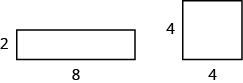
ⓐ Which figure looks like it has the larger area? Which looks like it has the larger perimeter?
ⓑ Now calculate the area and perimeter of each figure. Which has the larger area? Which has the larger perimeter?
Answers will vary.
The length of a rectangle is feet more than the width. The area is square feet. Find the length and the width.
ⓐ Write the equation you would use to solve the problem.
ⓑ Why can’t you solve this equation with the methods you learned in the previous chapter?
Self Check
ⓐ After completing the exercises, use this checklist to evaluate your mastery of the objectives of this section.
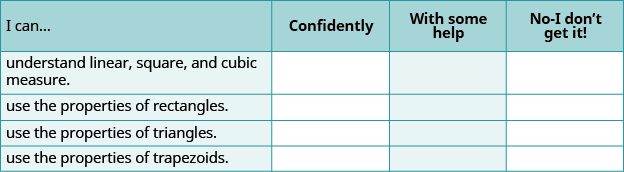
ⓑ On a scale of 1–10, how would you rate your mastery of this section in light of your responses on the checklist? How can you improve this?