
9.5 Solve Geometry Applications: Circles and Irregular Figures
In this section, we’ll continue working with geometry applications. We will add several new formulas to our collection of formulas. To help you as you do the examples and exercises in this section, we will show the Problem Solving Strategy for Geometry Applications here.
Problem Solving Strategy for Geometry Applications
- Read the problem and make sure you understand all the words and ideas. Draw the figure and label it with the given information.
- Identify what you are looking for.
- Name what you are looking for. Choose a variable to represent that quantity.
- Translate into an equation by writing the appropriate formula or model for the situation. Substitute in the given information.
- Solve the equation using good algebra techniques.
- Check the answer in the problem and make sure it makes sense.
- Answer the question with a complete sentence.
Use the Properties of Circles
Do you remember the properties of circles from Decimals and Fractions Together? We’ll show them here again to refer to as we use them to solve applications.
Remember, that we approximate with or depending on whether the radius of the circle is given as a decimal or a fraction. If you use the key on your calculator to do the calculations in this section, your answers will be slightly different from the answers shown. That is because the key uses more than two decimal places.
We usually see the formula for circumference in terms of the radius of the circle:
But since the diameter of a circle is two times the radius, we could write the formula for the circumference in terms
We will use this form of the circumference when we’re given the length of the diameter instead of the radius.
Find the Area of Irregular Figures
So far, we have found area for rectangles, triangles, trapezoids, and circles. An irregular figure is a figure that is not a standard geometric shape. Its area cannot be calculated using any of the standard area formulas. But some irregular figures are made up of two or more standard geometric shapes. To find the area of one of these irregular figures, we can split it into figures whose formulas we know and then add the areas of the figures.
Key Concepts
- Problem Solving Strategy for Geometry Applications
- Read the problem and make sure you understand all the words and ideas. Draw the figure and label it with the given information.
- Identify what you are looking for.
- Name what you are looking for. Choose a variable to represent that quantity.
- Translate into an equation by writing the appropriate formula or model for the situation. Substitute in the given information.
- Solve the equation using good algebra techniques.
- Check the answer in the problem and make sure it makes sense.
- Answer the question with a complete sentence.
- Properties of Circles
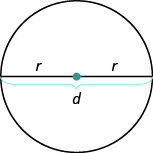
- Circumference: or
- Area:
Practice Makes Perfect
Use the Properties of Circles
In the following exercises, solve using the properties of circles.
The lid of a paint bucket is a circle with radius inches. Find the ⓐ circumference and ⓑ area of the lid.
- ⓐ 43.96 in.
- ⓑ 153.86 sq. in.
An extra-large pizza is a circle with radius inches. Find the ⓐ circumference and ⓑ area of the pizza.
A farm sprinkler spreads water in a circle with radius of feet. Find the ⓐ circumference and ⓑ area of the watered circle.
- ⓐ 53.38 ft
- ⓑ 226.865 sq. ft
A circular rug has radius of feet. Find the ⓐ circumference and ⓑ area of the rug.
A reflecting pool is in the shape of a circle with diameter of feet. What is the circumference of the pool?
62.8 ft
A turntable is a circle with diameter of inches. What is the circumference of the turntable?
A circular saw has a diameter of inches. What is the circumference of the saw?
37.68 in.
A round coin has a diameter of centimeters. What is the circumference of the coin?
A barbecue grill is a circle with a diameter of feet. What is the circumference of the grill?
6.908 ft
The top of a pie tin is a circle with a diameter of inches. What is the circumference of the top?
A circle has a circumference of inches. Find the diameter.
52 in.
A circle has a circumference of feet. Find the diameter.
A circle has a circumference of meters. Find the diameter.
5.5 m
A circle has a circumference of centimeters. Find the diameter.
In the following exercises, find the radius of the circle with given circumference.
A circle has a circumference of feet.
24 ft
A circle has a circumference of centimeters.
A circle has a circumference of miles.
6.5 mi
A circle has a circumference of inches.
Find the Area of Irregular Figures
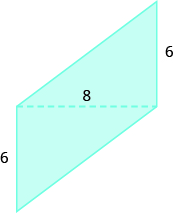
In the following exercises, find the area of the irregular figure. Round your answers to the nearest hundredth.
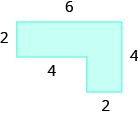
16 sq. units
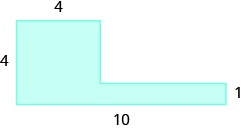
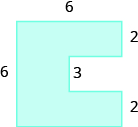
30 sq. units
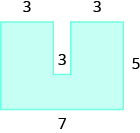
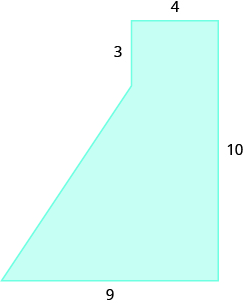
57.5 sq. units
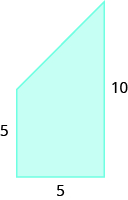
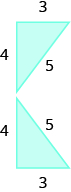
12 sq. units
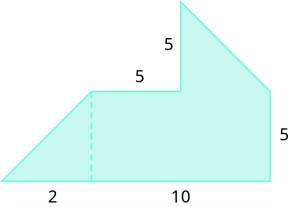
67.5 sq. units
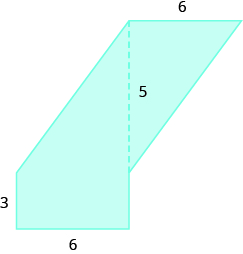
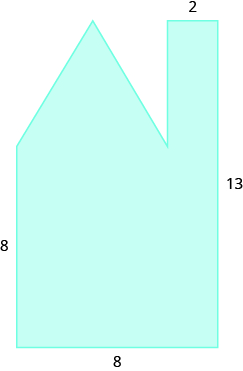
89 sq. units
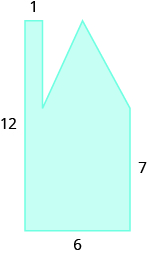
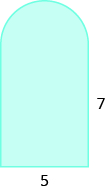
44.81 sq. units
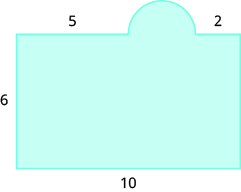
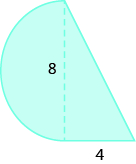
41.12 sq. units
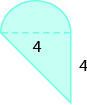
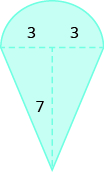
35.13 sq. units
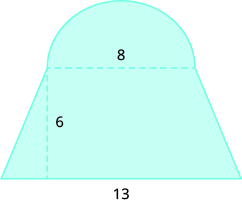
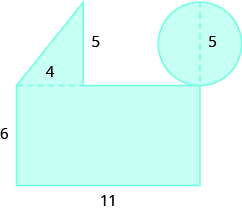
95.625 sq. units
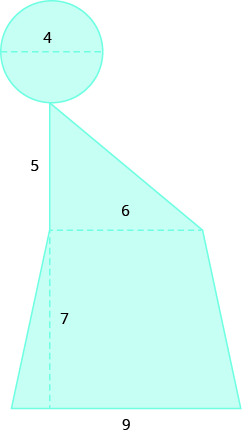
In the following exercises, solve.
A city park covers one block plus parts of four more blocks, as shown. The block is a square with sides feet long, and the triangles are isosceles right triangles. Find the area of the park.
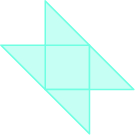
187,500 sq. ft
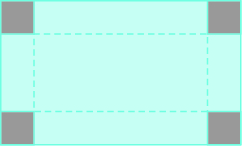
A gift box will be made from a rectangular piece of cardboard measuring inches by inches, with squares cut out of the corners of the sides, as shown. The sides of the squares are inches. Find the area of the cardboard after the corners are cut out.
Perry needs to put in a new lawn. His lot is a rectangle with a length of feet and a width of feet. The house is rectangular and measures feet by feet. His driveway is rectangular and measures feet by feet, as shown. Find the area of Perry’s lawn.
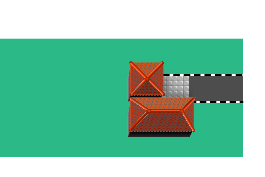
9400 sq. ft
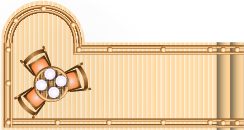
Denise is planning to put a deck in her back yard. The deck will be a by rectangle with a semicircle of diameter feet, as shown below. Find the area of the deck.
Everyday Math
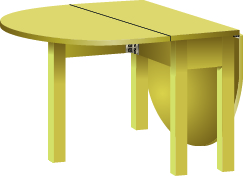
Area of a Tabletop Yuki bought a drop-leaf kitchen table. The rectangular part of the table is a by rectangle with a semicircle at each end, as shown. ⓐ Find the area of the table with one leaf up. ⓑ Find the area of the table with both leaves up.
- ⓐ 6.5325 sq. ft
- ⓑ 10.065 sq. ft
Painting Leora wants to paint the nursery in her house. The nursery is an by rectangle, and the ceiling is feet tall. There is a by door on one wall, a by closet door on another wall, and one by window on the third wall. The fourth wall has no doors or windows. If she will only paint the four walls, and not the ceiling or doors, how many square feet will she need to paint?
Writing Exercises
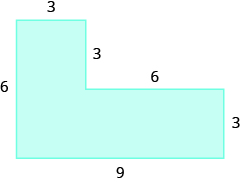
Describe two different ways to find the area of this figure, and then show your work to make sure both ways give the same area.
Answers will vary.
A circle has a diameter of feet. Find the area of the circle ⓐ using for ⓑ using for ⓒ Which calculation to do prefer? Why?
Self Check
ⓐ After completing the exercises, use this checklist to evaluate your mastery of the objectives of this section.

ⓑ After looking at the checklist, do you think you are well prepared for the next section? Why or why not?