
5.4 Solve Equations with Decimals
Determine Whether a Decimal is a Solution of an Equation
Solving equations with decimals is important in our everyday lives because money is usually written with decimals. When applications involve money, such as shopping for yourself, making your family’s budget, or planning for the future of your business, you’ll be solving equations with decimals.
Now that we’ve worked with decimals, we are ready to find solutions to equations involving decimals. The steps we take to determine whether a number is a solution to an equation are the same whether the solution is a whole number, an integer, a fraction, or a decimal. We’ll list these steps here again for easy reference.
Solve Equations with Decimals
In previous chapters, we solved equations using the Properties of Equality. We will use these same properties to solve equations with decimals.
When you add, subtract, multiply or divide the same quantity from both sides of an equation, you still have equality.
Translate to an Equation and Solve
Now that we have solved equations with decimals, we are ready to translate word sentences to equations and solve. Remember to look for words and phrases that indicate the operations to use.
Key Concepts
- Determine whether a number is a solution to an equation.
- Substitute the number for the variable in the equation.
- Simplify the expressions on both sides of the equation.
- Determine whether the resulting equation is true.
If so, the number is a solution.
If not, the number is not a solution.
- Properties of Equality
| Subtraction Property of Equality | Addition Property of Equality |
|---|---|
| For any numbers , , and , | For any numbers , , and , |
| Division of Property of Equality | Multiplication Property of Equality |
| For any numbers , , and , | For any numbers , , and , |
Practice Makes Perfect
Determine Whether a Decimal is a Solution of an Equation
In the following exercises, determine whether each number is a solution of the given equation.
ⓐ ⓑ ⓒ
- ⓐ no
- ⓑ no
- ⓒ yes
ⓐ ⓑ ⓒ
ⓐ ⓑ ⓒ
- ⓐ no
- ⓑ yes
- ⓒ no
ⓐ ⓑ ⓒ
Solve Equations with Decimals
In the following exercises, solve the equation.
y = 2.8
f = −0.85
a = −7.9
c = −4.65
n = 4.4
x = −3.5
j = −4.68
m = −1.42
x = 7
c = −5
p = 3
q = −80
x = 20
z = 2.7
a = −8
x = −0.28
p = 8.25
r = 7.2
Mixed Practice
In the following exercises, solve the equation. Then check your solution.
x = −6
p = −10
m = 8
a = −0.8
r = −1.45
h = 24
Translate to an Equation and Solve
In the following exercises, translate and solve.
The difference of and is
The difference and is
The product of and is
−6.2x = −4.96; 0.8
The product of and is
The quotient of and is
The quotient of and is
The sum of and is
n + (−7.3) = 2.4; 9.7
The sum of and is
Everyday Math
Shawn bought a pair of shoes on sale for . Solve the equation to find the original price of the shoes,
$104
Mary bought a new refrigerator. The total price including sales tax was Find the retail price, of the refrigerator before tax by solving the equation
Writing Exercises
Think about solving the equation but do not actually solve it. Do you think the solution should be greater than or less than Explain your reasoning. Then solve the equation to see if your thinking was correct.
Answers will vary.
Think about solving the equation but do not actually solve it. Do you think the solution should be greater than or less than Explain your reasoning. Then solve the equation to see if your thinking was correct.
Self Check
ⓐ After completing the exercises, use this checklist to evaluate your mastery of the objectives of this section.
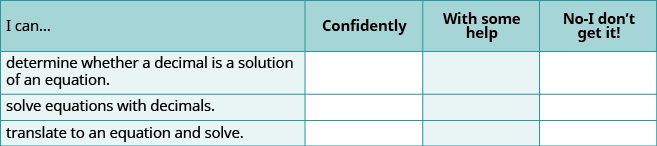
ⓑ On a scale of 1–10, how would you rate your mastery of this section in light of your responses on the checklist? How can you improve this?
Adapted from Prealgebra 2e by OpenStax (openstax.org), licensed under CC BY-NC-SA 4.0. Changes were made. License: CC-BY-NC-SA-4.0.