In Decimals, we learned to convert decimals to fractions. Now we will do the reverse—convert fractions to decimals. Remember that the fraction bar indicates division. So can be written or This means that we can convert a fraction to a decimal by treating it as a division problem.
Repeating Decimals
So far, in all the examples converting fractions to decimals the division resulted in a remainder of zero. This is not always the case. Let’s see what happens when we convert the fraction to a decimal. First, notice that is an improper fraction. Its value is greater than The equivalent decimal will also be greater than
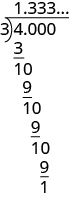
We divide by
No matter how many more zeros we write, there will always be a remainder of and the threes in the quotient will go on forever. The number is called a repeating decimal. Remember that the “…” means that the pattern repeats.
How do you know how many ‘repeats’ to write? Instead of writing we use a shorthand notation by placing a line over the digits that repeat. The repeating decimal is written The line above the tells you that the repeats endlessly. So
For other decimals, two or more digits might repeat. Table 5.5 shows some more examples of repeating decimals.
Table 5.5
is the repeating digit
is the repeating digit
is the repeating block
is the repeating block
It is useful to convert between fractions and decimals when we need to add or subtract numbers in different forms. To add a fraction and a decimal, for example, we would need to either convert the fraction to a decimal or the decimal to a fraction.
Order Decimals and Fractions
In Decimals, we compared two decimals and determined which was larger. To compare a decimal to a fraction, we will first convert the fraction to a decimal and then compare the decimals.
When ordering negative numbers, remember that larger numbers are to the right on the number line and any positive number is greater than any negative number.
Simplify Expressions Using the Order of Operations
The order of operations introduced in Use the Language of Algebra also applies to decimals. Do you remember what the phrase “Please excuse my dear Aunt Sally” stands for?
Find the Circumference and Area of Circles
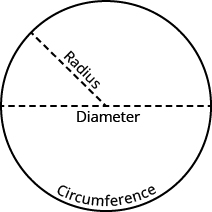
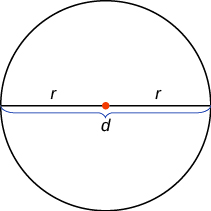
The properties of circles have been studied for over years. All circles have exactly the same shape, but their sizes are affected by the length of the radius, a line segment from the center to any point on the circle. A line segment that passes through a circle’s center connecting two points on the circle is called a diameter. The diameter is twice as long as the radius. See Figure 5.8.
The size of a circle can be measured in two ways. The distance around a circle is called its circumference.
Figure 5.8
Archimedes discovered that for circles of all different sizes, dividing the circumference by the diameter always gives the same number. The value of this number is pi, symbolized by Greek letter (pronounced pie). However, the exact value of cannot be calculated since the decimal never ends or repeats (we will learn more about numbers like this in The Properties of Real Numbers.)
If we want the exact circumference or area of a circle, we leave the symbol in the answer. We can get an approximate answer by substituting as the value of We use the symbol to show that the result is approximate, not exact.
Since the diameter is twice the radius, another way to find the circumference is to use the formula
Suppose we want to find the exact area of a circle of radius inches. To calculate the area, we would evaluate the formula for the area when inches and leave the answer in terms of
We write after the So the exact value of the area is square inches.
To approximate the area, we would substitute
Remember to use square units, such as square inches, when you calculate the area.
Approximate with a Fraction
Convert the fraction to a decimal. If you use your calculator, the decimal number will fill up the display and show But if we round that number to two decimal places, we get the decimal approximation of When we have a circle with radius given as a fraction, we can substitute for instead of And, since is also an approximation of we will use the symbol to show we have an approximate value.
Key Concepts
Convert a Fraction to a Decimal To convert a fraction to a decimal, divide the numerator of the fraction by the denominator of the fraction.
Properties of Circles
is the length of the radius
is the length of the diameter
The circumference is .
The area is .
Practice Makes Perfect
Convert Fractions to Decimals
In the following exercises, convert each fraction to a decimal.
0.4
−0.375
0.85
2.75
−12.4
In the following exercises, simplify the expression.
7
3.025
10.58
Order Decimals and Fractions
In the following exercises, order each pair of numbers, using or
<
>
<
<
>
>
In the following exercises, write each set of numbers in order from least to greatest.
Simplify Expressions Using the Order of Operations
In the following exercises, simplify.
−187
295.12
6.15
20.2
107.11
449
9.14
−0.23
Mixed Practice
In the following exercises, simplify. Give the answer as a decimal.
−3.25
16.29
632.045
−5.742
Find the Circumference and Area of Circles
In the following exercises, approximate the ⓐ circumference and ⓑ area of each circle. If measurements are given in fractions, leave answers in fraction form.
ⓐ 31.4 in
ⓑ 78.5 sq.in.
ⓐ 56.52.ft.
ⓑ 254.34 sq.ft.
ⓐ 288.88 cm
ⓑ 6644.24 sq.cm
ⓐ 116.808 m
ⓑ 1086.3144 sq.m
ⓐ
ⓑ
ⓐ
ⓑ
ⓐ
ⓑ
Everyday Math
Kelly wants to buy a pair of boots that are on sale for of the original price. The original price of the boots is What is the sale price of the shoes?
$56.66
An architect is planning to put a circular mosaic in the entry of a new building. The mosaic will be in the shape of a circle with radius of feet. How many square feet of tile will be needed for the mosaic? (Round your answer up to the next whole number.)
Writing Exercises
Is it easier for you to convert a decimal to a fraction or a fraction to a decimal? Explain.
Answers will vary.
Describe a situation in your life in which you might need to find the area or circumference of a circle.
Self Check
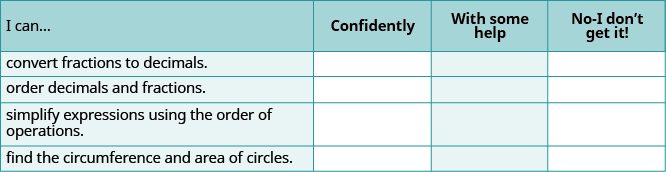
ⓐ After completing the exercises, use this checklist to evaluate your mastery of the objectives of this section.
Figure 5.9
ⓑ What does this checklist tell you about your mastery of this section? What steps will you take to improve?
Adapted from Prealgebra 2e by OpenStax (openstax.org), licensed under CC BY-NC-SA 4.0. Changes were made. License: CC-BY-NC-SA-4.0.
These eBooks are a prerelease and are not yet certified conformant with WCAG 2.1 AA or ADA Title II. Every page is built against an automated accessibility gate, and the published editions will meet ADA Title II requirements when they release in late September 2026. If something is unusable, please tell us.