
5.1 Decimals
Name Decimals
You probably already know quite a bit about decimals based on your experience with money. Suppose you buy a sandwich and a bottle of water for lunch. If the sandwich costs , the bottle of water costs , and the total sales tax is , what is the total cost of your lunch?
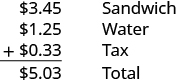
The total is Suppose you pay with a bill and pennies. Should you wait for change? No, and pennies is the same as
Because each penny is worth of a dollar. We write the value of one penny as since
Writing a number with a decimal is known as decimal notation. It is a way of showing parts of a whole when the whole is a power of ten. In other words, decimals are another way of writing fractions whose denominators are powers of ten. Just as the counting numbers are based on powers of ten, decimals are based on powers of ten. Table 5.1 shows the counting numbers.
| Counting number | Name |
|---|---|
| One | |
| Ten | |
| One hundred | |
| One thousand | |
| Ten thousand |
How are decimals related to fractions? Table 5.2 shows the relation.
| Decimal | Fraction | Name |
|---|---|---|
| One tenth | ||
| One hundredth | ||
| One thousandth | ||
| One ten-thousandth |
When we name a whole number, the name corresponds to the place value based on the powers of ten. In Whole Numbers, we learned to read as ten thousand. Likewise, the names of the decimal places correspond to their fraction values. Notice how the place value names in Figure 5.2 relate to the names of the fractions from Table 5.2.
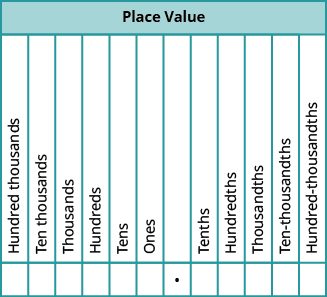
Notice two important facts shown in Figure 5.2.
- The “th” at the end of the name means the number is a fraction. “One thousand” is a number larger than one, but “one thousandth” is a number smaller than one.
- The tenths place is the first place to the right of the decimal, but the tens place is two places to the left of the decimal.
Remember that lunch? We read as five dollars and three cents. Naming decimals (those that don’t represent money) is done in a similar way. We read the number as five and three hundredths.
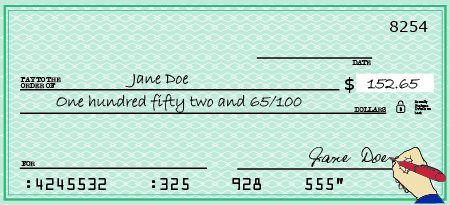
We sometimes need to translate a number written in decimal notation into words. As shown in Figure 5.3, we write the amount on a check in both words and numbers.
| Let’s try naming a decimal, such as 15.68. | |
|---|---|
| We start by naming the number to the left of the decimal. | fifteen______ |
| We use the word “and” to indicate the decimal point. | fifteen and_____ |
| Then we name the number to the right of the decimal point as if it were a whole number. | fifteen and sixty-eight_____ |
| Last, name the decimal place of the last digit. | fifteen and sixty-eight hundredths |
The number is read fifteen and sixty-eight hundredths.
Write Decimals
Now we will translate the name of a decimal number into decimal notation. We will reverse the procedure we just used.
Let’s start by writing the number six and seventeen hundredths:
| six and seventeen hundredths | |
|---|---|
| The word and tells us to place a decimal point. | ___.___ |
| The word before and is the whole number; write it to the left of the decimal point. | 6._____ |
| The decimal part is seventeen hundredths. Mark two places to the right of the decimal point for hundredths. | 6._ _ |
| Write the numerals for seventeen in the places marked. | 6.17 |
The second bullet in Step 2 is needed for decimals that have no whole number part, like ‘nine thousandths’. We recognize them by the words that indicate the place value after the decimal – such as ‘tenths’ or ‘hundredths.’ Since there is no whole number, there is no ‘and.’ We start by placing a zero to the left of the decimal and continue by filling in the numbers to the right, as we did above.
Before we move on to our next objective, think about money again. We know that is the same as The way we write depends on the context. In the same way, integers can be written as decimals with as many zeros as needed to the right of the decimal.
Convert Decimals to Fractions or Mixed Numbers
We often need to rewrite decimals as fractions or mixed numbers. Let’s go back to our lunch order to see how we can convert decimal numbers to fractions. We know that means dollars and cents. Since there are cents in one dollar, cents means of a dollar, so
We convert decimals to fractions by identifying the place value of the farthest right digit. In the decimal the is in the hundredths place, so is the denominator of the fraction equivalent to
For our lunch, we can write the decimal as a mixed number.
Notice that when the number to the left of the decimal is zero, we get a proper fraction. When the number to the left of the decimal is not zero, we get a mixed number.
Locate Decimals on the Number Line
Since decimals are forms of fractions, locating decimals on the number line is similar to locating fractions on the number line.
Order Decimals
Which is larger, or
If you think of this as money, you know that (forty cents) is greater than (four cents). So,
In previous chapters, we used the number line to order numbers.
Where are and located on the number line?

We see that is to the right of So we know
How does compare to This doesn’t translate into money to make the comparison easy. But if we convert and to fractions, we can tell which is larger.
| Convert to fractions. | ||
| We need a common denominator to compare them. |  | |
Because we know that Therefore,
Notice what we did in converting to a fraction—we started with the fraction and ended with the equivalent fraction Converting back to a decimal gives So is equivalent to Writing zeros at the end of a decimal does not change its value.
If two decimals have the same value, they are said to be equivalent decimals.
We say and are equivalent decimals.
Remember, writing zeros at the end of a decimal does not change its value.
When we order negative decimals, it is important to remember how to order negative integers. Recall that larger numbers are to the right on the number line. For example, because lies to the right of on the number line, we know that Similarly, smaller numbers lie to the left on the number line. For example, because lies to the left of on the number line, we know that

If we zoomed in on the interval between and we would see in the same way that
Round Decimals
In the United States, gasoline prices are usually written with the decimal part as thousandths of a dollar. For example, a gas station might post the price of unleaded gas at per gallon. But if you were to buy exactly one gallon of gas at this price, you would pay , because the final price would be rounded to the nearest cent. In Whole Numbers, we saw that we round numbers to get an approximate value when the exact value is not needed. Suppose we wanted to round to the nearest dollar. Is it closer to or to What if we wanted to round to the nearest ten cents; is it closer to or to The number lines in Figure 5.4 can help us answer those questions.

ⓑ We see that is closer to than So we say that rounded to the nearest tenth is
Can we round decimals without number lines? Yes! We use a method based on the one we used to round whole numbers.
Key Concepts
- Name a decimal number.
- Name the number to the left of the decimal point.
- Write “and” for the decimal point.
- Name the “number” part to the right of the decimal point as if it were a whole number.
- Name the decimal place of the last digit.
- Write a decimal number from its name.
- Look for the word “and”—it locates the decimal point.
Place a decimal point under the word “and.” Translate the words before “and” into the whole number and place it to the left of the decimal point.
If there is no “and,” write a “0” with a decimal point to its right. - Mark the number of decimal places needed to the right of the decimal point by noting the place value indicated by the last word.
- Translate the words after “and” into the number to the right of the decimal point. Write the number in the spaces—putting the final digit in the last place.
- Fill in zeros for place holders as needed.
- Look for the word “and”—it locates the decimal point.
- Convert a decimal number to a fraction or mixed number.
- Look at the number to the left of the decimal.
If it is zero, the decimal converts to a proper fraction.
If it is not zero, the decimal converts to a mixed number.
Write the whole number. - Determine the place value of the final digit.
- Write the fraction. numerator—the ‘numbers’ to the right of the decimal point denominator—the place value corresponding to the final digit
- Simplify the fraction, if possible.
- Look at the number to the left of the decimal.
- Order decimals.
- Check to see if both numbers have the same number of decimal places. If not, write zeros at the end of the one with fewer digits to make them match.
- Compare the numbers to the right of the decimal point as if they were whole numbers.
- Order the numbers using the appropriate inequality sign.
- Round a decimal.
- Locate the given place value and mark it with an arrow.
- Underline the digit to the right of the given place value.
- Is this digit greater than or equal to 5?
Yes - add 1 to the digit in the given place value.
No - do not change the digit in the given place value - Rewrite the number, removing all digits to the right of the given place value.
Practice Makes Perfect
Name Decimals
In the following exercises, name each decimal.
five and five tenths
five and one hundredth
eight and seventy-one hundredths
two thousandths
three hundred eighty-one thousandths
negative seventeen and nine tenths
Write Decimals
In the following exercises, translate the name into a decimal number.
Eight and three hundredths
8.03
Nine and seven hundredths
Twenty-nine and eighty-one hundredths
29.81
Sixty-one and seventy-four hundredths
Seven tenths
0.7
Six tenths
One thousandth
0.001
Nine thousandths
Twenty-nine thousandths
0.029
Thirty-five thousandths
Negative eleven and nine ten-thousandths
−11.0009
Negative fifty-nine and two ten-thousandths
Thirteen and three hundred ninety-five ten thousandths
13.0395
Thirty and two hundred seventy-nine thousandths
Convert Decimals to Fractions or Mixed Numbers
In the following exercises, convert each decimal to a fraction or mixed number.
Locate Decimals on the Number Line
In the following exercises, locate each number on a number line.
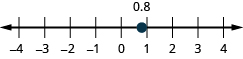
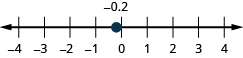
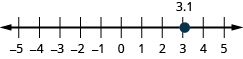
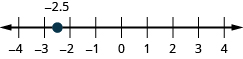
Order Decimals
In the following exercises, order each of the following pairs of numbers, using
>
<
>
>
<
<
Round Decimals
In the following exercises, round each number to the nearest tenth.
0.7
2.8
In the following exercises, round each number to the nearest hundredth.
0.85
5.79
0.30
4.10
In the following exercises, round each number to the nearest ⓐ hundredth ⓑ tenth ⓒ whole number.
- ⓐ 5.78
- ⓑ 5.8
- ⓒ 6
- ⓐ 63.48
- ⓑ 63.5
- ⓒ 63
Everyday Math
Salary Increase Danny got a raise and now makes a year. Round this number to the nearest:
ⓐ dollar
ⓑ thousand dollars
ⓒ ten thousand dollars.
- ⓐ $58,966
- ⓑ $59,000
- ⓒ $60,000
New Car Purchase Selena’s new car cost Round this number to the nearest:
ⓐ dollar
ⓑ thousand dollars
ⓒ ten thousand dollars.
Sales Tax Hyo Jin lives in San Diego. She bought a refrigerator for and when the clerk calculated the sales tax it came out to exactly Round the sales tax to the nearest ⓐ penny ⓑ dollar.
- ⓐ $142.19
- ⓑ $142
Sales Tax Jennifer bought a dining room set for her home in Cincinnati. She calculated the sales tax to be exactly Round the sales tax to the nearest ⓐ penny ⓑ dollar.
Writing Exercises
How does your knowledge of money help you learn about decimals?
Answers will vary.
Explain how you write “three and nine hundredths” as a decimal.
Jim ran a race in Tim ran the same race in Who had the faster time, Jim or Tim? How do you know?
Tim had the faster time. 12.3 is less than 12.32, so Tim had the faster time.
Gerry saw a sign advertising postcards marked for sale at What is wrong with the advertised price?
Self Check
ⓐ After completing the exercises, use this checklist to evaluate your mastery of the objectives of this section.
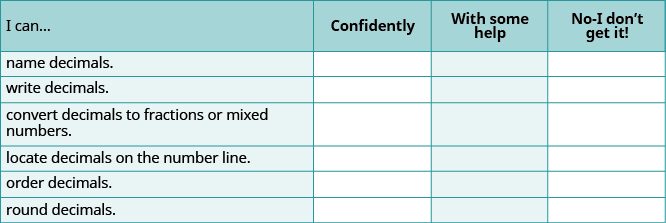
ⓑ If most of your checks were:
…confidently. Congratulations! You have achieved the objectives in this section. Reflect on the study skills you used so that you can continue to use them. What did you do to become confident of your ability to do these things? Be specific.
…with some help. This must be addressed quickly because topics you do not master become potholes in your road to success. In math, every topic builds upon previous work. It is important to make sure you have a strong foundation before you move on. Whom can you ask for help? Your fellow classmates and instructor are good resources. Is there a place on campus where math tutors are available? Can your study skills be improved?
…no—I don’t get it! This is a warning sign and you must not ignore it. You should get help right away or you will quickly be overwhelmed. See your instructor as soon as you can to discuss your situation. Together you can come up with a plan to get you the help you need.
Adapted from Prealgebra 2e by OpenStax (openstax.org), licensed under CC BY-NC-SA 4.0. Changes were made. License: CC-BY-NC-SA-4.0.