
5.2 Decimal Operations
Add and Subtract Decimals
Let’s take one more look at the lunch order from the start of Decimals, this time noticing how the numbers were added together.
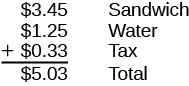
All three items (sandwich, water, tax) were priced in dollars and cents, so we lined up the dollars under the dollars and the cents under the cents, with the decimal points lined up between them. Then we just added each column, as if we were adding whole numbers. By lining up decimals this way, we can add or subtract the corresponding place values just as we did with whole numbers.
How much change would you get if you handed the cashier a bill for a purchase? We will show the steps to calculate this in the next example.
Multiply Decimals
Multiplying decimals is very much like multiplying whole numbers—we just have to determine where to place the decimal point. The procedure for multiplying decimals will make sense if we first review multiplying fractions.
Do you remember how to multiply fractions? To multiply fractions, you multiply the numerators and then multiply the denominators.
So let’s see what we would get as the product of decimals by converting them to fractions first. We will do two examples side-by-side in Table 5.3. Look for a pattern.
| A | B | |
|---|---|---|
| Convert to fractions. | ||
| Multiply. | ||
| Convert back to decimals. |
There is a pattern that we can use. In A, we multiplied two numbers that each had one decimal place, and the product had two decimal places. In B, we multiplied a number with one decimal place by a number with two decimal places, and the product had three decimal places.
How many decimal places would you expect for the product of If you said “five”, you recognized the pattern. When we multiply two numbers with decimals, we count all the decimal places in the factors—in this case two plus three—to get the number of decimal places in the product—in this case five.
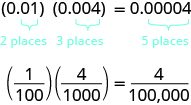
Once we know how to determine the number of digits after the decimal point, we can multiply decimal numbers without converting them to fractions first. The number of decimal places in the product is the sum of the number of decimal places in the factors.
The rules for multiplying positive and negative numbers apply to decimals, too, of course.
When you multiply signed decimals, first determine the sign of the product and then multiply as if the numbers were both positive. Finally, write the product with the appropriate sign.
In the next example, we’ll need to add several placeholder zeros to properly place the decimal point.
Multiply by Powers of
In many fields, especially in the sciences, it is common to multiply decimals by powers of Let’s see what happens when we multiply by some powers of
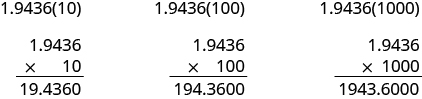
Look at the results without the final zeros. Do you notice a pattern?
The number of places that the decimal point moved is the same as the number of zeros in the power of ten. Table 5.4 summarizes the results.
| Multiply by | Number of zeros | Number of places decimal point moves |
|---|---|---|
| place to the right | ||
| places to the right | ||
| places to the right | ||
| places to the right |
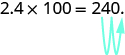
We can use this pattern as a shortcut to multiply by powers of ten instead of multiplying using the vertical format. We can count the zeros in the power of and then move the decimal point that same of places to the right.
So, for example, to multiply by move the decimal point places to the right.
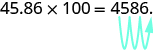
Sometimes when we need to move the decimal point, there are not enough decimal places. In that case, we use zeros as placeholders. For example, let’s multiply by We need to move the decimal point places to the right. Since there is only one digit to the right of the decimal point, we must write a in the hundredths place.
Divide Decimals
Just as with multiplication, division of decimals is very much like dividing whole numbers. We just have to figure out where the decimal point must be placed.
To understand decimal division, let’s consider the multiplication problem
Remember, a multiplication problem can be rephrased as a division problem. So we can write
We can think of this as “If we divide 8 tenths into four groups, how many are in each group?” Figure 5.6 shows that there are four groups of two-tenths in eight-tenths. So

Using long division notation, we would write

Notice that the decimal point in the quotient is directly above the decimal point in the dividend.
To divide a decimal by a whole number, we place the decimal point in the quotient above the decimal point in the dividend and then divide as usual. Sometimes we need to use extra zeros at the end of the dividend to keep dividing until there is no remainder.
In everyday life, we divide whole numbers into decimals—money—to find the price of one item. For example, suppose a case of water bottles cost To find the price per water bottle, we would divide by and round the answer to the nearest cent (hundredth).
Divide a Decimal by Another Decimal
So far, we have divided a decimal by a whole number. What happens when we divide a decimal by another decimal? Let’s look at the same multiplication problem we looked at earlier, but in a different way.
Remember, again, that a multiplication problem can be rephrased as a division problem. This time we ask, “How many times does go into Because we can say that goes into four times. This means that divided by is
We would get the same answer, if we divide by both whole numbers. Why is this so? Let’s think about the division problem as a fraction.
We multiplied the numerator and denominator by and ended up just dividing by To divide decimals, we multiply both the numerator and denominator by the same power of to make the denominator a whole number. Because of the Equivalent Fractions Property, we haven’t changed the value of the fraction. The effect is to move the decimal points in the numerator and denominator the same number of places to the right.
We use the rules for dividing positive and negative numbers with decimals, too. When dividing signed decimals, first determine the sign of the quotient and then divide as if the numbers were both positive. Finally, write the quotient with the appropriate sign.
It may help to review the vocabulary for division:

Now we will divide a whole number by a decimal number.
Use Decimals in Money Applications
We often apply decimals in real life, and most of the applications involving money. The Strategy for Applications we used in The Language of Algebra gives us a plan to follow to help find the answer. Take a moment to review that strategy now.
Be careful to follow the order of operations in the next example. Remember to multiply before you add.
Key Concepts
- Add or subtract decimals.
- Write the numbers vertically so the decimal points line up.
- Use zeros as place holders, as needed.
- Add or subtract the numbers as if they were whole numbers. Then place the decimal in the answer under the decimal points in the given numbers.
- Multiply decimal numbers.
- Determine the sign of the product.
- Write the numbers in vertical format, lining up the numbers on the right.
- Multiply the numbers as if they were whole numbers, temporarily ignoring the decimal points.
- Place the decimal point. The number of decimal places in the product is the sum of the number of decimal places in the factors. If needed, use zeros as placeholders.
- Write the product with the appropriate sign.
- Multiply a decimal by a power of 10.
- Move the decimal point to the right the same number of places as the number of zeros in the power of 10.
- Write zeros at the end of the number as placeholders if needed.
- Divide a decimal by a whole number.
- Write as long division, placing the decimal point in the quotient above the decimal point in the dividend.
- Divide as usual.
- Divide decimal numbers.
- Determine the sign of the quotient.
- Make the divisor a whole number by moving the decimal point all the way to the right. Move the decimal point in the dividend the same number of places to the right, writing zeros as needed.
- Divide. Place the decimal point in the quotient above the decimal point in the dividend.
- Write the quotient with the appropriate sign.
- Strategy for Applications
- Identify what you are asked to find.
- Write a phrase that gives the information to find it.
- Translate the phrase to an expression.
- Simplify the expression.
- Answer the question with a complete sentence.
Practice Makes Perfect
Add and Subtract Decimals
In the following exercises, add or subtract.
24.48
170.88
−9.23
49.73
−40.91
−7.22
−13.5
35.8
−27.5
15.73
42.51
102.212
51.31
−4.89
Multiply Decimals
In the following exercises, multiply.
0.12
0.144
42.008
26.7528
−11.653
337.8914
2.2302
1.305
92.4
55,200
Divide Decimals
In the following exercises, divide.
0.03
0.19
$0.71
$2.44
3
−4.8
35
2.08
150
20
Mixed Practice
In the following exercises, simplify.
19.2
12.09
32.706
$48.60
20
2
$17.80
Use Decimals in Money Applications
In the following exercises, use the strategy for applications to solve.
Spending money Brenda got from the ATM. She spent on a pair of earrings. How much money did she have left?
$24.89
Spending money Marissa found in her pocket. She spent on a smoothie. How much of the did she have left?
Shopping Adam bought a t-shirt for and a book for The sales tax was How much did Adam spend?
$29.06
Restaurant Roberto’s restaurant bill was for the entrée and for the drink. He left a tip. How much did Roberto spend?
Coupon Emily bought a box of cereal that cost She had a coupon for off, and the store doubled the coupon. How much did she pay for the box of cereal?
$3.19
Coupon Diana bought a can of coffee that cost She had a coupon for off, and the store doubled the coupon. How much did she pay for the can of coffee?
Diet Leo took part in a diet program. He weighed pounds at the start of the program. During the first week, he lost pounds. During the second week, he had lost pounds. The third week, he gained pounds. The fourth week, he lost pounds. What did Leo weigh at the end of the fourth week?
181.7 pounds
Snowpack On April the snowpack at the ski resort was meters deep, but the next few days were very warm. By April the snow depth was meters less. On April it snowed and added meters of snow. What was the total depth of the snow?
Coffee Noriko bought coffees for herself and her co-workers. Each coffee was How much did she pay for all the coffees?
$15.00
Subway Fare Arianna spends per day on subway fare. Last week she rode the subway days. How much did she spend for the subway fares?
Income Mayra earns per hour. Last week she worked hours. How much did she earn?
$296.00
Income Peter earns per hour. Last week he worked hours. How much did he earn?
Hourly Wage Alan got his first paycheck from his new job. He worked hours and earned How much does he earn per hour?
$12.75
Hourly Wage Maria got her first paycheck from her new job. She worked hours and earned How much does she earn per hour?
Restaurant Jeannette and her friends love to order mud pie at their favorite restaurant. They always share just one piece of pie among themselves. With tax and tip, the total cost is How much does each girl pay if the total number sharing the mud pie is
ⓐ
ⓑ
ⓒ
ⓓ
ⓔ
- ⓐ $3
- ⓑ $2
- ⓒ $1.50
- ⓓ $1.20
- ⓔ $1
Pizza Alex and his friends go out for pizza and video games once a week. They share the cost of a pizza equally. How much does each person pay if the total number sharing the pizza is
ⓐ
ⓑ
ⓒ
ⓓ
ⓔ
Fast Food At their favorite fast food restaurant, the Carlson family orders burgers that cost each and orders of fries at each. What is the total cost of the order?
$18.64
Home Goods Chelsea needs towels to take with her to college. She buys bath towels that cost each and washcloths that cost each. What is the total cost for the bath towels and washcloths?
Zoo The Lewis and Chousmith families are planning to go to the zoo together. Adult tickets cost and children’s tickets cost What will the total cost be for adults and children?
$259.45
Ice Skating Jasmine wants to have her birthday party at the local ice skating rink. It will cost per child and per adult. What will the total cost be for children and adults?
Everyday Math
Paycheck Annie has two jobs. She gets paid per hour for tutoring at City College and per hour at a coffee shop. Last week she tutored for hours and worked at the coffee shop for hours.
ⓐ How much did she earn?
ⓑ If she had worked all hours as a tutor instead of working both jobs, how much more would she have earned?
- ⓐ $243.57
- ⓑ $79.35
Paycheck Jake has two jobs. He gets paid per hour at the college cafeteria and at the art gallery. Last week he worked hours at the cafeteria and hours at the art gallery.
ⓐ How much did he earn?
ⓑ If he had worked all hours at the art gallery instead of working both jobs, how much more would he have earned?
Writing Exercises
At the 2010 winter Olympics, two skiers took the silver and bronze medals in the Men's Super-G ski event. Miller's time was minute seconds and Weibrecht's time was minute seconds. Find the difference in their times and then write the name of that decimal.
The difference: 0.03 seconds. Three hundredths of a second.
Find the quotient of and explain in words all the steps taken.
Self Check
ⓐ After completing the exercises, use this checklist to evaluate your mastery of the objectives of this section.
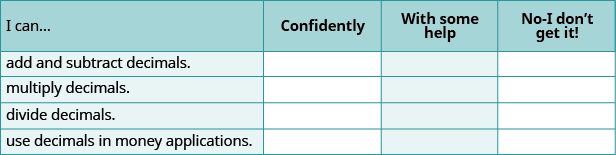
ⓑ After reviewing this checklist, what will you do to become confident for all objectives?
Adapted from Prealgebra 2e by OpenStax (openstax.org), licensed under CC BY-NC-SA 4.0. Changes were made. License: CC-BY-NC-SA-4.0.