
4.4 Add and Subtract Fractions with Common Denominators
Model Fraction Addition
How many quarters are pictured? One quarter plus quarters equals quarters.

Remember, quarters are really fractions of a dollar. Quarters are another way to say fourths. So the picture of the coins shows that
Let’s use fraction circles to model the same example,
| Start with one piece. |  |  |
|---|---|---|
| Add two more pieces. | 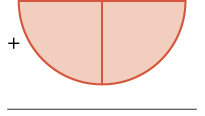 | 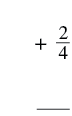 |
| The result is . | 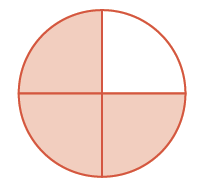 |  |
So again, we see that
Add Fractions with a Common Denominator
Example 1 shows that to add the same-size pieces—meaning that the fractions have the same denominator—we just add the number of pieces.
Model Fraction Subtraction
Subtracting two fractions with common denominators is much like adding fractions. Think of a pizza that was cut into slices. Suppose five pieces are eaten for dinner. This means that, after dinner, there are seven pieces (or of the pizza) left in the box. If Leonardo eats of these remaining pieces (or of the pizza), how much is left? There would be pieces left (or of the pizza).
Let’s use fraction circles to model the same example,
Start with seven pieces. Take away two pieces. How many twelfths are left?
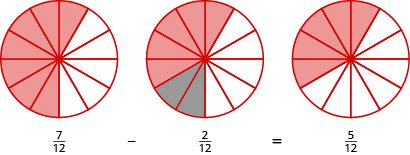
Again, we have five twelfths,
Subtract Fractions with a Common Denominator
We subtract fractions with a common denominator in much the same way as we add fractions with a common denominator.
Now lets do an example that involves both addition and subtraction.
Key Concepts
- Fraction Addition
- If and are numbers where , then .
- To add fractions, add the numerators and place the sum over the common denominator.
- Fraction Subtraction
- If and are numbers where , then .
- To subtract fractions, subtract the numerators and place the difference over the common denominator.
Practice Makes Perfect
Model Fraction Addition
In the following exercises, use a model to add the fractions. Show a diagram to illustrate your model.
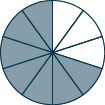

Add Fractions with a Common Denominator
In the following exercises, find each sum.
Model Fraction Subtraction
In the following exercises, use a model to subtract the fractions. Show a diagram to illustrate your model.

Subtract Fractions with a Common Denominator
In the following exercises, find the difference.
Mixed Practice
In the following exercises, perform the indicated operation and write your answers in simplified form.
Everyday Math
Trail Mix Jacob is mixing together nuts and raisins to make trail mix. He has of a pound of nuts and of a pound of raisins. How much trail mix can he make?
Baking Janet needs of a cup of flour for a recipe she is making. She only has of a cup of flour and will ask to borrow the rest from her next-door neighbor. How much flour does she have to borrow?
cup
Writing Exercises
Greg dropped his case of drill bits and three of the bits fell out. The case has slots for the drill bits, and the slots are arranged in order from smallest to largest. Greg needs to put the bits that fell out back in the case in the empty slots. Where do the three bits go? Explain how you know.
Bits in case: , , ___, ___, , , ___, , , .
Bits that fell out: , , .
After a party, Lupe has of a cheese pizza, of a pepperoni pizza, and of a veggie pizza left. Will all the slices fit into pizza box? Explain your reasoning.
No, adding up the number of pieces gives , which is greater than 1. (Answers may vary.)
Self Check
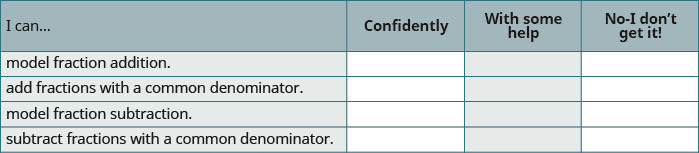
ⓐ After completing the exercises, use this checklist to evaluate your mastery of the objectives of this section.
ⓑ On a scale of 1–10, how would you rate your mastery of this section in light of your responses on the checklist? How can you improve this?