
4.3 Multiply and Divide Mixed Numbers and Complex Fractions
Multiply and Divide Mixed Numbers
In the previous section, you learned how to multiply and divide fractions. All of the examples there used either proper or improper fractions. What happens when you are asked to multiply or divide mixed numbers? Remember that we can convert a mixed number to an improper fraction. And you learned how to do that in Visualize Fractions.
Translate Phrases to Expressions with Fractions
The words quotient and ratio are often used to describe fractions. In Subtract Whole Numbers, we defined quotient as the result of division. The quotient of and is the result you get from dividing by or Let’s practice translating some phrases into algebraic expressions using these terms.
Simplify Complex Fractions
Our work with fractions so far has included proper fractions, improper fractions, and mixed numbers. Another kind of fraction is called complex fraction, which is a fraction in which the numerator or the denominator contains a fraction.
Some examples of complex fractions are:
To simplify a complex fraction, remember that the fraction bar means division. So the complex fraction can be written as
Simplify Expressions with a Fraction Bar
Where does the negative sign go in a fraction? Usually, the negative sign is placed in front of the fraction, but you will sometimes see a fraction with a negative numerator or denominator. Remember that fractions represent division. The fraction could be the result of dividing a negative by a positive, or of dividing a positive by a negative. When the numerator and denominator have different signs, the quotient is negative.

If both the numerator and denominator are negative, then the fraction itself is positive because we are dividing a negative by a negative.
Fraction bars act as grouping symbols. The expressions above and below the fraction bar should be treated as if they were in parentheses. For example, means The order of operations tells us to simplify the numerator and the denominator first—as if there were parentheses—before we divide.
We’ll add fraction bars to our set of grouping symbols from Use the Language of Algebra to have a more complete set here.
Key Concepts
- Multiply or divide mixed numbers.
- Convert the mixed numbers to improper fractions.
- Follow the rules for fraction multiplication or division.
- Simplify if possible.
- Simplify a complex fraction.
- Rewrite the complex fraction as a division problem.
- Follow the rules for dividing fractions.
- Simplify if possible.
- Placement of negative sign in a fraction.
- For any positive numbers and , .
- Simplify an expression with a fraction bar.
- Simplify the numerator.
- Simplify the denominator.
- Simplify the fraction.
Practice Makes Perfect
Multiply and Divide Mixed Numbers
In the following exercises, multiply and write the answer in simplified form.
In the following exercises, divide, and write your answer in simplified form.
2
5
Translate Phrases to Expressions with Fractions
In the following exercises, translate each English phrase into an algebraic expression.
the quotient of and
the quotient of and
the quotient of and
the quotient of and
the quotient of and the sum of and
the quotient of and the difference of and
Simplify Complex Fractions
In the following exercises, simplify the complex fraction.
28
Simplify Expressions with a Fraction Bar
In the following exercises, identify the equivalent fractions.
Which of the following fractions are equivalent to
Which of the following fractions are equivalent to
Which of the following fractions are equivalent to
Which of the following fractions are equivalent to
In the following exercises, simplify.
2
−10
−2
Everyday Math
Baking A recipe for chocolate chip cookies calls for cups of flour. Graciela wants to double the recipe.
- ⓐ How much flour will Graciela need? Show your calculation. Write your result as an improper fraction and as a mixed number.
- ⓑ Measuring cups usually come in sets with cups for and cup. Draw a diagram to show two different ways that Graciela could measure out the flour needed to double the recipe.
Baking A booth at the county fair sells fudge by the pound. Their award winning “Chocolate Overdose” fudge contains cups of chocolate chips per pound.
- ⓐ How many cups of chocolate chips are in a half-pound of the fudge?
- ⓑ The owners of the booth make the fudge in -pound batches. How many chocolate chips do they need to make a -pound batch? Write your results as improper fractions and as a mixed numbers.
- ⓐ cups
- ⓑ cups
Writing Exercises
Explain how to find the reciprocal of a mixed number.
Explain how to multiply mixed numbers.
Answers will vary.
Randy thinks that is Explain what is wrong with Randy’s thinking.
Explain why and are equivalent.
Answers will vary.
Self Check
ⓐ After completing the exercises, use this checklist to evaluate your mastery of the objectives of this section.
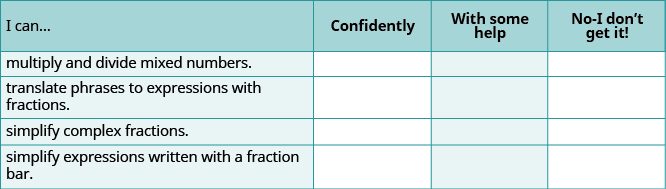
ⓑ What does this checklist tell you about your mastery of this section? What steps will you take to improve?