
4.7 Solve Equations with Fractions
Determine Whether a Fraction is a Solution of an Equation
As we saw in Solve Equations with the Subtraction and Addition Properties of Equality and Solve Equations Using Integers; The Division Property of Equality, a solution of an equation is a value that makes a true statement when substituted for the variable in the equation. In those sections, we found whole number and integer solutions to equations. Now that we have worked with fractions, we are ready to find fraction solutions to equations.
The steps we take to determine whether a number is a solution to an equation are the same whether the solution is a whole number, an integer, or a fraction.
Solve Equations with Fractions using the Addition, Subtraction, and Division Properties of Equality
In Solve Equations with the Subtraction and Addition Properties of Equality and Solve Equations Using Integers; The Division Property of Equality, we solved equations using the Addition, Subtraction, and Division Properties of Equality. We will use these same properties to solve equations with fractions.
We used the Subtraction Property of Equality in Example 2. Now we’ll use the Addition Property of Equality.
The next example may not seem to have a fraction, but let’s see what happens when we solve it.
Solve Equations with Fractions Using the Multiplication Property of Equality
Consider the equation We want to know what number divided by gives So to “undo” the division, we will need to multiply by The Multiplication Property of Equality will allow us to do this. This property says that if we start with two equal quantities and multiply both by the same number, the results are equal.
Let’s use the Multiplication Property of Equality to solve the equation
Solve Equations with a Coefficient of
Look at the equation Does it look as if is already isolated? But there is a negative sign in front of so it is not isolated.
There are three different ways to isolate the variable in this type of equation. We will show all three ways in Example 7.
Solve Equations with a Fraction Coefficient
When we have an equation with a fraction coefficient we can use the Multiplication Property of Equality to make the coefficient equal to
For example, in the equation:
The coefficient of is To solve for we need its coefficient to be Since the product of a number and its reciprocal is our strategy here will be to isolate by multiplying by the reciprocal of We will do this in Example 8.
Translate Sentences to Equations and Solve
Now we have covered all four properties of equality—subtraction, addition, division, and multiplication. We’ll list them all together here for easy reference.
| Subtraction Property of Equality: For any real numbers and if then | Addition Property of Equality: For any real numbers and if then |
|---|---|
| Division Property of Equality: For any numbers and where if then | Multiplication Property of Equality: For any real numbers and if then |
When you add, subtract, multiply or divide the same quantity from both sides of an equation, you still have equality.
In the next few examples, we’ll translate sentences into equations and then solve the equations. It might be helpful to review the translation table in Evaluate, Simplify, and Translate Expressions.
Key Concepts
- Determine whether a number is a solution to an equation.
- Substitute the number for the variable in the equation.
- Simplify the expressions on both sides of the equation.
- Determine whether the resulting equation is true. If it is true, the number is a solution. If it is not true, the number is not a solution.
- Addition, Subtraction, and Division Properties of Equality
- For any numbers a, b, and c,
if , then . Addition Property of Equality - if , then . Subtraction Property of Equality
- if , then , . Division Property of Equality
- For any numbers a, b, and c,
- The Multiplication Property of Equality
- For any numbers and , then .
- If you multiply both sides of an equation by the same quantity, you still have equality.
Section Exercises
Practice Makes Perfect
Determine Whether a Fraction is a Solution of an Equation
In the following exercises, determine whether each number is a solution of the given equation.
:
- ⓐ
- ⓑ
- ⓒ
:
- ⓐ
- ⓑ
- ⓒ
- ⓐ no
- ⓑ yes
- ⓒ no
:
- ⓐ
- ⓑ
- ⓒ
:
- ⓐ
- ⓑ
- ⓒ
- ⓐ no
- ⓑ yes
- ⓒ no
Solve Equations with Fractions using the Addition, Subtraction, and Division Properties of Equality
In the following exercises, solve.
c = −1
z = −1
Solve Equations with Fractions Using the Multiplication Property of Equality
In the following exercises, solve.
b = −27
x = −256
q = 160
s = 45
y = −42
p = 100
m = −16
b = −21
v = 36
Mixed Practice
In the following exercises, solve.
y = 0
Translate Sentences to Equations and Solve
In the following exercises, translate to an algebraic equation and solve.
divided by eight is
divided by six is
divided by is
divided by is
The quotient of and is
The quotient of and is
The quotient of and twelve is
The quotient of and nine is
Three-fourths of is
Two-fifths of is
Seven-tenths of is
Four-ninths of is
divided by equals negative
The quotient of and is
Three-fourths of is
The quotient of and is
The sum of five-sixths and is
The sum of three-fourths and is
The difference of and one-fourth is
The difference of and one-third is
Everyday Math
Shopping Teresa bought a pair of shoes on sale for . The sale price was of the regular price. Find the regular price of the shoes by solving the equation
Playhouse The table in a child’s playhouse is of an adult-size table. The playhouse table is inches high. Find the height of an adult-size table by solving the equation
30 inches
Writing Exercises
Example 6 describes three methods to solve the equation Which method do you prefer? Why?
Richard thinks the solution to the equation is Explain why Richard is wrong.
Answers will vary.
Self Check
ⓐ After completing the exercises, use this checklist to evaluate your mastery of the objectives of this section.
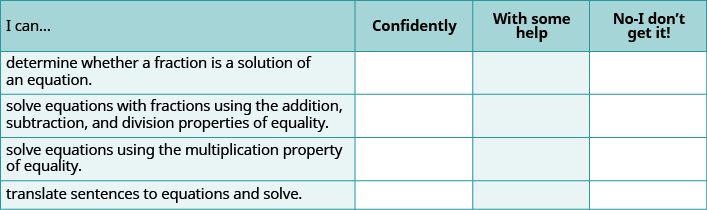
ⓑ Overall, after looking at the checklist, do you think you are well-prepared for the next Chapter? Why or why not?
Chapter Review Exercises
Visualize Fractions
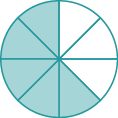
In the following exercises, name the fraction of each figure that is shaded.

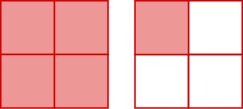
In the following exercises, name the improper fractions. Then write each improper fraction as a mixed number.

In the following exercises, convert the improper fraction to a mixed number.
In the following exercises, convert the mixed number to an improper fraction.
Find three fractions equivalent to Show your work, using figures or algebra.
Find three fractions equivalent to Show your work, using figures or algebra.
Answers may vary.
In the following exercises, locate the numbers on a number line.
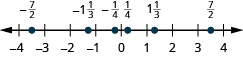
In the following exercises, order each pair of numbers, using or
>
Multiply and Divide Fractions
In the following exercises, simplify.
In the following exercises, multiply.
6
In the following exercises, find the reciprocal.
−4
Fill in the chart.
| Opposite | Absolute Value | Reciprocal | |
|---|---|---|---|
In the following exercises, divide.
4
Multiply and Divide Mixed Numbers and Complex Fractions
In the following exercises, perform the indicated operation.
8
In the following exercises, translate the English phrase into an algebraic expression.
the quotient of and
the quotient of and the difference of and
In the following exercises, simplify the complex fraction
22
In the following exercises, simplify.
Add and Subtract Fractions with Common Denominators
In the following exercises, add.
In the following exercises, subtract.
Add and Subtract Fractions with Different Denominators
In the following exercises, find the least common denominator.
and
and
15
and
and
60
In the following exercises, change to equivalent fractions using the given LCD.
and LCD
and LCD
and
and LCD
and LCD
and
In the following exercises, perform the indicated operations and simplify.
In the following exercises, evaluate.
when
- ⓐ
- ⓑ
- ⓐ
- ⓑ
when and
Add and Subtract Mixed Numbers
In the following exercises, perform the indicated operation.
Solve Equations with Fractions
In the following exercises, determine whether each number is a solution of the given equation.
:
- ⓐ
- ⓑ
- ⓒ
- ⓐ no
- ⓑ yes
- ⓒ no
:
- ⓐ
- ⓑ
- ⓒ
In the following exercises, solve the equation.
z = −23
In the following exercises, translate and solve.
The sum of two-thirds and is
The difference of and one-tenth is
The quotient of and is
Three-eighths of is
Chapter Practice Test
Convert the improper fraction to a mixed number.
Convert the mixed number to an improper fraction.
Locate the numbers on a number line.
and
In the following exercises, simplify.
16u
−2
5
13
−1
3
Evaluate.
when
- ⓐ
- ⓑ
In the following exercises, solve the equation.
c = −27
Translate and solve: The quotient of and is Solve for
Adapted from Prealgebra 2e by OpenStax (openstax.org), licensed under CC BY-NC-SA 4.0. Changes were made. License: CC-BY-NC-SA-4.0.