
4.2 Multiply and Divide Fractions
Simplify Fractions
In working with equivalent fractions, you saw that there are many ways to write fractions that have the same value, or represent the same part of the whole. How do you know which one to use? Often, we’ll use the fraction that is in simplified form.
A fraction is considered simplified if there are no common factors, other than in the numerator and denominator. If a fraction does have common factors in the numerator and denominator, we can reduce the fraction to its simplified form by removing the common factors.
For example,
- is simplified because there are no common factors of and
- is not simplified because is a common factor of and
The process of simplifying a fraction is often called reducing the fraction. In the previous section, we used the Equivalent Fractions Property to find equivalent fractions. We can also use the Equivalent Fractions Property in reverse to simplify fractions. We rewrite the property to show both forms together.
Notice that is a common factor in the numerator and denominator. Anytime we have a common factor in the numerator and denominator, it can be removed.
To simplify a negative fraction, we use the same process as in Example 1. Remember to keep the negative sign.
After simplifying a fraction, it is always important to check the result to make sure that the numerator and denominator do not have any more factors in common. Remember, the definition of a simplified fraction: a fraction is considered simplified if there are no common factors in the numerator and denominator.
When we simplify an improper fraction, there is no need to change it to a mixed number.
Sometimes it may not be easy to find common factors of the numerator and denominator. A good idea, then, is to factor the numerator and the denominator into prime numbers. (You may want to use the factor tree method to identify the prime factors.) Then divide out the common factors using the Equivalent Fractions Property.
We can also simplify fractions containing variables. If a variable is a common factor in the numerator and denominator, we remove it just as we do with an integer factor.
Multiply Fractions
A model may help you understand multiplication of fractions. We will use fraction tiles to model To multiply and think of
Start with fraction tiles for three-fourths. To find one-half of three-fourths, we need to divide them into two equal groups. Since we cannot divide the three tiles evenly into two parts, we exchange them for smaller tiles.
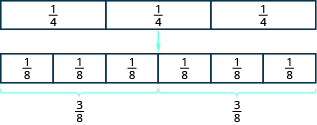
We see is equivalent to Taking half of the six tiles gives us three tiles, which is
Therefore,
Look at the result we got from the model in Example 6. We found that Do you notice that we could have gotten the same answer by multiplying the numerators and multiplying the denominators?
| Multiply the numerators, and multiply the denominators. | |
| Simplify. |
This leads to the definition of fraction multiplication. To multiply fractions, we multiply the numerators and multiply the denominators. Then we write the fraction in simplified form.
When multiplying fractions, the properties of positive and negative numbers still apply. It is a good idea to determine the sign of the product as the first step. In Example 8 we will multiply two negatives, so the product will be positive.
When multiplying a fraction by an integer, it may be helpful to write the integer as a fraction. Any integer, can be written as So, for example.
Find Reciprocals
The fractions and are related to each other in a special way. So are and Do you see how? Besides looking like upside-down versions of one another, if we were to multiply these pairs of fractions, the product would be
Such pairs of numbers are called reciprocals.
To find the reciprocal of a fraction, we invert the fraction. This means that we place the numerator in the denominator and the denominator in the numerator.
To get a positive result when multiplying two numbers, the numbers must have the same sign. So reciprocals must have the same sign.
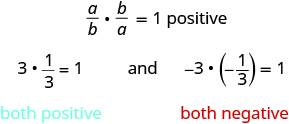
To find the reciprocal, keep the same sign and invert the fraction. The number zero does not have a reciprocal. Why? A number and its reciprocal multiply to Is there any number so that No. So, the number does not have a reciprocal.
In a previous chapter, we worked with opposites and absolute values. Table 4.1 compares opposites, absolute values, and reciprocals.
| Opposite | Absolute Value | Reciprocal |
|---|---|---|
| has opposite sign | is never negative | has same sign, fraction inverts |
Divide Fractions
Why is We previously modeled this with counters. How many groups of counters can be made from a group of counters?

There are groups of counters. In other words, there are four s in So,
What about dividing fractions? Suppose we want to find the quotient: We need to figure out how many s there are in We can use fraction tiles to model this division. We start by lining up the half and sixth fraction tiles as shown in Figure 4.6. Notice, there are three tiles in so

Let’s use money to model in another way. We often read as a ‘quarter’, and we know that a quarter is one-fourth of a dollar as shown in Figure 4.7. So we can think of as, “How many quarters are there in two dollars?” One dollar is quarters, so dollars would be quarters. So again,

Using fraction tiles, we showed that Notice that also. How are and related? They are reciprocals. This leads us to the procedure for fraction division.
We need to say and to be sure we don’t divide by zero.
Key Concepts
- Equivalent Fractions Property
- If are numbers where , , then and .
- Simplify a fraction.
- Rewrite the numerator and denominator to show the common factors. If needed, factor the numerator and denominator into prime numbers.
- Simplify, using the equivalent fractions property, by removing common factors.
- Multiply any remaining factors.
- Fraction Multiplication
- If and are numbers where and , then .
- Reciprocal
- A number and its reciprocal have a product of .
Table 4.2 Opposite Absolute Value Reciprocal has opposite sign is never negative has same sign, fraction inverts
- Fraction Division
- If and are numbers where , and , then
- To divide fractions, multiply the first fraction by the reciprocal of the second.
- If and are numbers where , and , then
Practice Makes Perfect
Simplify Fractions
In the following exercises, simplify each fraction. Do not convert any improper fractions to mixed numbers.
Multiply Fractions
In the following exercises, use a diagram to model.


In the following exercises, multiply, and write the answer in simplified form.
9n
7p
−34
Find Reciprocals
In the following exercises, find the reciprocal.
1
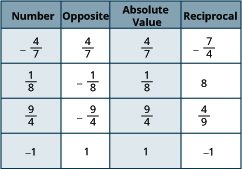
Fill in the chart.
| Opposite | Absolute Value | Reciprocal | |
|---|---|---|---|
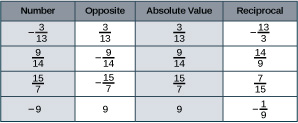
Fill in the chart.
| Opposite | Absolute Value | Reciprocal | |
|---|---|---|---|
Divide Fractions
In the following exercises, model each fraction division.
4
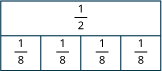
12

In the following exercises, divide, and write the answer in simplified form.
4
1
−12
9
Everyday Math
Baking A recipe for chocolate chip cookies calls for cup brown sugar. Imelda wants to double the recipe.
ⓐ How much brown sugar will Imelda need? Show your calculation. Write your result as an improper fraction and as a mixed number.
ⓑ Measuring cups usually come in sets of and cup. Draw a diagram to show two different ways that Imelda could measure the brown sugar needed to double the recipe.
Baking Nina is making pans of fudge to serve after a music recital. For each pan, she needs cup of condensed milk.
- ⓐ How much condensed milk will Nina need? Show your calculation. Write your result as an improper fraction and as a mixed number.
- ⓑ Measuring cups usually come in sets of and cup. Draw a diagram to show two different ways that Nina could measure the condensed milk she needs.
- ⓐ cups cups cups
- ⓑ Answers will vary.
Portions Don purchased a bulk package of candy that weighs pounds. He wants to sell the candy in little bags that hold pound. How many little bags of candy can he fill from the bulk package?
Portions Kristen has yards of ribbon. She wants to cut it into equal parts to make hair ribbons for her daughter’s dolls. How long will each doll’s hair ribbon be?
yard
Writing Exercises
Explain how you find the reciprocal of a fraction.
Explain how you find the reciprocal of a negative fraction.
Answers will vary.
Rafael wanted to order half a medium pizza at a restaurant. The waiter told him that a medium pizza could be cut into or slices. Would he prefer out of slices or out of slices? Rafael replied that since he wasn’t very hungry, he would prefer out of slices. Explain what is wrong with Rafael’s reasoning.
Give an example from everyday life that demonstrates how is
Answers will vary.
Self Check
ⓐ After completing the exercises, use this checklist to evaluate your mastery of the objectives of this section.
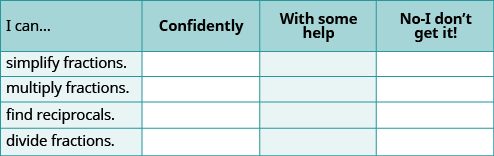
ⓑ After reviewing this checklist, what will you do to become confident for all objectives?
Adapted from Prealgebra 2e by OpenStax (openstax.org), licensed under CC BY-NC-SA 4.0. Changes were made. License: CC-BY-NC-SA-4.0.