
2.5 Prime Factorization and the Least Common Multiple
Find the Prime Factorization of a Composite Number
In the previous section, we found the factors of a number. Prime numbers have only two factors, the number and the prime number itself. Composite numbers have more than two factors, and every composite number can be written as a unique product of primes. This is called the prime factorization of a number. When we write the prime factorization of a number, we are rewriting the number as a product of primes. Finding the prime factorization of a composite number will help you later in this course.
You may want to refer to the following list of prime numbers less than as you work through this section.
Prime Factorization Using the Factor Tree Method
One way to find the prime factorization of a number is to make a factor tree. We start by writing the number, and then writing it as the product of two factors. We write the factors below the number and connect them to the number with a small line segment—a “branch” of the factor tree.
If a factor is prime, we circle it (like a bud on a tree), and do not factor that “branch” any further. If a factor is not prime, we repeat this process, writing it as the product of two factors and adding new branches to the tree.
We continue until all the branches end with a prime. When the factor tree is complete, the circled primes give us the prime factorization.
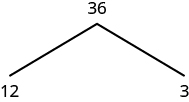
For example, let’s find the prime factorization of We can start with any factor pair such as and We write and below with branches connecting them.
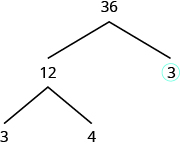
The factor is prime, so we circle it. The factor is composite, so we need to find its factors. Let’s use and We write these factors on the tree under the
The factor is prime, so we circle it. The factor is composite, and it factors into We write these factors under the Since is prime, we circle both
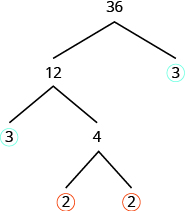
The prime factorization is the product of the circled primes. We generally write the prime factorization in order from least to greatest.
In cases like this, where some of the prime factors are repeated, we can write prime factorization in exponential form.
Note that we could have started our factor tree with any factor pair of We chose and but the same result would have been the same if we had started with and and
Prime Factorization Using the Ladder Method
The ladder method is another way to find the prime factors of a composite number. It leads to the same result as the factor tree method. Some people prefer the ladder method to the factor tree method, and vice versa.
To begin building the “ladder,” divide the given number by its smallest prime factor. For example, to start the ladder for we divide by the smallest prime factor of

To add a “step” to the ladder, we continue dividing by the same prime until it no longer divides evenly.

Then we divide by the next prime; so we divide by

We continue dividing up the ladder in this way until the quotient is prime. Since the quotient, is prime, we stop here.
Do you see why the ladder method is sometimes called stacked division?
The prime factorization is the product of all the primes on the sides and top of the ladder.
Notice that the result is the same as we obtained with the factor tree method.
Find the Least Common Multiple (LCM) of Two Numbers
One of the reasons we look at multiples and primes is to use these techniques to find the least common multiple of two numbers. This will be useful when we add and subtract fractions with different denominators.
Listing Multiples Method
A common multiple of two numbers is a number that is a multiple of both numbers. Suppose we want to find common multiples of and We can list the first several multiples of each number. Then we look for multiples that are common to both lists—these are the common multiples.
We see that and appear in both lists. They are common multiples of and We would find more common multiples if we continued the list of multiples for each.
The smallest number that is a multiple of two numbers is called the least common multiple (LCM). So the least LCM of and is
Prime Factors Method
Another way to find the least common multiple of two numbers is to use their prime factors. We’ll use this method to find the LCM of and
We start by finding the prime factorization of each number.
Then we write each number as a product of primes, matching primes vertically when possible.
Now we bring down the primes in each column. The LCM is the product of these factors.
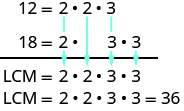
Notice that the prime factors of and the prime factors of are included in the LCM. By matching up the common primes, each common prime factor is used only once. This ensures that is the least common multiple.
Key Concepts
- Find the prime factorization of a composite number using the tree method.
- Find any factor pair of the given number, and use these numbers to create two branches.
- If a factor is prime, that branch is complete. Circle the prime.
- If a factor is not prime, write it as the product of a factor pair and continue the process.
- Write the composite number as the product of all the circled primes.
- Find the prime factorization of a composite number using the ladder method.
- Divide the number by the smallest prime.
- Continue dividing by that prime until it no longer divides evenly.
- Divide by the next prime until it no longer divides evenly.
- Continue until the quotient is a prime.
- Write the composite number as the product of all the primes on the sides and top of the ladder.
- Find the LCM by listing multiples.
- List the first several multiples of each number.
- Look for multiples common to both lists. If there are no common multiples in the lists, write out additional multiples for each number.
- Look for the smallest number that is common to both lists.
- This number is the LCM.
- Find the LCM using the prime factors method.
- Find the prime factorization of each number.
- Write each number as a product of primes, matching primes vertically when possible.
- Bring down the primes in each column.
- Multiply the factors to get the LCM.
Section Exercises
Practice Makes Perfect
Find the Prime Factorization of a Composite Number
In the following exercises, find the prime factorization of each number using the factor tree method.
2 ⋅ 43
2 ⋅ 2 ⋅ 3 ⋅ 11
3 ⋅ 3 ⋅ 7 ⋅ 11
5 ⋅ 23
3 ⋅ 3 ⋅ 5 ⋅ 5 ⋅ 11
1560
In the following exercises, find the prime factorization of each number using the ladder method.
2 ⋅ 2 ⋅ 2 ⋅ 7
2 ⋅ 2 ⋅ 2 ⋅ 3 ⋅ 7
17 ⋅ 23
2 ⋅ 2 ⋅ 2 ⋅ 2 ⋅ 3 ⋅ 3 ⋅ 3
2 ⋅ 2 ⋅ 2 ⋅ 2 ⋅ 3 ⋅ 3 ⋅ 3 ⋅ 5
In the following exercises, find the prime factorization of each number using any method.
2 ⋅ 3 ⋅ 5 ⋅ 5
3 ⋅ 5 ⋅ 5 ⋅ 7
2 ⋅ 2 ⋅ 3 ⋅ 3
2 ⋅ 5 ⋅ 5 ⋅ 7
Find the Least Common Multiple (LCM) of Two Numbers
In the following exercises, find the least common multiple (LCM) by listing multiples.
24
30
120
300
In the following exercises, find the least common multiple (LCM) by using the prime factors method.
24
120
420
In the following exercises, find the least common multiple (LCM) using any method.
42
120
Everyday Math
Grocery shopping Hot dogs are sold in packages of ten, but hot dog buns come in packs of eight. What is the smallest number of hot dogs and buns that can be purchased if you want to have the same number of hot dogs and buns? (Hint: it is the LCM!)
40
Grocery shopping Paper plates are sold in packages of and party cups come in packs of What is the smallest number of plates and cups you can purchase if you want to have the same number of each? (Hint: it is the LCM!)
Writing Exercises
Do you prefer to find the prime factorization of a composite number by using the factor tree method or the ladder method? Why?
Do you prefer to find the LCM by listing multiples or by using the prime factors method? Why?
Self Check
ⓐ After completing the exercises, use this checklist to evaluate your mastery of the objectives of this section.
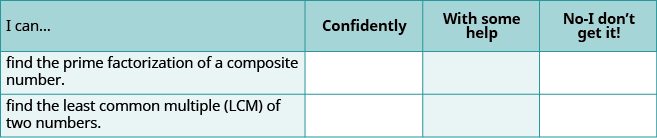
ⓑ Overall, after looking at the checklist, do you think you are well-prepared for the next Chapter? Why or why not?
Chapter Review Exercises
Use the Language of Algebra
Use Variables and Algebraic Symbols
In the following exercises, translate from algebra to English.
3 times 8, the product of three and eight.
24 divided by 6, the quotient of twenty-four and six.
50 is greater than or equal to 47
The sum of n and 4 is equal to 13
Identify Expressions and Equations
In the following exercises, determine if each is an expression or equation.
equation
expression
Simplify Expressions with Exponents
In the following exercises, write in exponential form.
23
x6
In the following exercises, write in expanded form.
8 ⋅ 8 ⋅ 8 ⋅ 8
y ⋅ y ⋅ y ⋅ y ⋅ y
In the following exercises, simplify each expression.
81
128
Simplify Expressions Using the Order of Operations
In the following exercises, simplify.
20
18
74
31
Evaluate, Simplify, and Translate Expressions
Evaluate an Expression
In the following exercises, evaluate the following expressions.
58
26
Identify Terms, Coefficients and Like Terms
In the following exercises, identify the terms in each expression.
12n2,3n, 1
In the following exercises, identify the coefficient of each term.
6
In the following exercises, identify the like terms.
3 and 4; 3x and x
Simplify Expressions by Combining Like Terms
In the following exercises, simplify the following expressions by combining like terms.
24a
14x
12n + 11
10y2 + 2y + 3
Translate English Phrases to Algebraic Expressions
In the following exercises, translate the following phrases into algebraic expressions.
the difference of and
x − 6
the sum of and twice
the product of and
3n ⋅ 9
the quotient of and
times the sum of and
5(y + 1)
less than the product of and
Jack bought a sandwich and a coffee. The cost of the sandwich was more than the cost of the coffee. Call the cost of the coffee Write an expression for the cost of the sandwich.
c + 3
The number of poetry books on Brianna’s bookshelf is less than twice the number of novels. Call the number of novels Write an expression for the number of poetry books.
Solve Equations Using the Subtraction and Addition Properties of Equality
Determine Whether a Number is a Solution of an Equation
In the following exercises, determine whether each number is a solution to the equation.
- ⓐ
- ⓑ
- ⓐ yes
- ⓑ no
- ⓐ
- ⓑ
- ⓐ
- ⓑ
- ⓐ yes
- ⓑ no
- ⓐ
- ⓑ
- ⓐ
- ⓑ
- ⓐ no
- ⓑ yes
- ⓐ
- ⓑ
Model the Subtraction Property of Equality
In the following exercises, write the equation modeled by the envelopes and counters and then solve the equation using the subtraction property of equality.

x + 3 = 5; x = 2

Solve Equations using the Subtraction Property of Equality
In the following exercises, solve each equation using the subtraction property of equality.
c = 6
x = 11
Solve Equations using the Addition Property of Equality
In the following exercises, solve each equation using the addition property of equality.
y = 23
p = 34
Translate English Sentences to Algebraic Equations
In the following exercises, translate each English sentence into an algebraic equation.
The sum of and is equal to
7 + 33 = 40
The difference of and is equal to
The product of and is equal to
4 ⋅ 8 = 32
The quotient of and is equal to
Twice the difference of and gives
2(n − 3) = 76
The sum of five times and is
Translate to an Equation and Solve
In the following exercises, translate each English sentence into an algebraic equation and then solve it.
Eight more than is equal to
x + 8 = 35; x = 27
less than is
The difference of and is
q − 18 = 57; q = 75
The sum of and is
Mixed Practice
In the following exercises, solve each equation.
h = 42
z = 33
q = 8
v = 56
Find Multiples and Factors
Identify Multiples of Numbers
In the following exercises, list all the multiples less than for each of the following.
3, 6, 9, 12, 15, 18, 21, 24, 27, 30, 33, 36, 39, 42, 45, 48
8, 16, 24, 32, 40, 48
Use Common Divisibility Tests
In the following exercises, using the divisibility tests, determine whether each number is divisible by
2, 3, 6
2, 3, 5, 6, 10
Find All the Factors of a Number
In the following exercises, find all the factors of each number.
1, 2, 3, 5, 6, 10, 15, 30
1, 2, 3, 4, 5, 6, 9, 10, 12, 15, 18, 20, 30, 36, 45, 60, 90, 180
Identify Prime and Composite Numbers
In the following exercises, identify each number as prime or composite.
prime
composite
Prime Factorization and the Least Common Multiple
Find the Prime Factorization of a Composite Number
In the following exercises, find the prime factorization of each number.
2 ⋅ 2 ⋅ 3 ⋅ 7
2 ⋅ 5 ⋅ 5 ⋅ 7
Find the Least Common Multiple of Two Numbers
In the following exercises, find the least common multiple of each pair of numbers.
45
175
Everyday Math
Describe how you have used two topics from The Language of Algebra chapter in your life outside of your math class during the past month.
Answers will vary
Chapter Practice Test
In the following exercises, translate from an algebraic equation to English phrases.
15 minus x, the difference of fifteen and x.
In the following exercises, identify each as an expression or equation.
equation
- ⓐ Write in exponential form.
- ⓑ Write in expanded form and then simplify.
- ⓐ n6
- ⓑ 3 ⋅ 3 ⋅ 3 ⋅ 3 ⋅ 3 = 243
In the following exercises, simplify, using the order of operations.
36
5
45
In the following exercises, evaluate each expression.
125
36
Simplify by combining like terms.
- ⓐ
- ⓑ
In the following exercises, translate each phrase into an algebraic expression.
more than
x + 5
the quotient of and
three times the difference of
3(a − b)
Caroline has fewer earrings on her left ear than on her right ear. Call the number of earrings on her right ear, Write an expression for the number of earrings on her left ear.
In the following exercises, solve each equation.
n = 31
In the following exercises, translate each English sentence into an algebraic equation and then solve it.
less than is
y − 15 = 32; y = 47
the sum of and is
List all the multiples of that are less than
4, 8, 12, 16, 20, 24, 28, 32, 36, 40, 44, 48
Find all the factors of
Find the prime factorization of
23 ⋅ 33 ⋅ 5
Find the LCM (Least Common Multiple) of and