
2.1 Use the Language of Algebra
Use Variables and Algebraic Symbols
Greg and Alex have the same birthday, but they were born in different years. This year Greg is years old and Alex is so Alex is years older than Greg. When Greg was Alex was When Greg is Alex will be No matter what Greg’s age is, Alex’s age will always be years more, right?
In the language of algebra, we say that Greg’s age and Alex’s age are variable and the three is a constant. The ages change, or vary, so age is a variable. The years between them always stays the same, so the age difference is the constant.
In algebra, letters of the alphabet are used to represent variables. Suppose we call Greg’s age Then we could use to represent Alex’s age. See Table 2.1.
| Greg’s age | Alex’s age |
|---|---|
Letters are used to represent variables. Letters often used for variables are
To write algebraically, we need some symbols as well as numbers and variables. There are several types of symbols we will be using. In Whole Numbers, we introduced the symbols for the four basic arithmetic operations: addition, subtraction, multiplication, and division. We will summarize them here, along with words we use for the operations and the result.
| Operation | Notation | Say: | The result is… |
|---|---|---|---|
| Addition | the sum of and | ||
| Subtraction | the difference of and | ||
| Multiplication | The product of and | ||
| Division | divided by | The quotient of and |
In algebra, the cross symbol, is not used to show multiplication because that symbol may cause confusion. Does mean (three times ) or (three times )? To make it clear, use ⋅ or parentheses for multiplication.
We perform these operations on two numbers. When translating from symbolic form to words, or from words to symbolic form, pay attention to the words of or and to help you find the numbers.
- The sum of and means add plus which we write as
- The difference of and means subtract minus which we write as
- The product of and means multiply times which we can write as
- The quotient of and means divide by which we can write as
When two quantities have the same value, we say they are equal and connect them with an equal sign.
An inequality is used in algebra to compare two quantities that may have different values. The number line can help you understand inequalities. Remember that on the number line the numbers get larger as they go from left to right. So if we know that is greater than it means that is to the right of on the number line. We use the symbols and for inequalities.
The expressions can be read from left-to-right or right-to-left, though in English we usually read from left-to-right. In general,
When we write an inequality symbol with a line under it, such as it means or We read this is less than or equal to Also, if we put a slash through an equal sign, it means not equal.
We summarize the symbols of equality and inequality in Table 2.2.
| Algebraic Notation | Say |
|---|---|
| is equal to | |
| is not equal to | |
| is less than | |
| is greater than | |
| is less than or equal to | |
| is greater than or equal to |
Grouping symbols in algebra are much like the commas, colons, and other punctuation marks in written language. They indicate which expressions are to be kept together and separate from other expressions. Table 2.3 lists three of the most commonly used grouping symbols in algebra.
| Common Grouping Symbols | |
|---|---|
| parentheses | |
| brackets | |
| braces | |
Here are some examples of expressions that include grouping symbols. We will simplify expressions like these later in this section.
Identify Expressions and Equations
What is the difference in English between a phrase and a sentence? A phrase expresses a single thought that is incomplete by itself, but a sentence makes a complete statement. “Running very fast” is a phrase, but “The football player was running very fast” is a sentence. A sentence has a subject and a verb.
In algebra, we have expressions and equations. An expression is like a phrase. Here are some examples of expressions and how they relate to word phrases:
| Expression | Words | Phrase |
|---|---|---|
| the sum of three and five | ||
| minus one | the difference of and one | |
| the product of six and seven | ||
| divided by | the quotient of and |
Notice that the phrases do not form a complete sentence because the phrase does not have a verb. An equation is two expressions linked with an equal sign. When you read the words the symbols represent in an equation, you have a complete sentence in English. The equal sign gives the verb. Here are some examples of equations:
| Equation | Sentence |
|---|---|
| The sum of three and five is equal to eight. | |
| minus one equals fourteen. | |
| The product of six and seven is equal to forty-two. | |
| is equal to fifty-three. | |
| plus nine is equal to two minus three. |
Simplify Expressions with Exponents
To simplify a numerical expression means to do all the math possible. For example, to simplify we’d first multiply to get and then add the to get A good habit to develop is to work down the page, writing each step of the process below the previous step. The example just described would look like this:
Suppose we have the expression We could write this more compactly using exponential notation. Exponential notation is used in algebra to represent a quantity multiplied by itself several times. We write as and as In expressions such as the is called the base and the is called the exponent. The exponent tells us how many factors of the base we have to multiply.

We say is in exponential notation and is in expanded notation.
For powers of and we have special names.
Table 2.4 lists some examples of expressions written in exponential notation.
| Exponential Notation | In Words |
|---|---|
| to the second power, or squared | |
| to the third power, or cubed | |
| to the fourth power | |
| to the fifth power |
To simplify an exponential expression without using a calculator, we write it in expanded form and then multiply the factors.
Simplify Expressions Using the Order of Operations
We’ve introduced most of the symbols and notation used in algebra, but now we need to clarify the order of operations. Otherwise, expressions may have different meanings, and they may result in different values.
For example, consider the expression:
Imagine the confusion that could result if every problem had several different correct answers. The same expression should give the same result. So mathematicians established some guidelines called the order of operations, which outlines the order in which parts of an expression must be simplified.
Students often ask, “How will I remember the order?” Here is a way to help you remember: Take the first letter of each key word and substitute the silly phrase. Please Excuse My Dear Aunt Sally.
| Order of Operations | |
|---|---|
| Please | Parentheses |
| Excuse | Exponents |
| My Dear | Multiplication and Division |
| Aunt Sally | Addition and Subtraction |
It’s good that ‘My Dear’ goes together, as this reminds us that multiplication and division have equal priority. We do not always do multiplication before division or always do division before multiplication. We do them in order from left to right.
Similarly, ‘Aunt Sally’ goes together and so reminds us that addition and subtraction also have equal priority and we do them in order from left to right.
When there are multiple grouping symbols, we simplify the innermost parentheses first and work outward.
Key Concepts
| Operation | Notation | Say: | The result is… |
|---|---|---|---|
| Addition | the sum of and | ||
| Multiplication | The product of and | ||
| Subtraction | the difference of and | ||
| Division | divided by | The quotient of and |
- Equality Symbol
- is read as is equal to
- The symbol is called the equal sign.
- Inequality
- is read is less than
- is to the left of on the number line

- is read is greater than
- is to the right of on the number line

| Algebraic Notation | Say |
|---|---|
| is equal to | |
| is not equal to | |
| is less than | |
| is greater than | |
| is less than or equal to | |
| is greater than or equal to |
- Exponential Notation
- For any expression is a factor multiplied by itself times, if is a positive integer.
- means multiply factors of
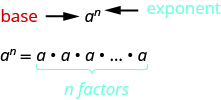
- The expression of is read to the power.
Order of Operations When simplifying mathematical expressions perform the operations in the following order:
- Parentheses and other Grouping Symbols: Simplify all expressions inside the parentheses or other grouping symbols, working on the innermost parentheses first.
- Exponents: Simplify all expressions with exponents.
- Multiplication and Division: Perform all multiplication and division in order from left to right. These operations have equal priority.
- Addition and Subtraction: Perform all addition and subtraction in order from left to right. These operations have equal priority.
Practice Makes Perfect
Use Variables and Algebraic Symbols
In the following exercises, translate from algebraic notation to words.
16 minus 9, the difference of sixteen and nine
5 times 6, the product of five and six
28 divided by 4, the quotient of twenty-eight and four
x plus 8, the sum of x and eight
2 times 7, the product of two and seven
fourteen is less than twenty-one
thirty-six is greater than or equal to nineteen
3 times n equals 24, the product of three and n equals twenty-four
y minus 1 is greater than 6, the difference of y and one is greater than six
2 is less than or equal to 18 divided by 6; 2 is less than or equal to the quotient of eighteen and six
a is not equal to 7 times 4, a is not equal to the product of seven and four
Identify Expressions and Equations
In the following exercises, determine if each is an expression or an equation.
equation
expression
expression
equation
Simplify Expressions with Exponents
In the following exercises, write in exponential form.
37
x5
In the following exercises, write in expanded form.
Simplify Expressions Using the Order of Operations
In the following exercises, simplify.
- ⓐ
- ⓑ
- ⓐ 43
- ⓑ 55
- ⓐ
- ⓑ
5
34
58
6
13
4
35
10
41
81
149
50
Everyday Math
Basketball In the 2014 NBA playoffs, the San Antonio Spurs beat the Miami Heat. The table below shows the heights of the starters on each team. Use this table to fill in the appropriate symbol
| Spurs | Height | Heat | Height | |
|---|---|---|---|---|
| Tim Duncan | Rashard Lewis | |||
| Boris Diaw | LeBron James | |||
| Kawhi Leonard | Chris Bosh | |||
| Tony Parker | Dwyane Wade | |||
| Danny Green | Ray Allen |
- ⓐ Height of Tim Duncan____Height of Rashard Lewis
- ⓑ Height of Boris Diaw____Height of LeBron James
- ⓒ Height of Kawhi Leonard____Height of Chris Bosh
- ⓓ Height of Tony Parker____Height of Dwyane Wade
- ⓔ Height of Danny Green____Height of Ray Allen
Elevation In Colorado there are more than mountains with an elevation of over The table shows the ten tallest. Use this table to fill in the appropriate inequality symbol.
| Mountain | Elevation |
|---|---|
| Mt. Elbert | |
| Mt. Massive | |
| Mt. Harvard | |
| Blanca Peak | |
| La Plata Peak | |
| Uncompahgre Peak | |
| Crestone Peak | |
| Mt. Lincoln | |
| Grays Peak | |
| Mt. Antero |
- ⓐ Elevation of La Plata Peak____Elevation of Mt. Antero
- ⓑ Elevation of Blanca Peak____Elevation of Mt. Elbert
- ⓒ Elevation of Gray’s Peak____Elevation of Mt. Lincoln
- ⓓ Elevation of Mt. Massive____Elevation of Crestone Peak
- ⓔ Elevation of Mt. Harvard____Elevation of Uncompahgre Peak
Writing Exercises
Explain the difference between an expression and an equation.
Why is it important to use the order of operations to simplify an expression?
Self Check
ⓐ After completing the exercises, use this checklist to evaluate your mastery of the objectives of this section.
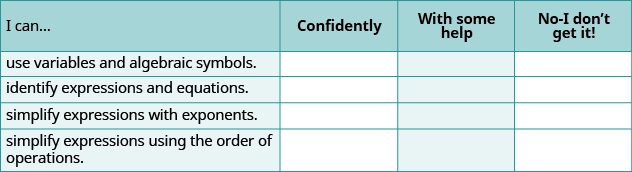
ⓑ If most of your checks were:
…confidently. Congratulations! You have achieved the objectives in this section. Reflect on the study skills you used so that you can continue to use them. What did you do to become confident of your ability to do these things? Be specific.
…with some help. This must be addressed quickly because topics you do not master become potholes in your road to success. In math, every topic builds upon previous work. It is important to make sure you have a strong foundation before you move on. Whom can you ask for help? Your fellow classmates and instructor are good resources. Is there a place on campus where math tutors are available? Can your study skills be improved?
…no—I don’t get it! This is a warning sign and you must not ignore it. You should get help right away or you will quickly be overwhelmed. See your instructor as soon as you can to discuss your situation. Together you can come up with a plan to get you the help you need.
Adapted from Prealgebra 2e by OpenStax (openstax.org), licensed under CC BY-NC-SA 4.0. Changes were made. License: CC-BY-NC-SA-4.0.