
2.2 Evaluate, Simplify, and Translate Expressions
Evaluate Algebraic Expressions
In the last section, we simplified expressions using the order of operations. In this section, we’ll evaluate expressions—again following the order of operations.
To evaluate an algebraic expression means to find the value of the expression when the variable is replaced by a given number. To evaluate an expression, we substitute the given number for the variable in the expression and then simplify the expression using the order of operations.
Identify Terms, Coefficients, and Like Terms
Algebraic expressions are made up of terms. A term is a constant or the product of a constant and one or more variables. Some examples of terms are
The constant that multiplies the variable(s) in a term is called the coefficient. We can think of the coefficient as the number in front of the variable. The coefficient of the term is When we write the coefficient is since Table 2.6 gives the coefficients for each of the terms in the left column.
| Term | Coefficient |
|---|---|
An algebraic expression may consist of one or more terms added or subtracted. In this chapter, we will only work with terms that are added together. Table 2.7 gives some examples of algebraic expressions with various numbers of terms. Notice that we include the operation before a term with it.
| Expression | Terms |
|---|---|
Some terms share common traits. Look at the following terms. Which ones seem to have traits in common?
Which of these terms are like terms?
- The terms and are both constant terms.
- The terms and are both terms with
- The terms and both have
Terms are called like terms if they have the same variables and exponents. All constant terms are also like terms. So among the terms
Simplify Expressions by Combining Like Terms
We can simplify an expression by combining the like terms. What do you think would simplify to? If you thought you would be right!
We can see why this works by writing both terms as addition problems.
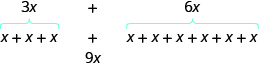
Add the coefficients and keep the same variable. It doesn’t matter what is. If you have of something and add more of the same thing, the result is of them. For example, oranges plus oranges is oranges. We will discuss the mathematical properties behind this later.
The expression has only two terms. When an expression contains more terms, it may be helpful to rearrange the terms so that like terms are together. The Commutative Property of Addition says that we can change the order of addends without changing the sum. So we could rearrange the following expression before combining like terms.
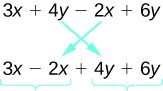
Now it is easier to see the like terms to be combined.
When any of the terms have negative coefficients, the procedure is the same, except that you have to subtract instead of adding to combine like terms.
Translate Words to Algebraic Expressions
In the previous section, we listed many operation symbols that are used in algebra, and then we translated expressions and equations into word phrases and sentences. Now we’ll reverse the process and translate word phrases into algebraic expressions. The symbols and variables we’ve talked about will help us do that. They are summarized in Table 2.8.
| Operation | Phrase | Expression |
|---|---|---|
| Addition | plus the sum of and increased by more than the total of and added to | |
| Subtraction | minus the difference of and subtracted from decreased by less than | |
| Multiplication | times the product of and | , , , |
| Division | divided by
the quotient of and the ratio of and divided into | , , , |
Look closely at these phrases using the four operations:
- the sum of and
- the difference of and
- the product of and
- the quotient of and
Each phrase tells you to operate on two numbers. Look for the words of and and to find the numbers.
How old will you be in eight years? What age is eight more years than your age now? Did you add to your present age? Eight more than means eight added to your present age.
How old were you seven years ago? This is seven years less than your age now. You subtract from your present age. Seven less than means seven subtracted from your present age.
Later in this course, we’ll apply our skills in algebra to solving equations. We’ll usually start by translating a word phrase to an algebraic expression. We’ll need to be clear about what the expression will represent. We’ll see how to do this in the next two examples.
Key Concepts
- Combine like terms.
- Identify like terms.
- Rearrange the expression so like terms are together.
- Add the coefficients of the like terms
Practice Makes Perfect
Evaluate Algebraic Expressions
In the following exercises, evaluate the expression for the given value.
22
26
144
32
27
21
41
9
225
73
54
Identify Terms, Coefficients, and Like Terms
In the following exercises, list the terms in the given expression.
15x2, 6x, 2
10y3, y, 2
In the following exercises, identify the coefficient of the given term.
8
5
In the following exercises, identify all sets of like terms.
x3 and 8x3; 14 and 5
16ab and 4ab; 16b2 and 9b2
Simplify Expressions by Combining Like Terms
In the following exercises, simplify the given expression by combining like terms.
13x
26a
7c
12x + 8
10u + 3
12p + 10
22a + 1
17x2 + 20x + 16
Translate English Phrases into Algebraic Expressions
In the following exercises, translate the given word phrase into an algebraic expression.
The sum of 8 and 12
8 + 12
The sum of 9 and 1
The difference of 14 and 9
14 − 9
8 less than 19
The product of 9 and 7
9 ⋅ 7
The product of 8 and 7
The quotient of 36 and 9
36 ÷ 9
The quotient of 42 and 7
The difference of and
x − 4
less than
The product of and
6y
The product of and
The sum of and
8x + 3x
The sum of and
The quotient of and
y ÷ 3
The quotient of and
Eight times the difference of and nine
8 (y − 9)
Seven times the difference of and one
Five times the sum of and
5 (x + y)
Nine times five less than twice
In the following exercises, write an algebraic expression.
Adele bought a skirt and a blouse. The skirt cost more than the blouse. Let represent the cost of the blouse. Write an expression for the cost of the skirt.
b + 15
Eric has rock and classical CDs in his car. The number of rock CDs is more than the number of classical CDs. Let represent the number of classical CDs. Write an expression for the number of rock CDs.
The number of girls in a second-grade class is less than the number of boys. Let represent the number of boys. Write an expression for the number of girls.
b − 4
Marcella has fewer male cousins than female cousins. Let represent the number of female cousins. Write an expression for the number of boy cousins.
Greg has nickels and pennies in his pocket. The number of pennies is seven less than twice the number of nickels. Let represent the number of nickels. Write an expression for the number of pennies.
2n − 7
Jeannette has and bills in her wallet. The number of fives is three more than six times the number of tens. Let represent the number of tens. Write an expression for the number of fives.
Everyday Math
In the following exercises, use algebraic expressions to solve the problem.
Car insurance Justin’s car insurance has a deductible per incident. This means that he pays and his insurance company will pay all costs beyond If Justin files a claim for how much will he pay, and how much will his insurance company pay?
He will pay $750. His insurance company will pay $1350.
Home insurance Pam and Armando’s home insurance has a deductible per incident. This means that they pay and their insurance company will pay all costs beyond If Pam and Armando file a claim for how much will they pay, and how much will their insurance company pay?
Writing Exercises
Explain why “the sum of x and y” is the same as “the sum of y and x,” but “the difference of x and y” is not the same as “the difference of y and x.” Try substituting two random numbers for and to help you explain.
Explain the difference between times the sum of and and “the sum of times and
Self Check
ⓐ After completing the exercises, use this checklist to evaluate your mastery of the objectives of this section.
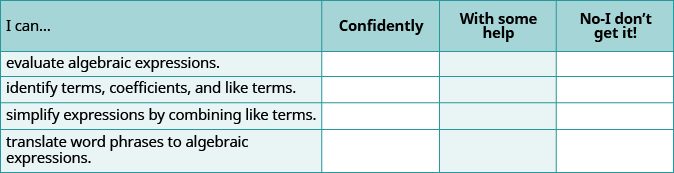
ⓑ After reviewing this checklist, what will you do to become confident for all objectives?
Adapted from Prealgebra 2e by OpenStax (openstax.org), licensed under CC BY-NC-SA 4.0. Changes were made. License: CC-BY-NC-SA-4.0.