
2.4 Find Multiples and Factors
Identify Multiples of Numbers
Annie is counting the shoes in her closet. The shoes are matched in pairs, so she doesn’t have to count each one. She counts by twos: She has shoes in her closet.
The numbers are called multiples of Multiples of can be written as the product of a counting number and The first six multiples of are given below.
A multiple of a number is the product of the number and a counting number. So a multiple of would be the product of a counting number and Below are the first six multiples of
We can find the multiples of any number by continuing this process. Table 2.9 shows the multiples of through for the first twelve counting numbers.
| Counting Number | ||||||||||||
|---|---|---|---|---|---|---|---|---|---|---|---|---|
Recognizing the patterns for multiples of will be helpful to you as you continue in this course.
Figure 2.9 shows the counting numbers from to Multiples of are highlighted. Do you notice a pattern?

The last digit of each highlighted number in Figure 2.9 is either This is true for the product of and any counting number. So, to tell if any number is a multiple of look at the last digit. If it is then the number is a multiple of
Now let’s look at multiples of Figure 2.10 highlights all of the multiples of between and What do you notice about the multiples of

All multiples of end with either or Just like we identify multiples of by looking at the last digit, we can identify multiples of by looking at the last digit.
Figure 2.11 highlights the multiples of between and All multiples of all end with a zero.

Figure 2.12 highlights multiples of The pattern for multiples of is not as obvious as the patterns for multiples of

Unlike the other patterns we’ve examined so far, this pattern does not involve the last digit. The pattern for multiples of is based on the sum of the digits. If the sum of the digits of a number is a multiple of then the number itself is a multiple of See Table 2.10.
Consider the number The digits are and and their sum is Since is a multiple of we know that is also a multiple of
Look back at the charts where you highlighted the multiples of of and of Notice that the multiples of are the numbers that are multiples of both and That is because Likewise, since the multiples of are the numbers that are multiples of both and
Use Common Divisibility Tests
Another way to say that is a multiple of is to say that is divisible by In fact, is so is Notice in Example 4 that is not a multiple of When we divided by we did not get a counting number, so is not divisible by
Since multiplication and division are inverse operations, the patterns of multiples that we found can be used as divisibility tests. Table 2.11 summarizes divisibility tests for some of the counting numbers between one and ten.
| Divisibility Tests | |
|---|---|
| A number is divisible by | |
| if the last digit is | |
| if the sum of the digits is divisible by | |
| if the last digit is or | |
| if divisible by both and | |
| if the last digit is | |
Find All the Factors of a Number
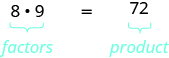
There are often several ways to talk about the same idea. So far, we’ve seen that if is a multiple of we can say that is divisible by We know that is the product of and so we can say is a multiple of and is a multiple of We can also say is divisible by and by Another way to talk about this is to say that and are factors of When we write we can say that we have factored
In algebra, it can be useful to determine all of the factors of a number. This is called factoring a number, and it can help us solve many kinds of problems.
For example, suppose a choreographer is planning a dance for a ballet recital. There are dancers, and for a certain scene, the choreographer wants to arrange the dancers in groups of equal sizes on stage.
In how many ways can the dancers be put into groups of equal size? Answering this question is the same as identifying the factors of Table 2.14 summarizes the different ways that the choreographer can arrange the dancers.
| Number of Groups | Dancers per Group | Total Dancers |
|---|---|---|
What patterns do you see in Table 2.14? Did you notice that the number of groups times the number of dancers per group is always This makes sense, since there are always dancers.
You may notice another pattern if you look carefully at the first two columns. These two columns contain the exact same set of numbers—but in reverse order. They are mirrors of one another, and in fact, both columns list all of the factors of which are:
We can find all the factors of any counting number by systematically dividing the number by each counting number, starting with If the quotient is also a counting number, then the divisor and the quotient are factors of the number. We can stop when the quotient becomes smaller than the divisor.
Identify Prime and Composite Numbers
Some numbers, like have many factors. Other numbers, such as have only two factors: and the number. A number with only two factors is called a prime number. A number with more than two factors is called a composite number. The number is neither prime nor composite. It has only one factor, itself.
Figure 2.13 lists the counting numbers from through along with their factors. The highlighted numbers are prime, since each has only two factors.
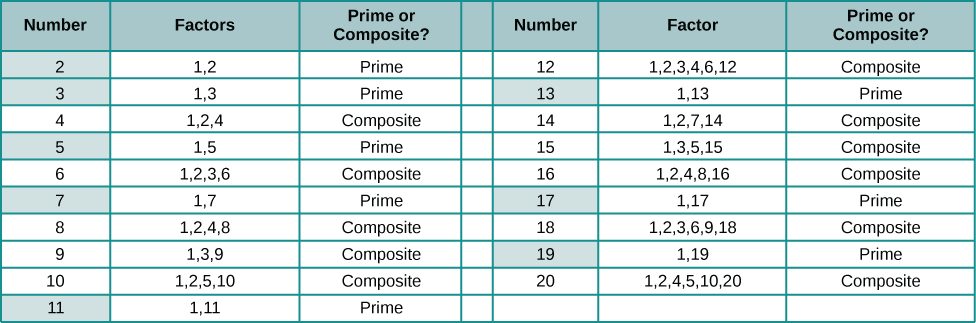
The prime numbers less than are There are many larger prime numbers too. In order to determine whether a number is prime or composite, we need to see if the number has any factors other than and itself. To do this, we can test each of the smaller prime numbers in order to see if it is a factor of the number. If none of the prime numbers are factors, then that number is also prime.
Key Concepts
| Divisibility Tests | |
|---|---|
| A number is divisible by | |
| 2 | if the last digit is 0, 2, 4, 6, or 8 |
| 3 | if the sum of the digits is divisible by 3 |
| 4 | if the last two digits are a number divisible by 4 |
| 5 | if the last digit is 5 or 0 |
| 6 | if divisible by both 2 and 3 |
| 10 | if the last digit is 0 |
- Factors If , then and are factors of , and is the product of and .
- Find all the factors of a counting number.
- Divide the number by each of the counting numbers, in order, until the quotient is smaller than the divisor.
- If the quotient is a counting number, the divisor and quotient are a pair of factors.
- If the quotient is not a counting number, the divisor is not a factor.
- List all the factor pairs.
- Write all the factors in order from smallest to largest.
- Divide the number by each of the counting numbers, in order, until the quotient is smaller than the divisor.
- Determine if a number is prime.
- Test each of the primes, in order, to see if it is a factor of the number.
- Start with 2 and stop when the quotient is smaller than the divisor or when a prime factor is found.
- If the number has a prime factor, then it is a composite number. If it has no prime factors, then the number is prime.
Practice Makes Perfect
Identify Multiples of Numbers
In the following exercises, list all the multiples less than for the given number.
2, 4, 6, 8, 10 12, 14, 16, 18, 20, 22, 24, 26, 28, 30, 32, 34, 36, 38, 40, 42, 44, 46, 48
4, 8, 12, 16, 20, 24, 28, 32, 36, 40, 44, 48
6, 12, 18, 24, 30, 36, 42, 48
8, 16, 24, 32, 40, 48
10, 20, 30, 40
Use Common Divisibility Tests
In the following exercises, use the divisibility tests to determine whether each number is divisible by
Divisible by 2, 3, 4, 6
Divisible by 3, 5
Divisible by 2, 3, 4, 6
Divisible by 2, 3, 4, 5, 6, 10
Divisible by 2, 4
Divisible by 3, 5
Divisible by 2, 5, 10
Divisible by 2, 5, 10
Divisible by 3, 5
Find All the Factors of a Number
In the following exercises, find all the factors of the given number.
1, 2, 3, 4, 6, 9, 12, 18, 36
1, 2, 3, 4, 5, 6, 10, 12, 15, 20, 30, 60
1, 2, 3, 4, 6, 8, 9, 12, 16, 18, 24, 36, 48, 72,144
1, 2, 3, 4, 6, 7, 12, 14, 21, 28, 42, 49, 84, 98, 147, 196, 294, 588
Identify Prime and Composite Numbers
In the following exercises, determine if the given number is prime or composite.
prime
composite
prime
composite
composite
composite
Everyday Math
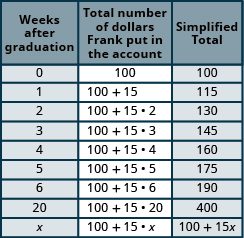
Banking Frank’s grandmother gave him at his high school graduation. Instead of spending it, Frank opened a bank account. Every week, he added to the account. The table shows how much money Frank had put in the account by the end of each week. Complete the table by filling in the blanks.
| Weeks after graduation | Total number of dollars Frank put in the account | Simplified Total |
|---|---|---|
Banking In March, Gina opened a Christmas club savings account at her bank. She deposited to open the account. Every week, she added to the account. The table shows how much money Gina had put in the account by the end of each week. Complete the table by filling in the blanks.
| Weeks after opening the account | Total number of dollars Gina put in the account | Simplified Total |
|---|---|---|
Writing Exercises
If a number is divisible by and by why is it also divisible by
What is the difference between prime numbers and composite numbers?
Self Check
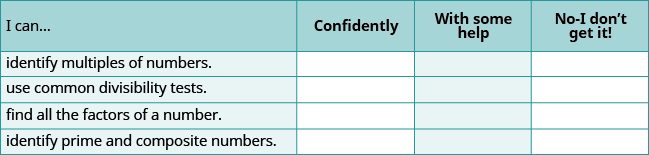
ⓐ After completing the exercises, use this checklist to evaluate your mastery of the objectives of this section.
ⓑ On a scale of 1–10, how would you rate your mastery of this section in light of your responses on the checklist? How can you improve this?
Adapted from Prealgebra 2e by OpenStax (openstax.org), licensed under CC BY-NC-SA 4.0. Changes were made. License: CC-BY-NC-SA-4.0.