
5.4 Stokes' Theorem: Two Caps, One Boundary
The last section computed a circulation of around a circle and called it a hint. Here is the theorem it hints at. Stokes' Theorem says that the circulation of a field around a closed curve equals the flux of its curl through any surface that has the curve as boundary:
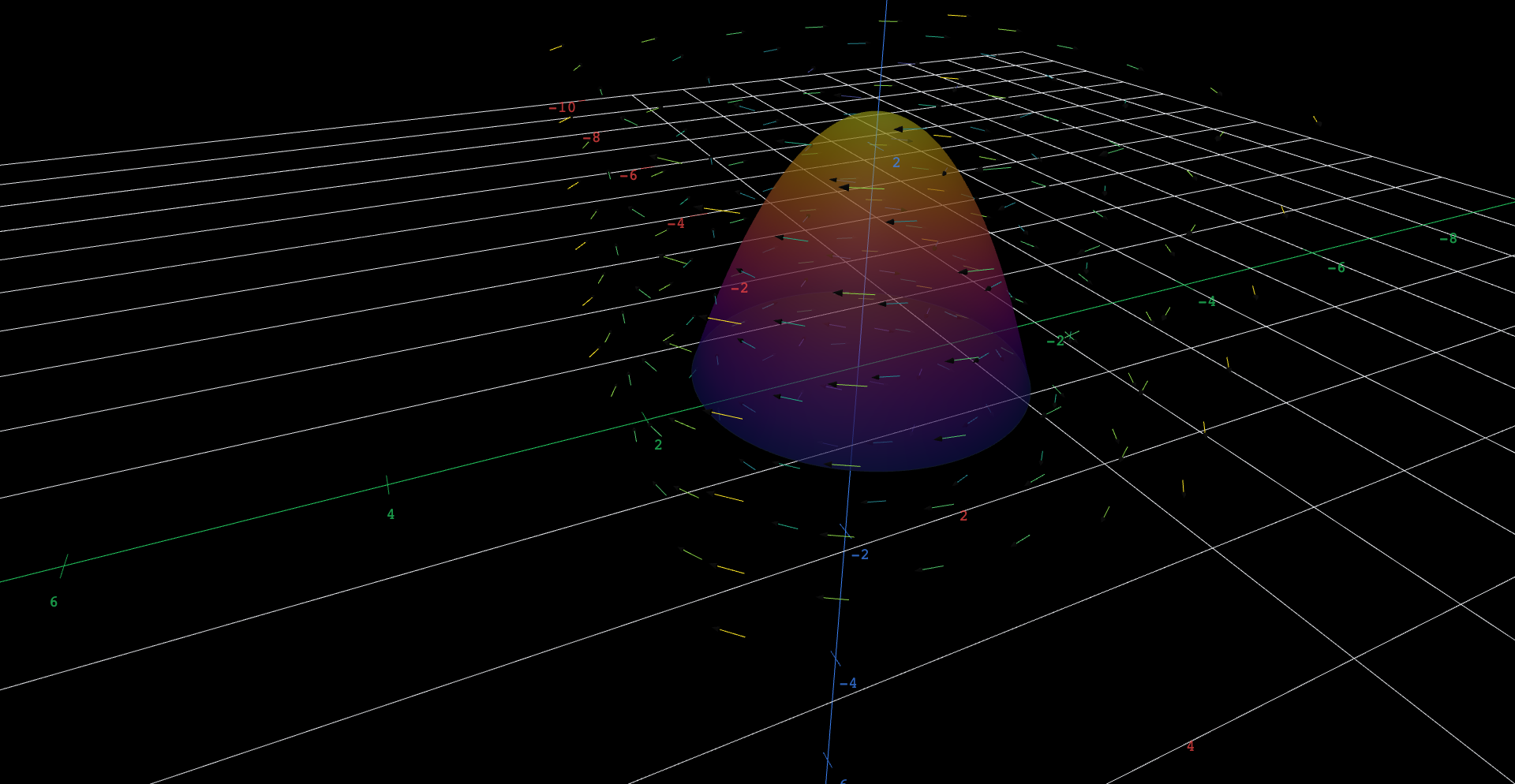
provided the curve's direction and the surface's normal are paired by the right-hand rule. The startling word is any. Hang two utterly different surfaces on the same rim and the theorem demands they collect identical curl flux — the cap is disposable, and only the boundary owns the answer. The figure stages exactly that confrontation.
 Explore in 3D (opens in a new tab)
Explore
- Orbit slowly and confirm the two facts everything below rests on: both surfaces hang on the same dark rim, and the field looks identical at every height — no appears in its components.
- Look straight down the -axis. The arrows circulate counterclockwise around the boundary. Curl your right hand's fingers that way: your thumb points . That pairing — counterclockwise rim, upward normals — fixes every sign below.
- The dome clearly has more surface area than the disk, and both sit in the same swirling field. Predict, with one sentence of reasoning: does more curl flux pass through the dome?
- Compute (the example below checks you). It comes out the same constant vertical vector everywhere — which makes the disk's flux a mental computation and sets up the trap in step 3.
- Orbit to a low side view and look at the dome near its rim, where it rises steeply — nearly vertical. How much of a purely vertical curl vector passes through a nearly vertical patch of surface? So where on the dome is its flux actually collected?
- Suppose the rim were traversed clockwise seen from above. What happens to the circulation's sign, and which way must both caps' normals point for the theorem to still balance?
The boundary owns the answer
Why should the cap not matter? Two caps on one rim, taken together (one normal flipped), enclose a solid region — and curl fields send zero net flux out of any closed surface. So whatever flux enters through one cap leaves through the other: hang any surface on the rim and the total is fixed by the rim alone. That is why the theorem writes on one side: only boundary data survives. In practice you read the equation right-to-left — replace a hard surface with an easy one, or with the boundary curve itself.
The quantity the surface side of the section rests on — and the one the section's own three-way agreement is least able to check.
Both fluxes are integrals of the curl's component along the surface normal, so an error in the vertical component moves both of them: replace by and each becomes . The rim would then expose it, because its circulation comes straight from and never touches the curl at all.
The horizontal components are a different story, and this is the reason the card is here. The disk's normal is , so anything horizontal contributes nothing to it; the dome's upward vector area element is over a disk centred at the origin, and by symmetry. So a curl of — or , or any horizontal error at all — yields exactly on both caps and around the rim. Three numbers agreeing perfectly, and a wrong curl. The certificate checks all three components, including the two this example could never have caught by itself.
An original work of XYZ Homework, built around interactive XYZ 3D figures. Aligned to OpenStax Calculus Volume 3 (Strang & Herman), © OpenStax (Rice University), licensed CC BY-NC-SA 4.0; no OpenStax content is reproduced, and this work is not affiliated with or endorsed by OpenStax or Rice University. License: CC-BY-NC-SA-4.0.