A double integral is a refined sum over cells. In rectangular coordinates the cells are congruent little squares, each of area , and nobody thinks twice. But regions with a center — disks, rings, anything round — beg to be chopped along rings and rays instead, and then something changes: the cells are not congruent. Every cell in one ring matches its neighbors, but the rings themselves widen as they move outward. The area element must record that widening, and the figure lets you measure it before any formula claims it.
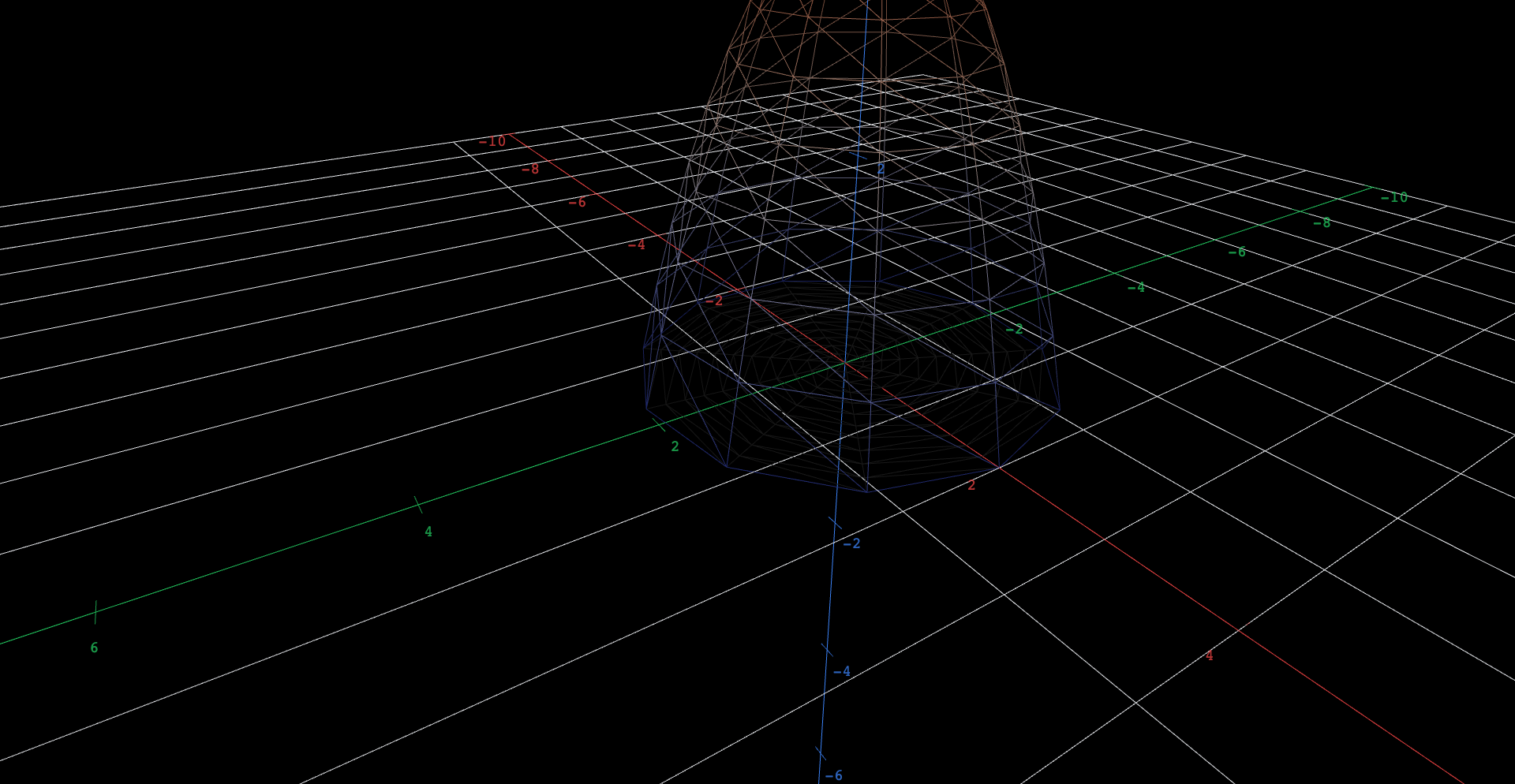
Explore in 3D (opens in a new tab)Two coarse wireframe objects: a flat disk at meshed by a polar grid of rings and wedges (resolution 12, so the cells are countable), and the dome carrying the same coarse polar mesh. A third object — a Cartesian-mesh copy of the dome, with identical square cells — waits hidden in the object list for the contrast step.
Explore
Orbit until you look straight down the -axis, so the flat grid reads like a dartboard. Count the cells in the innermost ring and in the outermost. Same count — same size?
Each cell is approximately a rectangle, one side running radially and one side running along the arc. Moving from center to rim, which side length stays fixed and which one grows?
Write, before touching anything, a formula for the approximate area of a cell at radius with radial step and angular step .
Now interrogate the mesh: retype the flat grid's resolution field from 12 to 24, then 64, then 128. At every fineness, cells within one ring stay congruent, and cell area keeps growing in proportion to — compare a cell near with one near at each level and watch the ratio stay locked near . The factor of is a property of polar coordinates, not of any particular mesh.
Set the resolution back to 12. Reveal the hidden Cartesian-mesh dome with its eye toggle (hide the two polar objects for a clean look) and orbit straight down: every Cartesian cell is an identical square, so needs no correction. Explain why summing over the polar cells — with no — would overweight the cells near the center.
Restore the polar objects. The colored dome is the integrand riding the same grid: each cell contributes height times of volume. Set up the volume both ways — the example below finishes the story.
One cell, measured exactly
The cell between radii and , spanning an angle , is a slice of a ring. Its exact area is the difference of two circular sectors:
which is up to a vanishing correction — arc length times radial step , exactly what steps 2 and 3 measured. Refining the mesh turns the sum into the integral . The extra is the local area-scaling of the map — its Jacobian, a name the next section grows into a general tool.
The Jacobian determinant of the polar map ✓ Computed · mojocas 0.1.0✓ Agrees with the text The Jacobian determinant of the polar map, computed exactly by mojocas 0.1.0, and confirmed to agree with the result stated in the text.
The area-scaling factor of , computed from the map itself rather than read off the ring-slice picture. It is the same the mesh above made you count, and the same that turns into . ( stands for .)
The inner integral, exactly ✓ Computed · mojocas 0.1.0✓ Agrees with the text The inner integral, exactly, computed exactly by mojocas 0.1.0, and confirmed to agree with the result stated in the text.
The pivot step of the volume computation, integrated exactly by the computer algebra system: the from the area element rides along, and the inner integral lands on the exact value the worked example reads off as . Multiply by the -integral's and the dome's volume follows.
These eBooks are a prerelease and are not yet certified conformant with WCAG 2.1 AA or ADA Title II. Every page is built against an automated accessibility gate, and the published editions will meet ADA Title II requirements when they release in late September 2026. If something is unusable, please tell us.

 Explore in 3D (opens in a new tab)