The last section measured two slopes at a point of a surface. This section makes the central claim of differential calculus: near a point where is differentiable, those two slopes are all you need, because the curved surface is locally indistinguishable from a plane. The plane through whose -slope is and whose -slope is is the tangent plane, the graph of the linear approximation
Claims deserve tests, and the only fair test of "locally flat" is to zoom in and look. The figure is built for exactly that: the zoom is performed by editing the plotted window, not by trusting a picture.
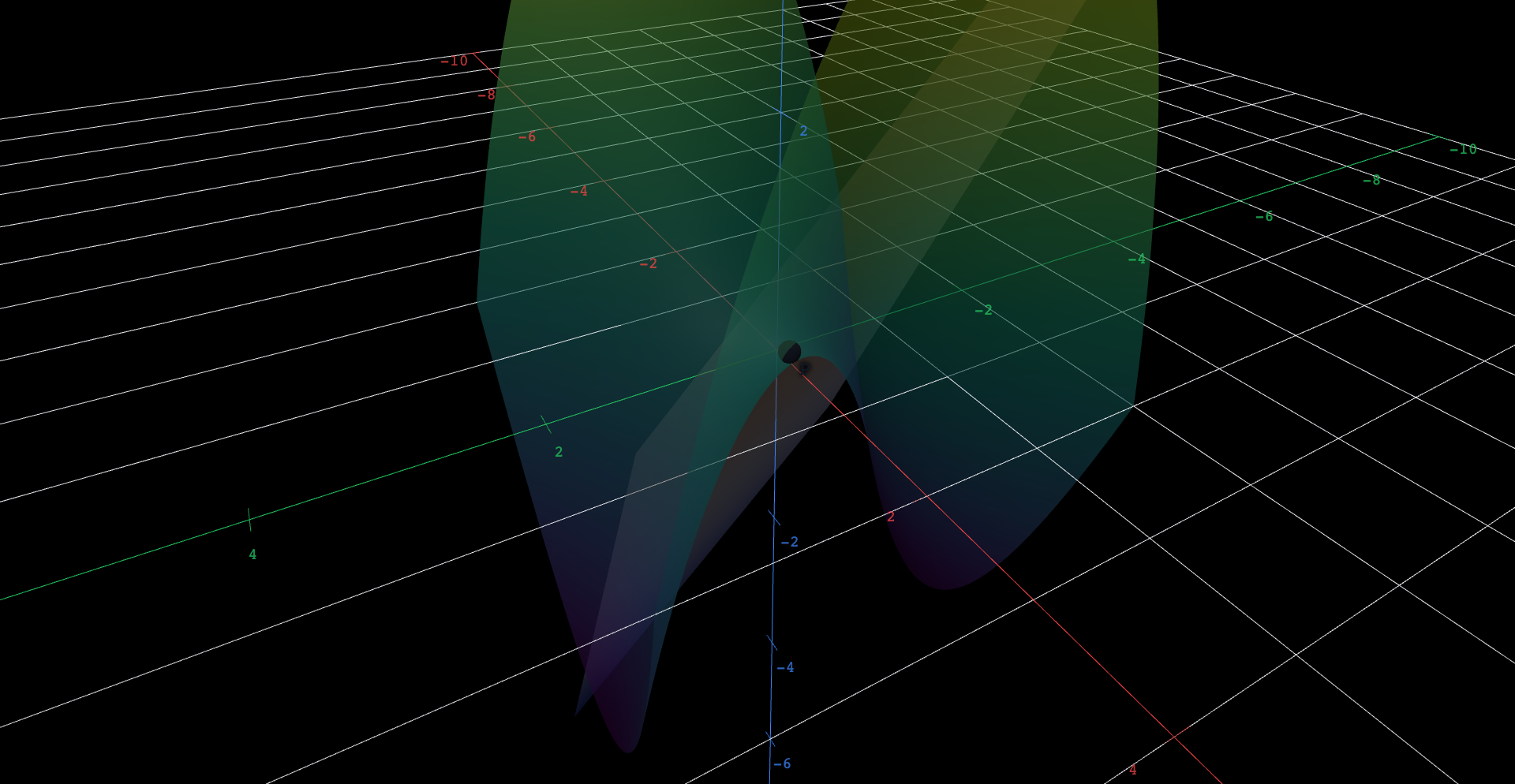
Explore in 3D (opens in a new tab)The saddle pierced by its half-transparent tangent plane , the two touching at the single marked dark point . The camera is aimed at , not the origin, so shrinking both objects' plotted domains zooms the scene in on the point of tangency.
Explore
Orbit around . The plane is tangent at , yet away from it slices straight through the saddle. Find a region where the plane runs above the surface and one where it runs below.
Orbit until you sight edge-on along the plane, so it reads as a line. Near , does the gap between surface and plane open quickly or slowly as you move away?
Predict before acting: if the plotted window shrinks to from to and from to on both objects, will you still be able to tell which patch is the curved one?
Retype the saddle's domain fields to those values, then the plane's. Each edit regenerates instantly. Zoom in on the two small patches and orbit edge-on again. Can you tell them apart?
Push it: set both domains to from to , from to . At this window the saddle is its tangent plane, to the eye.
Widen both domains back to , and watch curvature return. Zooming never changed the function — only the window. Moving away from , does the gap open fastest in the -direction, the -direction, or diagonally?
What differentiability means
Differentiability at is precisely the success of this experiment: the error shrinks faster than your distance to , so every step of zoom makes the surface look flatter, without limit. No other plane through the point survives the test — tilt the plane by any amount and the edge-on gap reappears at some zoom level. That is why the tangent plane is worth naming: near , evaluating the easy linear is as good as evaluating , and the next chapters spend the profit.
Both slice slopes of the saddle at once ✓ Computed · mojocas 0.1.0✓ Agrees with the text Both slice slopes of the saddle at once, computed exactly by mojocas 0.1.0, and confirmed to agree with the result stated in the text.
The two partials every tangent plane to the saddle is built from, computed symbolically: and . Evaluated at they give the plane's slopes and — the coefficients of .
These eBooks are a prerelease and are not yet certified conformant with WCAG 2.1 AA or ADA Title II. Every page is built against an automated accessibility gate, and the published editions will meet ADA Title II requirements when they release in late September 2026. If something is unusable, please tell us.

 Explore in 3D (opens in a new tab)