
3.2 Limits Along Different Roads
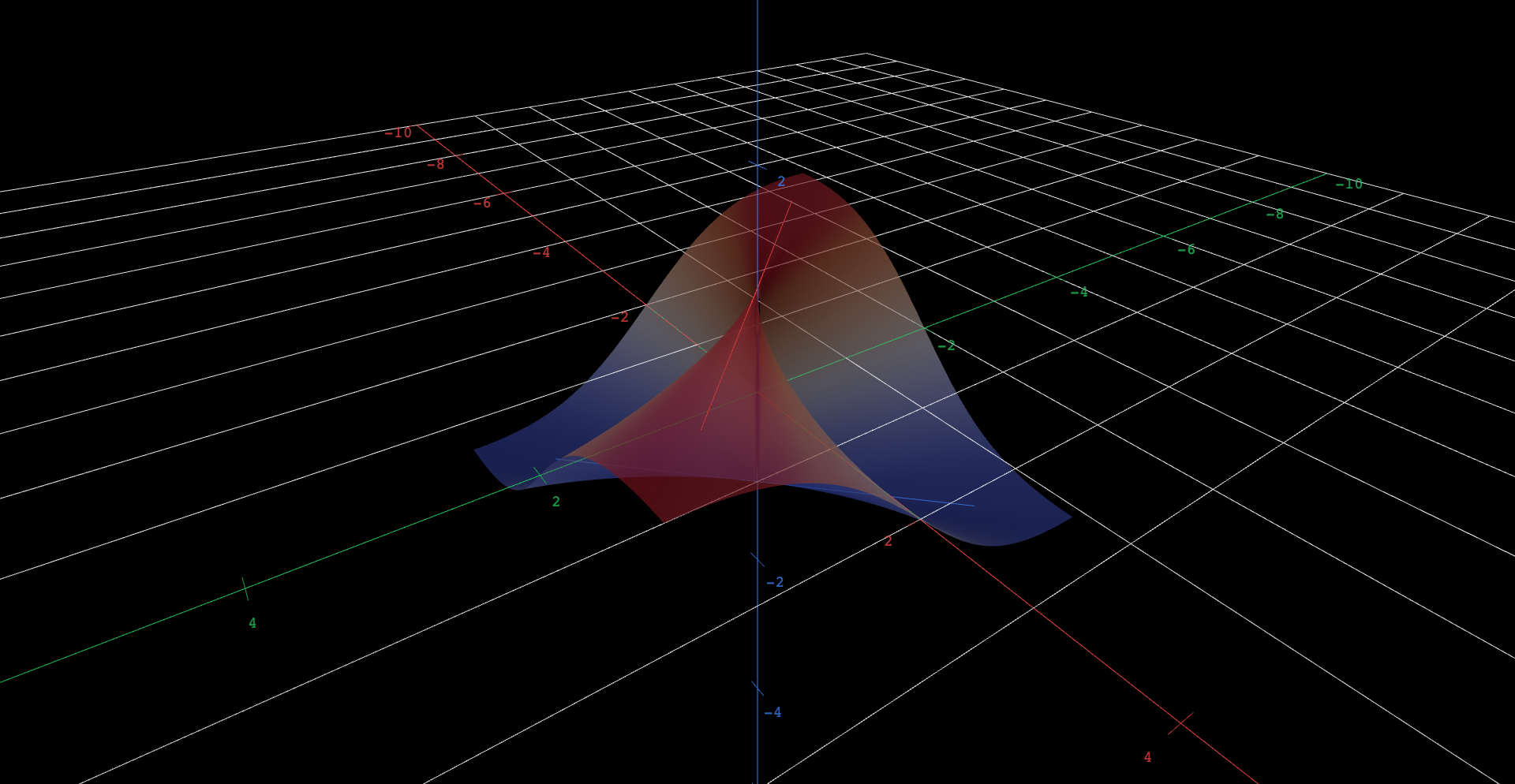
In one variable, a point can be approached from only two sides, and a limit exists when left and right agree. In the plane there are infinitely many roads into any point — every direction, every curve — and exists only if all of them agree. That is a far stronger demand, and this section builds a surface on which you can watch it fail: different straight roads into the origin genuinely arrive at different heights.
The specimen is
defined everywhere except the origin. Away from its graph is smooth ridges and valleys, but at the origin it pleats into a sharp vertical fin — and the fin, it will turn out, is the failed limit.
 Explore in 3D (opens in a new tab)
Explore
- Orbit slowly around the origin. Each colored road lies in a vertical plane over a straight line in the -plane. For each of the three visible roads, read off two things: the line it travels over, and the height it travels at.
- Every road is perfectly level — constant height — yet all three pass over the same point . What are the three heights over the origin? Could any single value agree with all three roads at once?
- The hidden amber road runs along , a line that sits between (green, height ) and (red, height ). Before revealing it, predict: will its height land between and ? Closer to which? Commit to a number.
- Reveal the amber road with its eye toggle in the object list, orbit to a side view, and read its height against the grid. How close was your guess? The example below does the algebra.
- Now make the scene grade your computation. Edit the amber road's -component from
2*tto5*t: the road jumps off the surface, because its -component still carries the old height. Compute the correct height for slope , retype the -component, and watch — if the road settles back onto the surface, your value is right. - All your computations follow one formula: the road over rides at height . Which slope rides highest? Which lowest? Sketch height against on paper.
Why the limit fails
Along any line through the origin the function is constant, so each road is level — but the constants differ from road to road, filling the whole range from to . For the limit to exist, one number would have to be the destination of every road at once. No number is, so
Continuity at the origin is then beyond rescue: it would require to equal a limit that is not there. No choice of value plugs the fin — the fin is the disagreement between roads, made solid.
The substitution the worked example performs, done by machine. Putting into leaves , and the certificate confirms that is the constant — no left anywhere, which is exactly the claim that each lifted road is level.
Two limits on what it proves, both worth stating. The cancellation is division by , so the identity holds for — the same restriction the example writes down before substituting. And is not every road: it is the family of straight lines through the origin except the vertical one, and no curved road at all. So the certificate covers exactly the roads the figure draws, which is the family that suffices to disprove the limit — and, as the section's closing warning says, would never have sufficed to prove one.
Set and take the honest one-variable limit as the road runs into the origin. It exists, and it is .
Set and do it again: .
Two certificates, one point, two different answers — and that is the section's argument in full. Neither limit is in doubt; each is exact. What fails is the demand that one number be the destination of every road, and it fails because these two roads have already produced two numbers. A limit that does not exist is usually hard to certify, since there is no value to check. Here it is easy: disagreement between two things that do exist.
The substitution the solution performs, done by a computer algebra system: put into and every cancels, leaving the single constant the amber road must be reseated to. That the 's vanish is the whole point — it is why each lifted road is level, and why roads of different slope sit at different heights.
Explore step 5 lets you check yourself against the picture, and it is worth knowing exactly how far that check goes. The scene tests no predicate — nothing compares your number to anything — so a value close to looks just as seated as the right one. And the drawn surface carries a tiny in its denominator so the mesh stays finite at the origin, which has a peculiar consequence: for down to about the drawn height matches to three decimals or better, but over that last thousandth the regularized surface dives to while the true road holds all the way in. Right where the section's whole argument lives, the picture is not merely approximate — it disagrees, by the entire height. That is the price of a finite mesh, and it is why this number is computed rather than read off the screen.
An original work of XYZ Homework, built around interactive XYZ 3D figures. Aligned to OpenStax Calculus Volume 3 (Strang & Herman), © OpenStax (Rice University), licensed CC BY-NC-SA 4.0; no OpenStax content is reproduced, and this work is not affiliated with or endorsed by OpenStax or Rice University. License: CC-BY-NC-SA-4.0.