How long is a curve? The honest answer starts with something you can actually measure: straight segments. Pick sample points along the curve, connect neighbors by chords, and add up the chord lengths. The result — the length of an inscribed polygon — is a slight underestimate, since each chord shortcuts its arc. Refine the sampling and the polygon hugs the curve ever more closely; arc length is the limit of the chord sums.
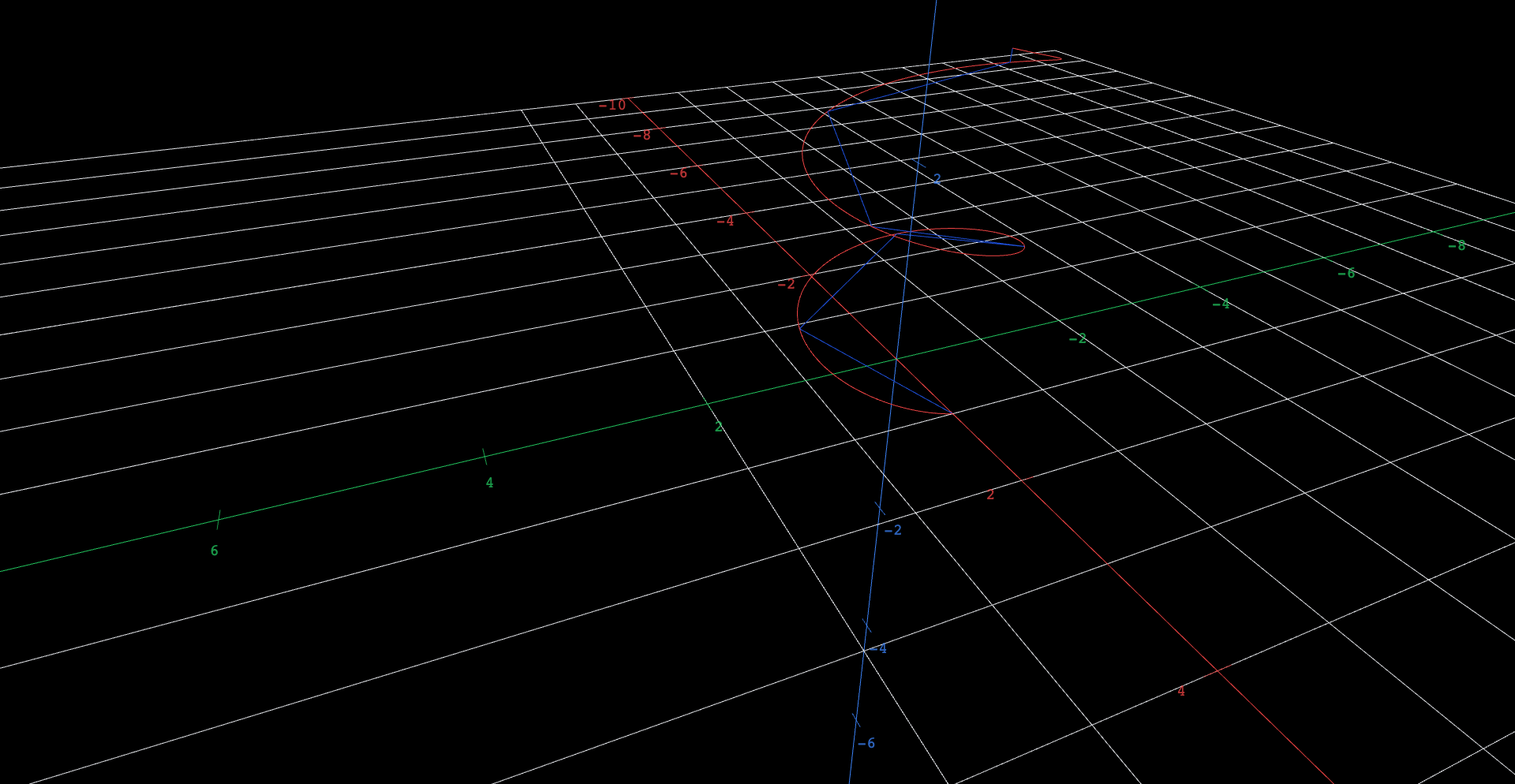
The figure below stages the definition on the helix from earlier in this chapter, drawn twice: once finely sampled, so it reads as the smooth curve, and once from only eight sample points, so it is the inscribed polygon.
Explore in 3D (opens in a new tab)The helix over two full turns, drawn smooth (red, 500 samples) and as its own inscribed chord polygon (blue, 8 samples — seven chords). The blue path cuts inside every turn of the red one.
Explore
Orbit until you can sight along one turn of the helix. Where does each blue chord sit relative to the red arc it replaces — inside or outside? What does that say about the sign of the error in a chord-sum estimate?
The seven chords look congruent. Use the symmetry of the helix to explain why they must be.
Roughly estimate one chord's length against the grid, multiply by seven, and hold onto the number — the example below computes what the fine curve converges to.
From chord sum to integral
Now let calculus take the limit. On a fine partition , the chord from to has length approximately — displacement is velocity times elapsed time, when the elapsed time is short. The chord sum is then a Riemann sum, and its limit is
The integrand is the speed of the moving point, so the formula says something you already believed: distance traveled is speed integrated over time. For plane curves and the same formula covers the cycloid and rose of the playground section.
The helix's arc length, integrated ✓ Computed · mojocas 0.1.0✓ Agrees with the text The helix's arc length, integrated, computed exactly by mojocas 0.1.0, and confirmed to agree with the result stated in the text.
The example's integral, computed: the helix's constant speed integrated over gives — the number the seven-chord polygon undershoots.
These eBooks are a prerelease and are not yet certified conformant with WCAG 2.1 AA or ADA Title II. Every page is built against an automated accessibility gate, and the published editions will meet ADA Title II requirements when they release in late September 2026. If something is unusable, please tell us.

 Explore in 3D (opens in a new tab)