
2.3 Cylindrical and Spherical Coordinates
Rectangular coordinates measure three straight distances. Cylindrical coordinates keep the vertical axis but describe the horizontal plane by polar coordinates; spherical coordinates go further and measure one distance and two angles: is distance from the origin, is the angle down from the positive -axis, and is the azimuth around that axis, the same angle cylindrical coordinates use. The conversion to rectangular is
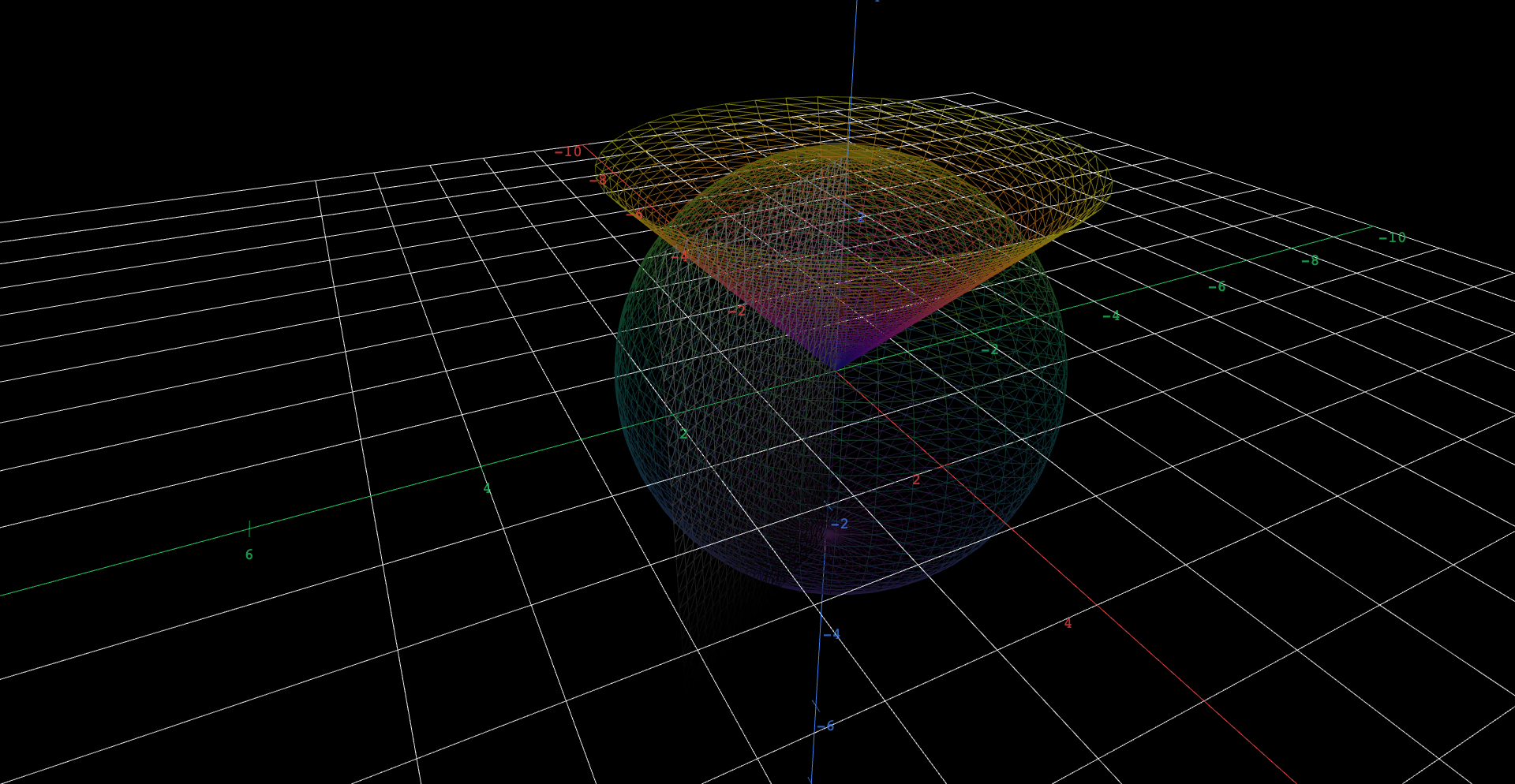
The character of a coordinate system lives in its coordinate surfaces: the sets you get by freezing one coordinate and letting the other two roam. For rectangular coordinates all three families are flat planes. For spherical coordinates they are far more interesting, and the figure below shows all three at once.
 Explore in 3D (opens in a new tab)
Explore
- Cover the labels and match each surface to its frozen coordinate. How does the shape alone give each one away? Why is the surface only half a plane?
- The mesh lines on the sphere are the curves where the other two coordinates are constant. Which family — horizontal circles or pole-to-pole arcs — is constant , and which is constant ?
- Predict what happens to the cone as grows from toward , then edit the cone's components to test it (replace the constant and factors with and of your new angle). What surface does the cone flatten into at exactly ?
- Reveal the hidden bright patch: the outer face of the spherical box , , . Orbit close and examine its four edges. Are any of them straight?
- In the patch's domain fields, slide the -interval down toward the equator, keeping its width the same. The face grows. The angular intervals did not change — so what did?
The box with almost no flat sides
A "box" in any coordinate system is a region where each coordinate runs between two constants, so its faces are patches of coordinate surfaces. In spherical coordinates that means: two sphere patches (inner and outer), two cone patches, and two half-plane patches. Only the half-plane faces are flat. Of the twelve edges, only the four radial ones are straight segments — all the others are arcs of circles. The spherical box is a bite taken out of an orange: curved skin, curved core, flat cuts only where the knife followed a meridian.
The exploration's last step is the one to remember. A face with the same spread of angles is small near the pole and large near the equator, because the meridians crowd together as shrinks. A patch at radius spanning by has area approximately — and that is exactly the factor that will appear in the spherical volume element when we integrate in the final chapter. You have now seen the reason before ever meeting the formula.
The volume factor you just watched crowd the meridians, computed from the spherical conversion formulas themselves: a determinant of partial derivatives, collapsed by the computer algebra system to exactly . (, , stand for , , .) The orange-bite picture and the algebra agree — and now that agreement is checked on every rebuild.
An original work of XYZ Homework, built around interactive XYZ 3D figures. Aligned to OpenStax Calculus Volume 3 (Strang & Herman), © OpenStax (Rice University), licensed CC BY-NC-SA 4.0; no OpenStax content is reproduced, and this work is not affiliated with or endorsed by OpenStax or Rice University. License: CC-BY-NC-SA-4.0.