
15.6 Exercises
Iterated Fractals
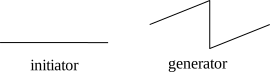
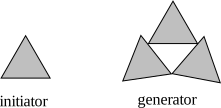
Using the initiator and generator shown, draw the next two stages of the iterated fractal.
1.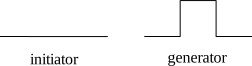 2.
2. 
3.  4.
4. 
5. 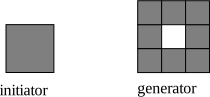 6.
6. 
7. Create your own version of Sierpinski gasket with added randomness.
8. Create a version of the branching tree fractal from example #3 with added randomness.
Fractal Dimension
9. Determine the fractal dimension of the Koch curve.
10. Determine the fractal dimension of the curve generated in exercise #1
11. Determine the fractal dimension of the Sierpinski carpet generated in exercise #5
12. Determine the fractal dimension of the Cantor set generated in exercise #4
Complex Numbers
13. Plot each number in the complex plane: a) b) c) d)
14. Plot each number in the complex plane: a) b) c) d)
15. Compute: a) b)
16. Compute: a) b)
17. Multiply: a) b) c)
18. Multiply: a) b) c)
19. Plot the number . Does multiplying by move the point closer to or further from the origin? Does it rotate the point, and if so which direction?
20. Plot the number . Does multiplying by move the point closer to or further from the origin? Does it rotate the point, and if so which direction?
Recursive Sequences
21. Given the recursive relationship, generate the next 3 terms of the recursive sequence.
22. Given the recursive relationship, generate the next 3 terms of the recursive sequence.
23. Using , calculate the first 4 terms of the Mandelbrot sequence.
24. Using , calculate the first 4 terms of the Mandelbrot sequence.
For a given value of c, the Mandelbrot sequence can be described as escaping (growing large), a attracted (it approaches a fixed value), or periodic (it jumps between several fixed values). A periodic cycle is typically described the number if values it jumps between; a 2-cycle jumps between 2 values, and a 4-cycle jumps between 4 values.
For questions 25 – 30, you’ll want to use a calculator that can compute with complex numbers, or use an online calculator which can compute a Mandelbrot sequence. For each value of c, examine the Mandelbrot sequence and determine if the value appears to be escaping, attracted, or periodic?
25. . 26. .
27. . 28. .
29. . 30. .
31. . 32. .
Exploration
The Julia Set for c is another fractal, related to the Mandelbrot set. The Julia Set for uses the recursive sequence: , where c is constant for any particular Julia set, and is the number being tested. A value d is part of the Julia Set for if the sequence does not grow large.
For example, the Julia Set for -2 would be defined by . We then pick values for , and test each to determine if it is part of the Julia Set for -2. If so, we color black the point in the complex plane corresponding with the number . If not, we can color the point based on how fast it grows, like we did with the Mandelbrot Set.
For questions 33-34, you will probably want to use the online calculator again.
33. Determine which of these numbers are in the Julia Set at
a) b) c)
34. Determine which of these numbers are in the Julia Set at
a) b) c)
You can find many images online of various Julia Sets[1].
35. Explain why no point with initial distance from the origin greater than 2 will be part of the Mandelbrot sequence
[1] For example, www.jcu.edu/math/faculty/spitz/juliaset/juliaset.htm,
Adapted from Math in Society by David Lippman, hosted on LibreTexts (math.libretexts.org) and licensed under CC BY-SA 3.0. Changes were made. License: CC-BY-SA-3.0.