
📚 Math in Society
⇩ Download ▾

15.1 Fractals

Fractals are mathematical sets, usually obtained through recursion, that exhibit interesting dimensional properties. We’ll explore what that sentence means through the rest of the chapter. For now, we can begin with the idea of self-similarity, a characteristic of most fractals.

Self-similarity can often be found in nature. In the Romanesco broccoli pictured below[1], if we zoom in on part of the image, the piece remaining looks similar to the whole.
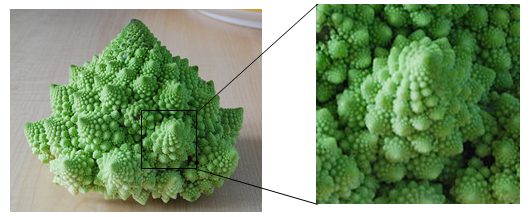
Two photographs of a head of Romanesco broccoli: the whole head of green spiral cones on the left with a small square outlined on one bud, and that square enlarged on the right, showing the same cone and spiral pattern repeated at a smaller scale.

Likewise, in the fern frond below[2], one piece of the frond looks similar to the whole.
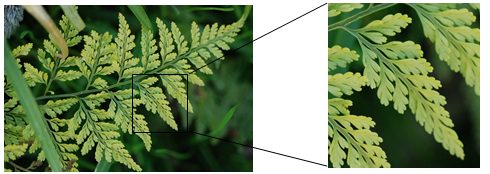
Two photographs of a fern frond: the whole frond on the left with a small square outlined around one leaflet, and that square enlarged on the right, showing that the single leaflet has the same shape as the entire frond.

Similarly, if we zoom in on the coastline of Portugal[3], each zoom reveals previously hidden detail, and the coastline, while not identical to the view from further way, does exhibit similar characteristics.
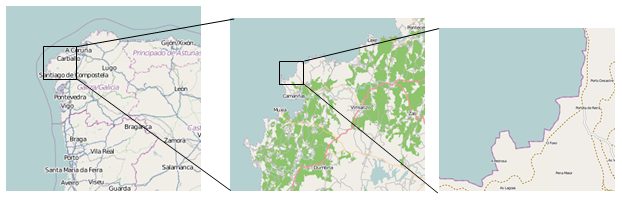
Three map panels of the northwest Iberian coastline, each an enlargement of the small box drawn on the panel before it: first the region from A Coruna and Santiago de Compostela south to Vigo and Porto, then a short stretch of inlets near Camarinas, then a single bay. Every zoom reveals new indentations of the same ragged character rather than a smoother line.

[1] en.Wikipedia.org/wiki/File:Ca...ractal_AVM.JPG

[2] http://www.flickr.com/photos/cjewel/3261398909/

[3] Openstreetmap.org, CC-BY-SA

Adapted from Math in Society by David Lippman, hosted on LibreTexts (math.libretexts.org) and licensed under CC BY-SA 3.0. Changes were made. License: CC-BY-SA-3.0.

These eBooks are a prerelease and are not yet certified conformant with WCAG 2.1 AA or ADA Title II. Every page is built against an automated accessibility gate, and the published editions will meet ADA Title II requirements when they release in late September 2026. If something is unusable, please tell us.