The least-squares computation of the last section was heavy in a specific way. Fitting a plane to seven points meant assembling the normal equations and solving a system, and the reason was that the model's columns were oblique — the -column overlapped both of the others, so no coefficient could be settled without settling the rest at once. (Not every pair was at fault: on that particular data the -column and the column of ones happen to be orthogonal already. One oblique pair is enough to force the system.)
Suppose the spanning vectors had been mutually perpendicular. Then projecting onto their span would decompose completely: for an orthogonal set the projection of any vector is
with each coefficient computed on its own, from two dot products, with no system to solve. The formula is right precisely because the vectors do not overlap: adding a multiple of changes nothing about the component, since their dot product is zero.
So it is worth having a way to manufacture orthogonality. Start with vectors that span what you want but sit at awkward angles:
They are independent — their determinant is not zero — so they are a basis of , just not a convenient one.
A basis, but an awkward one ✓ Computed · mojocas 0.1.0✓ Agrees with the text A basis, but an awkward one, computed exactly by mojocas 0.1.0, and confirmed to agree with the result stated in the text.
The determinant of the three starting vectors is , so by the Invertible Matrix Theorem they are independent and span . Nothing is wrong with this basis except its angles: , not , so the vectors overlap and projections onto their span cannot be computed one coefficient at a time.
One step, watched
Gram-Schmidt fixes the angles one vector at a time. Keep the first vector as it is, . Then take and remove the part of it that points along — its projection — leaving only what is perpendicular:
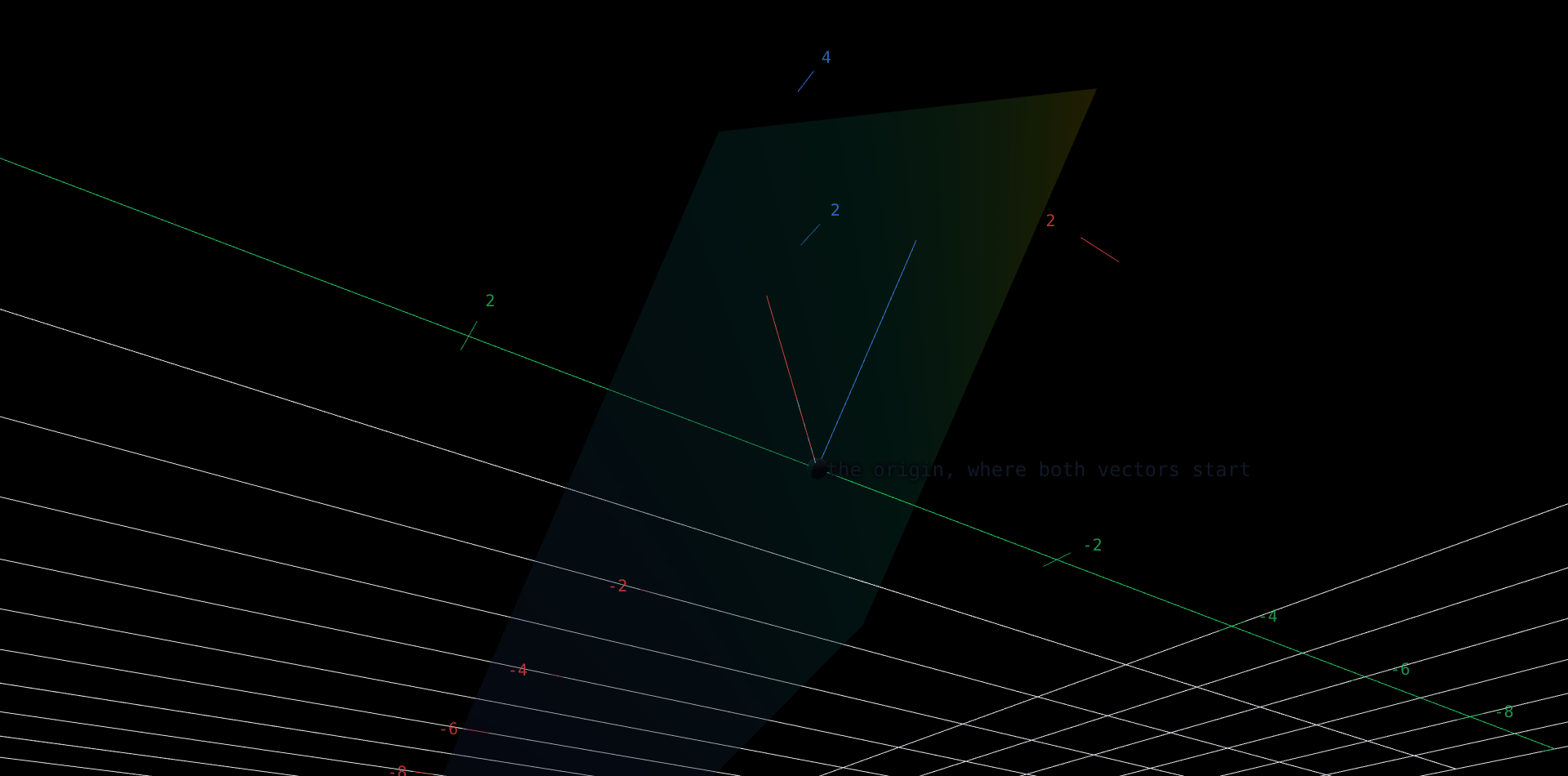
A semi-transparent tilted plane holding two vectors, drawn as segments that both start at a marked origin: a fixed red one and a blue one that swings as a slider is dragged. A small gray dot partway along the red segment marks where the projection of the blue vector's starting position onto the red one ends, and an amber segment runs from the blue vector's original tip to its current tip, showing the correction being removed. The slider starts halfway. At the start of its range the two vectors meet at a noticeably acute angle and the amber segment has no length; at the end of its range they meet at a right angle and the amber segment is as long as the projection, from the origin to the gray dot. Throughout, both vectors stay inside the same plane, so the pair always describes the same set of combinations.
The plane spanned by and , with the red fixed and the blue vector swinging as the slider subtracts more and more of the projection. The gray dot partway along the red one marks the tip of the projection being removed, and the amber segment joins the blue vector's original tip to its current one. The slider starts halfway, at .
Explore the figure
Set . The blue vector is now , the amber segment has shrunk to nothing, and the two vectors meet at an obviously acute angle. This is the awkward basis you started with.
Drag to . The blue vector swings to and now meets the red one at a right angle. The amber segment has grown to exactly the length of the projection — the distance from the origin to the gray dot — but it runs the opposite way to the projection: from the old tip to the new, because the projection is being subtracted rather than added.
Watch the plane while you drag, not the vectors. The blue vector stays inside the sheet the whole way. It has to: you only ever subtracted a multiple of , which is itself in the sheet.
That is the property worth keeping. At every slider setting the red and blue vectors span the same plane, so Gram-Schmidt has changed the description without changing the thing described.
Doing all three
The third vector must be cleared of both previous directions, so subtract both projections:
The dot products are against , giving coefficient ; and against , giving coefficient . So
and the three are now mutually perpendicular: , and .
Notice that subtracting the projection did not disturb the work already done — because and are perpendicular, adding a multiple of one leaves the other's component untouched. Each step is safe from the steps before it, which is what makes the process work at all rather than chasing its own tail.
An original work of XYZ Homework, built around interactive XYZ 3D figures. Chapters 1–6 follow the topic sequence of Interactive Linear Algebra (Margalit & Rabinoff, Georgia Tech, GNU FDL). Chapter 0's scope (its topics, their order, and the idea each figure shows) follows the Vectors chapter of Ximera's Linear Algebra: An Interactive Introduction. The prose, worked examples and figures were written for this book, which is not affiliated with or endorsed by the authors of either work. License: CC-BY-NC-SA-4.0.
These eBooks are a prerelease and are not yet certified conformant with WCAG 2.1 AA or any other accessibility standard. Every page is built against an automated accessibility gate, and our target for the published editions is WCAG 2.2 Level AA. If something is unusable, please tell us.

 Explore in 3D (opens in a new tab)