Here is a new kind of question. The plane is a subspace of — flat, through the origin, closed under the usual operations. The vector is not on it: the plane above the point sits at height , far below . Chapter 2 would stop there — not reachable — but the useful question is quantitative: which point of the plane is closest to ?
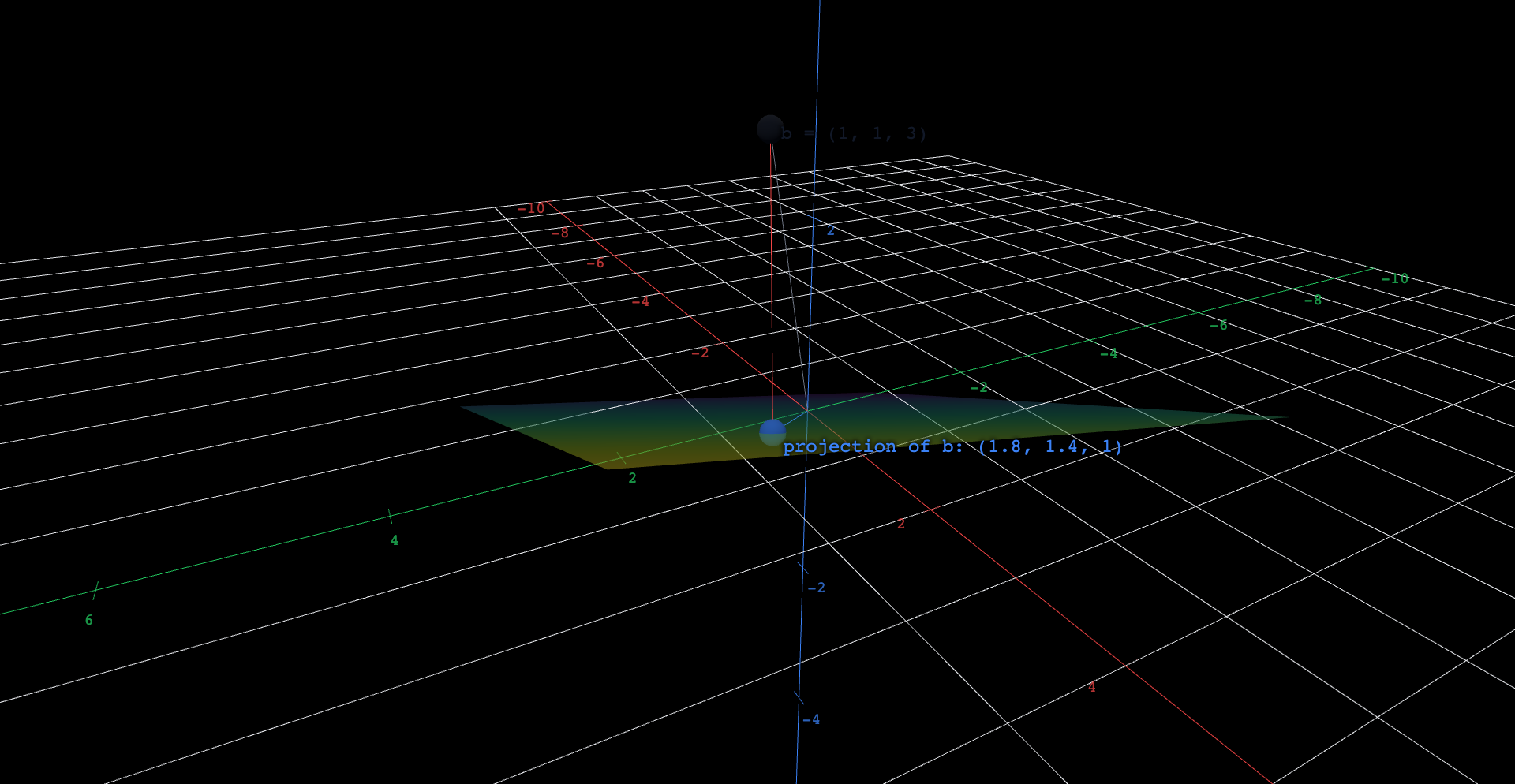
The answer is found by dropping a perpendicular from onto the plane. The figure shows the whole construction: the dark point floating above the plane, the dashed red segment falling from it along the plane's normal direction, and the blue point where it lands — the orthogonal projection of . Two solid segments from the origin trace itself (gray) and its projection (blue).
Explore in 3D (opens in a new tab)The point above the plane , with the dashed red perpendicular dropping to its projection , marked in blue. The gray and blue segments from the origin are and its projection as vectors.
Explore the figure
Orbit until you view the plane edge-on. The dashed segment meets it at a right angle — not a right angle on your screen from every viewpoint, but a true one in space, visible when the plane degenerates to a line in your view.
A natural first guess for the closest point is "straight down": drop vertically from to . That vertical trip has length . The dashed route is visibly shorter and lands at a different point — closest is measured perpendicular to the plane, not perpendicular to the floor.
Confirm by eye that the blue point actually lies in the plane, and that its coordinates are plausible: , exactly its height.
Follow the triangle made by the gray segment, the blue segment, and the dashed drop: splits into a piece inside the plane plus a piece perpendicular to it. Nothing overlaps and nothing is missing.
Computing the drop
Rewrite the plane as ; its normal vector is , and the perpendicular from must travel along . So the projection is for the value of that lands on the plane, which works out to . Here and , so and
The error vector is : a pure multiple of the normal, with length — beating the vertical guess of , as the figure promised. And perpendicularity is what makes provably the winner: for any other point of the plane, the segment from to lies in the plane, at right angles to , so Pythagoras gives , strictly larger. A perpendicular error is not one good option — it is a certificate that no better option exists.
The drop parameter t, solved ✓ Computed · mojocas 0.1.0✓ Agrees with the text The drop parameter t, solved, computed exactly by mojocas 0.1.0, and confirmed to agree with the result stated in the text.
The landing condition written out with the numbers of this example — and — and solved by a computer algebra system: , the value that drops exactly onto .
An original work of XYZ Homework, built around interactive XYZ 3D figures. Its chapter sequence is aligned to Interactive Linear Algebra (Margalit & Rabinoff, Georgia Tech, GNU FDL); this work is original, copies nothing from it, and is not affiliated with or endorsed by its authors. License: CC-BY-NC-SA-4.0.
These eBooks are a prerelease and are not yet certified conformant with WCAG 2.1 AA or ADA Title II. Every page is built against an automated accessibility gate, and the published editions will meet ADA Title II requirements when they release in late September 2026. If something is unusable, please tell us.

 Explore in 3D (opens in a new tab)