
6.2 A Line and Its Complement
The projection of the last section split a vector into two perpendicular pieces: one in the plane, one along the normal line. That pairing — plane and normal line — is no accident of the example. Every subspace has an orthogonal complement : the set of all vectors perpendicular to every vector of . The complement is itself a subspace (perpendicularity survives adding and scaling), and the two mesh so tightly that each determines the other completely.
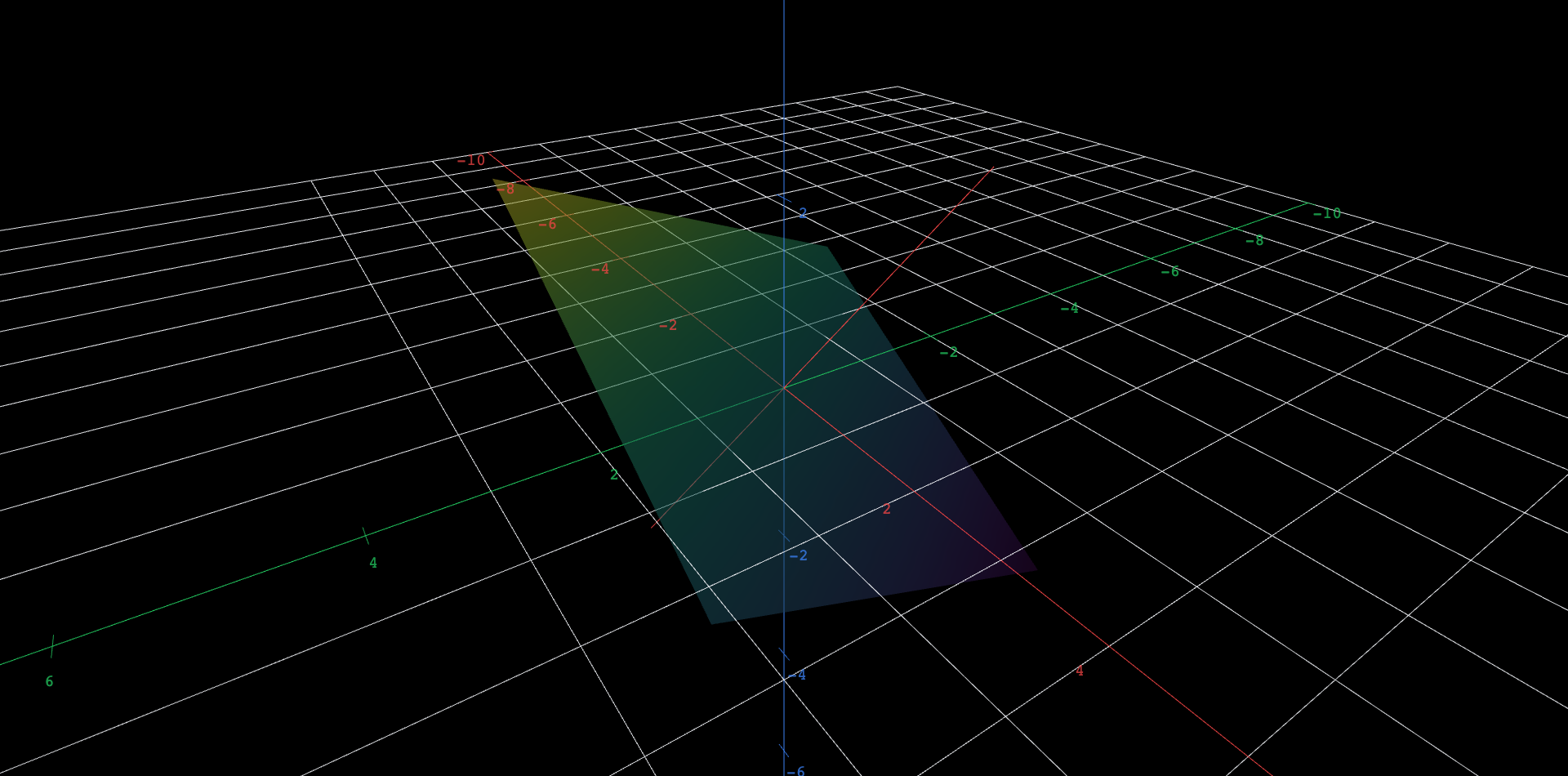
The figure makes the pairing mechanical. The red line consists of all multiples of the direction vector , with and on sliders. Which vectors are perpendicular to it? Exactly those with , that is, — the equation of a plane through the origin, drawn in the scene as the surface . The scene never computes an angle; the plane is perpendicular to the line by construction, because its equation is the perpendicularity condition itself.
 Explore in 3D (opens in a new tab)
Explore the figure
- At the defaults , , orbit until the plane is edge-on. Line and plane meet like a pole through a sheet — the right angle holds from every viewing direction that shows the plane as a line.
- Drag slowly across its range. The line swings one way; the plane counter-tilts instantly. No slider position breaks the perpendicularity, because the plane's formula is the perpendicularity condition.
- Set and . The line becomes the -axis and the complement flattens into the -plane — the most familiar line–plane pair in the book, revealed as an orthogonal complement pair.
- Count dimensions as you drag: one for the line, two for the plane, three in total, at every slider position. The complement absorbs every direction the line does not use.
Every vector splits, uniquely
The complement pairing is what makes projection bookkeeping exact. Given any vector and the line direction , the piece of along the line is — the projection onto the line — and what remains is perpendicular to , hence in the plane. So = line part + plane part, always. Uniqueness comes from the only vector the two subspaces share: a vector in both is perpendicular to itself, so forces it to be the zero vector. Two decompositions would differ by a shared nonzero vector, and there is none to differ by.
The section defines by a condition — every vector perpendicular to the line — and then asserts the condition describes a plane. That assertion is a null space, and here it is computed: the vectors killed by the single row at the default sliders. Two basis vectors come back, so the complement is two-dimensional. It is a plane because the computation says the solution set has two independent directions, not because the picture looks flat.
The engine's basis is and ; the card states and , read straight off . Four different-looking vectors, one plane — a subspace determines no basis, so the check is made by span. It is not a lenient check: drop either vector and it refuses, because the surviving span is then a line rather than the plane.
Explore step 4 asks you to count dimensions while dragging: one for the line, two for the plane, three in total, at every slider position. This is the first of those numbers. Together with the two basis vectors above it is — the rank–nullity theorem, arriving three chapters early as an observation about a picture you can tilt.
The example's second check, done by machine: the leftover piece dotted against the line's direction . The answer is , confirming that in this example what the projection left behind really does lie in the complement. That is the existence half of the split. Uniqueness is a separate argument and rests on , which no single dot product can establish.
The engine reaches it by exact rational arithmetic: is carried as , not as the nearest binary double, so the three products cancel as fractions and the result is the integer rather than a number that rounds to it. Nothing here hinges on the decimals in this particular example being well behaved.
An original work of XYZ Homework, built around interactive XYZ 3D figures. Its chapter sequence is aligned to Interactive Linear Algebra (Margalit & Rabinoff, Georgia Tech, GNU FDL); this work is original, copies nothing from it, and is not affiliated with or endorsed by its authors. License: CC-BY-NC-SA-4.0.