
5.2 Hunting the Eigenline
The last section was a rigged hunt: four candidate lines were drawn in advance, and you merely had to judge them. Suppose nobody marks the candidates. The honest search is continuous — sweep a line through every direction and watch for the moment the field stops crossing it.
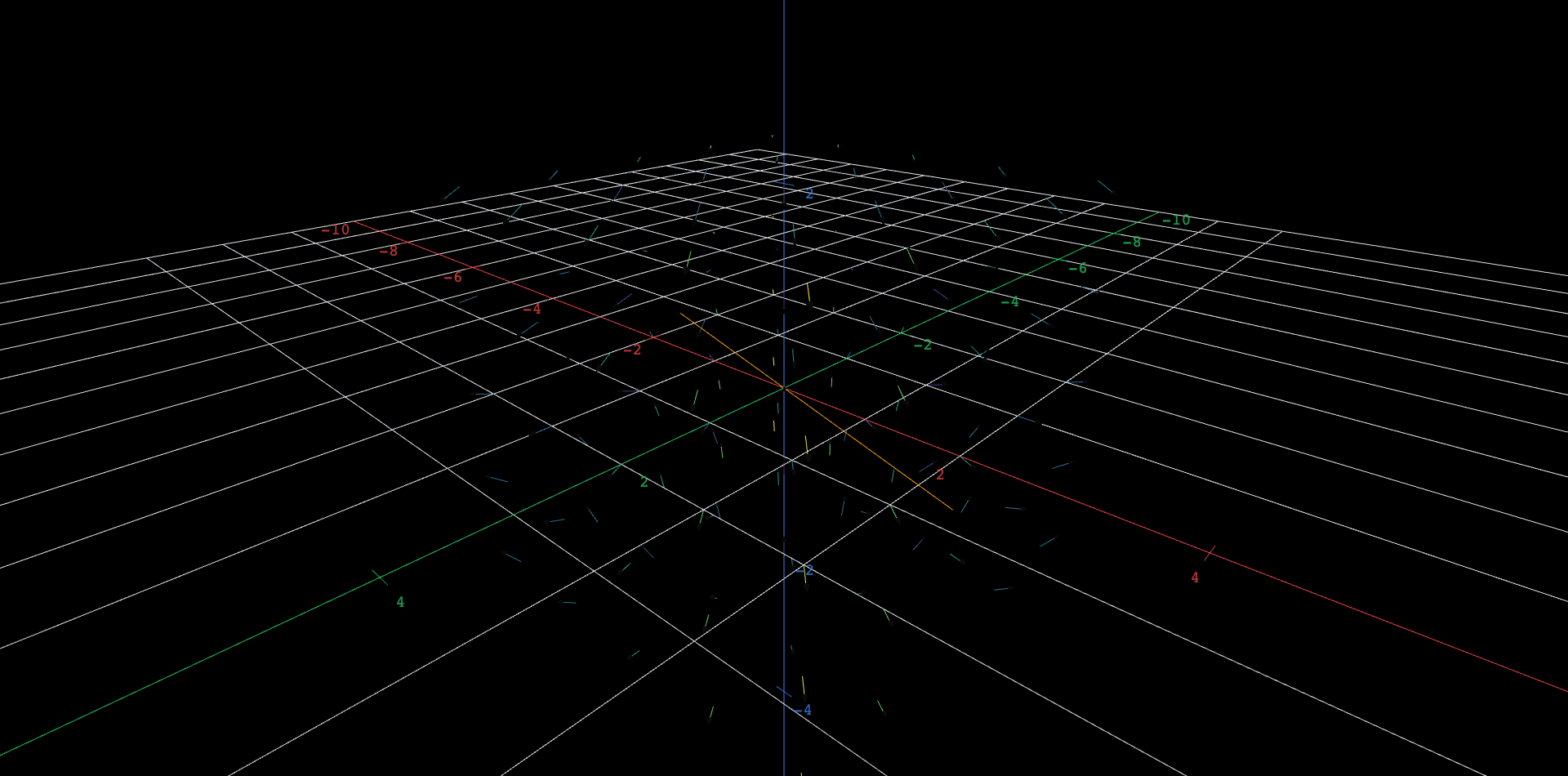
The figure below stages that search in the horizontal plane , where our matrix from the last section acts by . A thick amber test line runs through the origin at angle , controlled by a slider that rotates it from to — nearly a half-turn, which is all a line needs, since a line at angle is the same line. Two dashed answer lines are hidden in the scene; leave them hidden until step 4.
 Explore in 3D (opens in a new tab)
Explore the figure
- Start at the default and zoom toward the arrows sitting on the amber line. They cross it at a visible angle — this direction is being turned, so it is no eigenline. Notice that would be the -axis: the dashed decoy from last section, now just one more failed angle.
- Sweep slowly upward and watch only the arrows on the line. Somewhere near they swing into perfect alignment, pointing outward along the line and noticeably long. Park there.
- Keep sweeping. Alignment breaks, then returns near — but differently: the arrows again lie along the line, yet they are shorter, matching the position vectors in length. Two alignments in the whole sweep, with two different strengths.
- Reveal the two hidden dashed lines, answer: and answer: . Drive the slider to each and confirm your parked angles were and . Every other angle in the continuum — infinitely many candidates — lost the audition.
The alignment condition
The test direction at angle is , and the field there is . Alignment means is parallel to , and two plane vectors are parallel exactly when their cross-term vanishes:
The mixed products cancel, and the entire misalignment of this field collapses to the function . On the slider's range, exactly at and — the two places your sweep caught. Eigen-hunting is root-finding: a smooth misalignment function of the candidate direction, whose isolated roots are the eigenlines. That is why the winners are so rare, and it is the same rarity you met when a span collapsed at a single slider value in Chapter 2: special directions are knife-edge events, not neighborhoods.
One picture makes the two roots and their two eigenvalues visible at once. Feed the unit circle to instead of a single test direction: every direction is tested simultaneously, and the circle comes back as an ellipse.
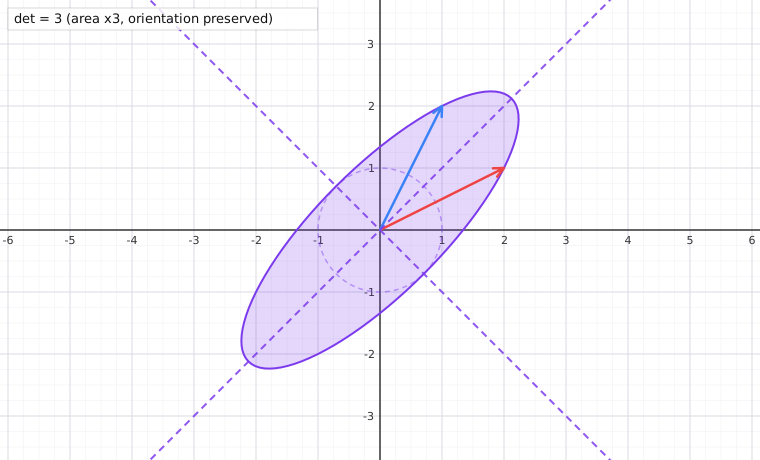
- Find the ellipse's longest radius. It points along — the direction you parked at — and reaches units, which is the eigenvalue there.
- Find the shortest radius. It points along , the direction, and reaches only : that direction is held still, not stretched.
- Every other point of the circle lands off the ray it started on — that is what "the direction was turned" looks like when all directions are tested at once. Only where the ellipse touches its own axes did a direction survive.
- The readout gives . Check it against the two eigenvalues: . A determinant is the product of the eigenvalues, which is the next section's fact, arriving early and for free.
The characteristic polynomial of the in-plane matrix with rows and , expanded by a computer algebra system: . ( stands for .) The sweep found its roots with a slider; the next block finds them by algebra.
The two winning angles of the sweep, recovered as the roots of the characteristic polynomial by a computer algebra system: (the long outward arrows at ) and (the pointwise fix at ).
An original work of XYZ Homework, built around interactive XYZ 3D figures. Its chapter sequence is aligned to Interactive Linear Algebra (Margalit & Rabinoff, Georgia Tech, GNU FDL); this work is original, copies nothing from it, and is not affiliated with or endorsed by its authors. License: CC-BY-NC-SA-4.0.