
5.1 The Directions a Matrix Cannot Turn
Take the matrix whose rows are , , and . Fed a vector , it hands back pointing somewhere else — for almost every . This section is a hunt for the exceptions: the directions cannot turn.
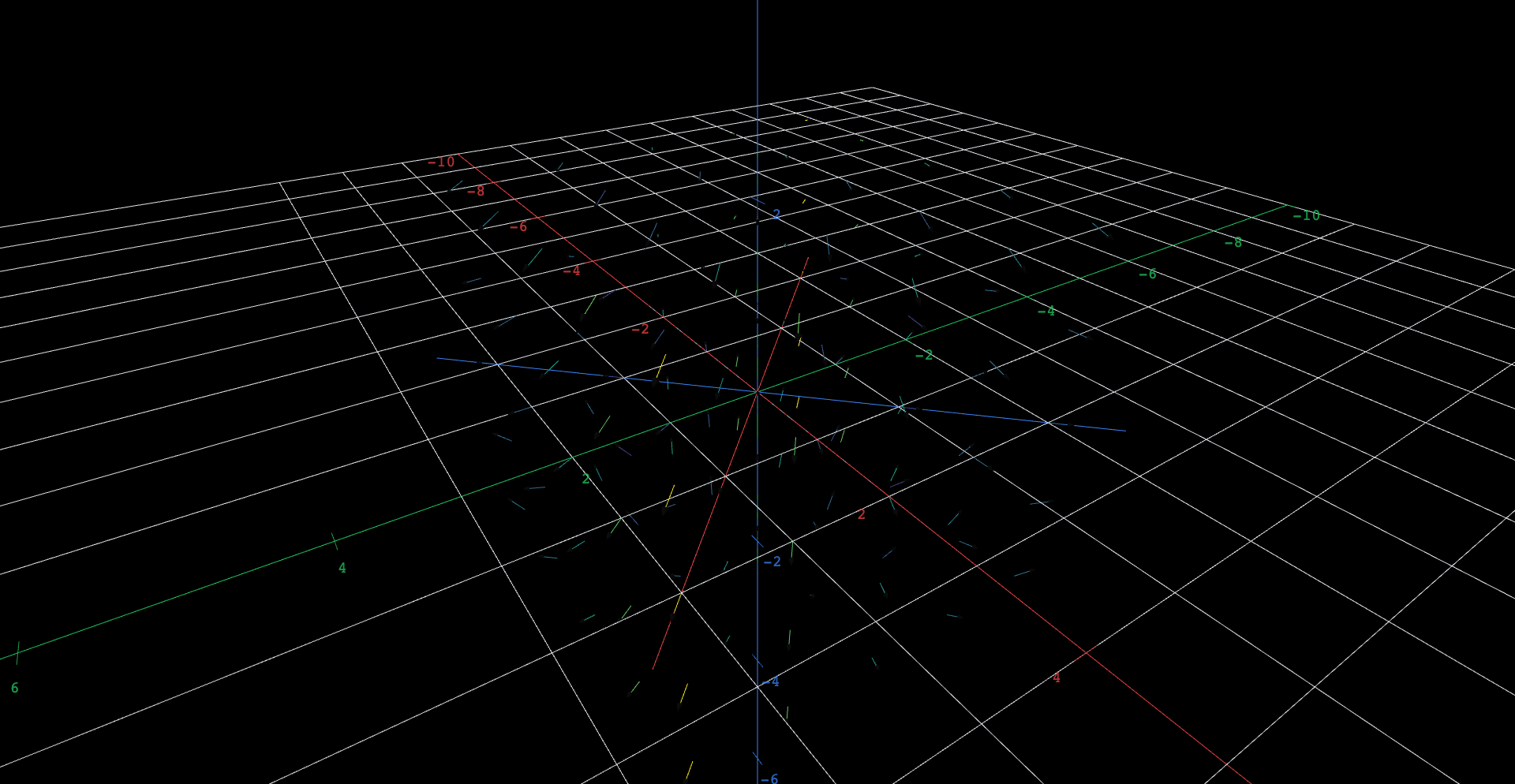
The figure plots as a field of arrows. At each grid point , an arrow shows , computed componentwise as , and the arrows are colored by length — dark purple for short, yellow for long. Threaded through the field are four straight lines through the origin: solid red along , solid blue along , solid green along the -axis, and a dashed gray line along the -axis. Three of them are genuinely special. One is a decoy.
 Explore in 3D (opens in a new tab)
Explore the figure
- Orbit slowly. Most arrows point off whatever line they sit near — the matrix is turning those vectors. On which of the four marked lines do the arrows lie exactly along the line itself?
- Zoom in on the dashed gray line near and read the field formula there: . The arrow visibly leaves the -axis — that is why this line is drawn dashed. Looking special is not being special; the field is the test.
- On each line that passes the test, note whether the arrows point outward (away from the origin, with the position vector) or inward (back toward it). One of the three solid lines disagrees with the other two.
- Now use the colors. At equal distances from the origin, the red line carries the long yellow arrows, roughly three times the position vector; the blue line's arrows match the position vector in length; the green line's match it too — but reversed. Three lines, three different stretch factors.
Naming what you found
A nonzero vector with is an eigenvector of , and the scalar is its eigenvalue. The equation says exactly what you hunted for: the line through is invariant — may stretch, shrink, or flip vectors on it, but cannot turn them off it. The arrows encode : outward means , inward means , and the length ratio is . Check the three catches by arithmetic: , so on the red line; , so on the blue line — invariant pointwise, the field there merely restating each position; and , so on the green line. The inward green arrows are not a failure of invariance — they are the visual signature of a negative eigenvalue. The decoy fails outright: is no multiple of .
Observation found these lines; algebra can find them blind. Rearranged, the eigenvector equation says has a nonzero solution — which, by the last chapter, happens exactly when collapses: . That determinant, as a function of , is the characteristic polynomial.
The characteristic polynomial of the same matrix the figure draws, expanded by a computer algebra system rather than by hand — and checked against the factored form worked out above. Its roots are the three stretch factors you read off the arrows: on red, on blue, on green. ( stands for .)
The same three numbers again — but this time the computer algebra system starts from the matrix itself, extracts the complete set of eigenvalues, and certifies each one's algebraic multiplicity along the way. All three are simple, listed here in ascending order, and they agree with the roots worked out above: the inward flip on green, the pointwise fix on blue, the outward triple stretch on red.
An original work of XYZ Homework, built around interactive XYZ 3D figures. Its chapter sequence is aligned to Interactive Linear Algebra (Margalit & Rabinoff, Georgia Tech, GNU FDL); this work is original, copies nothing from it, and is not affiliated with or endorsed by its authors. License: CC-BY-NC-SA-4.0.